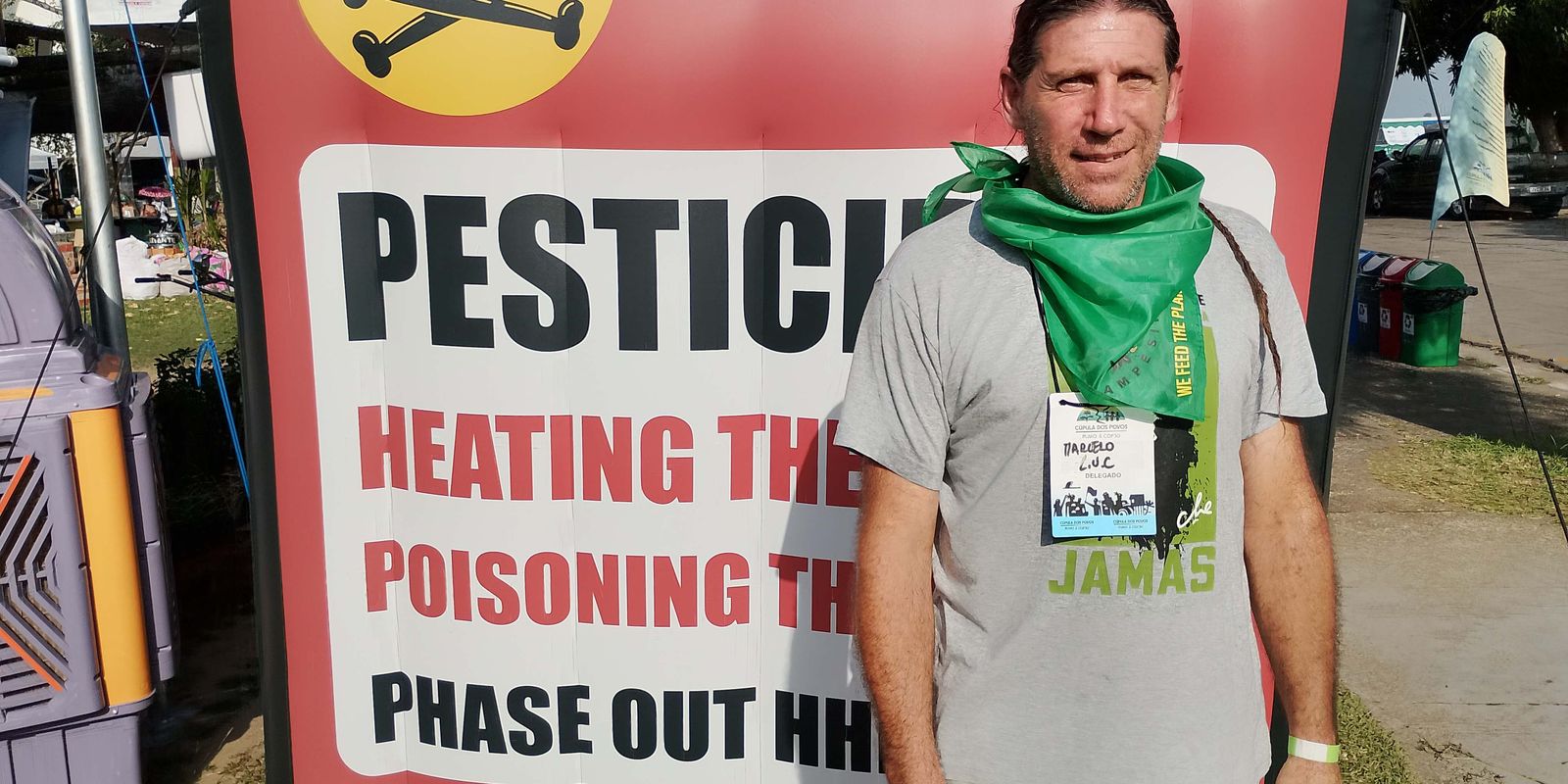
In the interior of Uruguay, in the town of Tala, 100 km from the capital Montevideo, decades of sugar beet cultivation have left a trail of contamination in the soil, groundwater and the health of farmers. To grow and maintain itself in the region, the plant needed a series of pesticides, applied by Uruguayan and foreign companies.
Nowadays, beetroot is no longer grown in this region, but all the harmful consequences of that production model are still present in the lives of the local population. All local agriculture depends on artificial irrigation, because chemical fertilizers have caused the soil to lose its ability to retain rainwater.
In an interview with Brazil Agencythe coordinator of the Red Nacional de Semillas Nativas y Criollas, the Uruguayan Marcelo Fossati, denounces multinational corporations for profiting at the expense of people’s health and environmental contamination.
The conversation took place on the campus of the Federal University of Pará (UFPA), during the People’s Summit. The event, organized by social movements as a counterpoint to the 30th United Nations Conference on Climate Change (COP30), takes place in Belém.
The network coordinated by Fossati covers more than 250 family properties and 350 producers spread across the departments of Montevideo, Maldonado, Colonia, Paysandú, Cerro Largo, Durazno, Canelones, Rocha, Tacuarembó, Treinta y Tres, Lavalleja, San José, Salto and Artigas. Since its creation, the Network has also included the Friends of the Earth Network – Uruguay – and the Faculty of Agronomy of the University of the Republic.
The main objective of the institution is to promote and promote native or traditional varieties of seeds for family production. Whether for self-consumption or to supply local markets.
Read the full interview:
Brazil Agency: You came to the Peoples’ Summit to denounce the use of pesticides in Uruguayan agriculture. Could you explain how these products have impacted life in the region where you live?
Marcelo Fossati: I live in a region that was formerly a sugar beet production area. In cold areas, sugar cane does not grow, so the energy crop was sugar beet. It is a crop that requires a lot of application of chemical fertilizers to produce and, furthermore, it is not a plant from this region — it is European, from the area of Belgium, Bulgaria, those cold zones. Therefore, here, it suffers from many pest and disease problems.
Cultivation needed to be heavily supported by pesticides to maintain itself. Nowadays, sugar beet is no longer planted in this region, but all the consequences of that model are still present: soil erosion, loss of the fertile horizon, and the clearest consequence that we, peasants and farmers, see is the lack of water retention capacity in the soil.
Now, when it rains, the soil washes away quickly — the water disappears — because the pesticide has destroyed the soil structure. The soil itself is a kind of sponge full of pores, and it is in these pores that the water remains. But the chemical destroyed these pores, so the soil lost its ability to retain water.
When it rains heavily, the water carries all the fertile soil to the rivers, instead of remaining trapped there. And it is this water in the soil that feeds the plants. So, when there is a lack of water in the soil, the plants are left without this food, and it becomes very difficult to produce in my region if you don’t have irrigation. It’s impossible with rainwater alone, because the soil doesn’t store water and everything is lost quickly.
Brazil Agency: And has the use of these pesticides had any impact on the health of the population?
Marcelo Fossati: This is very clear to us. Today, we have people aged 50, 60 — children of the Green Revolution — who have known no other way of producing. The Green Revolution in Uruguay began in the 1960s and was consolidated in the 1970s, imposing the model of pesticides, hybrid and improved seeds.
These people’s parents used organic fertilizers and creole seeds [nota da reportagem: as sementes crioulas são todas as possibilidades de multiplicação de vegetais por meio de grãos, ramas, folhas, flores, frutos, raízes e caule].
But not them. They grew up with agrochemicals since childhood, and today many cases of intestinal cancer, skin cancer, esophageal cancer, respiratory problems, skin problems due to direct contact are appearing.
Pesticides arrived with advertising saying that they did no harm, that someone could even take the poison and mix it with their hands. This poison entered the skin slowly. At the time, it was just a little itchy or a blister. But this poison was penetrating, slowly accumulating, and today, at the age of 50 or 55, problems appear.
There was even advertising saying that you could drink the pesticide without any problems and that it would help cleanse the stomach and digestive system, as a way of “purifying from within”. Imagine what this usage meant.
And today these people don’t realize the risk. As they were educated with a lot of propaganda that it was not dangerous, they lost the idea of risk. So, they use the poison without any type of protection: without a mask, without an apron, without gloves, without boots.
Often, they finish applying the product to tomatoes, eggplants or peppers, and leave the used clothes inside the house, with the children running around. This generates environmental contamination, affecting even those who are not in direct contact with the poison, but breathe the contaminated environment.
Another problem is the contamination of groundwater. Seven years ago, public education carried out a study in rural schools, analyzing the quality of the water that children drank — groundwater. There was not a single school, among 76 samples, that did not show contamination by pesticides.
Brazil Agency: And who are the companies responsible for the use of pesticides that you came to denounce here at the People’s Summit?
Marcelo Fossati: They are Uruguayan companies, or rather, companies that maintain Uruguayan names, but which have already been purchased by multinationals. One of them is called Isusa. Another is called Proquimur. They keep the old names so as not to directly associate the problems with multinationals.
So, when poisoning occurs — for example, a plane passes by, the wind changes, and people get blisters on their skin — the problem is not attributed to the multinational, but to Proquimur. But it’s the same company. It was an old company that sold bat guano [um tipo de adubo natural feito com as fezes do animal].
Brazil Agency: And, since we are at COP30, how can we relate the impacts of pesticides to the climate emergency?
Marcelo Fossati: There are two main relationships. First: pesticides do not exist in nature. It is a product of chemical synthesis, which combines different substances into a single molecule. This requires enormous energy expenditure. There are studies saying that more energy is spent producing urea [fertilizante nitrogenado] than the tractor uses to apply it.
This climate impact remains invisible. You look at the urea in the river, at the fish, but you don’t look back — at how that urea was produced using oil, gasoline and a lot of energy to condense several substances into a single molecule.
So, there is a lot of energy spent to produce the pesticide, a lot of energy spent to apply it and a lot of energy spent to transport the production. Soy, for example, goes to China in ships powered by heavy fuel — liters and liters of fuel, emitting greenhouse gases.
We then have: energy consumption to produce the molecule, energy consumption to apply the molecule and energy consumption to distribute the final product. The balance is highly negative.