SANTIAGO DE CUBA.-On February 14, Yaritza, 35 years old, collided head-on with the new oil prices while shopping in the informal market of Songo La Mayain Santiago de Cuba. The first thing he noticed was the absence of the product on the counters. The oil was not visible. It was sold quietly. “I have 900 ml oil for 2000 pesos, mulatto,” they whispered to her.
“I wanted to die,” he says. I had gone out with the idea of buying a package of chicken and a liter of oil. In the end, he could only pay for the oil—2,000 pesos—and five pounds of chicken for 2,500. The entire package, 11 pounds, cost 5,500. Too much for his pocket.
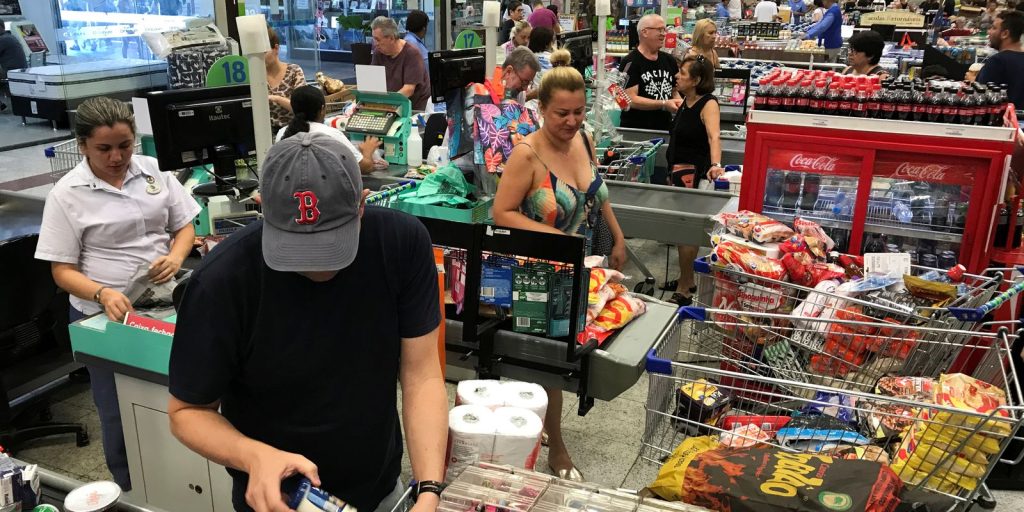
The scene is repeated in different parts of the country. In the last two weeks, the oil became one of the most visible indicators of an announced collapse. In the wholesale market, a 900 ml or liter bottle already costs more than 1,200 Cuban pesos, and this increase is transferred almost immediately to the informal market, where the price ranges between 2,000 and up to 2,500 pesos, depending on the area. This increase in price also extends to other essential foods, such as rice, which already exceeds 300 pesos, or chicken, which little by little has stopped being a regular purchase for many families.
Shortages, dollars and salaries that are not enough
The rise does not respond to a single cause. Added to the structural crisis are recent factors that have further stressed the market: cuts in multiple sectors, energy collapse and a fuel crisis that makes transportation more expensive and limits the movement of goods.
At the same time, shortages in the few stores that sell in national currency and the virtual absence of products in the warehouse network have pushed the population to depend almost entirely on the private market.
This problem becomes clearer when crossing prices with income. According to ONEI figures disclosed in 2025, the average state salary in Cuba is around 6,000 pesos per month in the budgeted sector, paid entirely in national currency. In parallel, the US dollar is quoted in the informal market at around 500 pesos per unit, which reduces that salary to just over 12 dollars per month in real terms.
In this context, a single knob of oil can absorb up to a third of the monthly income of a salaried family, not counting rice, proteins, electricity, transportation or medicines. In this sense, inflation ceases to be a macroeconomic phenomenon and becomes a sequence of daily renunciations.
Official limits and a market that does not obey
Meanwhile, the State maintains the stable sale of essential products such as oil and rice almost exclusively in stores that operate in MLC or dollars. This scheme has fueled a known circuit: those who have access to foreign currency buy in volume—to hoard or resell—and those who do not have it depend on intermediaries and markups.
From the wholesale market itself, the explanation is direct.
“Before, with 600,000 pesos we took a truck of rice out of the port. Now we had to go with a million and a half,” says a private worker in La Maya. “To bring beans now they ask for two million. Then people ask why prices rise. My question is: can we sell cheap?”
In the midst of this scenario, the National Tax Administration Office (ONAT) recalled that Resolution 225/2025 is still in force, which sets maximum prices for products in high demand. According to the standard, a pound of chicken should not exceed 312.80 pesos and a liter of oil would have a limit of 990 pesos. In practice, these prices are completely disconnected from the real market: 10-pound packages of chicken exceed 5,000 pesos, around 83% of what an average monthly salary covers, while oil doubles or triples the regulated price.
As expected, the ONAT publication generated thousands of reactions and dozens of comments. Beyond questioning the ineffectiveness of the resolution, many users denounced the double standards of the State, which imposes limits on the private sector while failing to comply with its own regulations.
Do capped prices apply only to self-employed workers? “Doesn’t the State fall within those limits?” questioned the Chocolates Cienfuegos MSME.
Along the same lines, Melvys García Cruz asked himself: “If in the state market they sell me a bottle of oil for 2.53 USD, wouldn’t the capped price be violated?”
The contradiction is evident. Although the official exchange rate is slightly lower than the informal one—458 pesos per dollar, according to the Central Bank of Cuba (BCC)—in foreign currency stores the oil reaches up to 2.70 USD, which is equivalent to 1,236 pesos at the official exchange rate. Even so, the price exceeds the established limit, confirming that the main offender of the regulation is the State itself.
An economy that flees towards currencies
This non-compliance is not a minor detail, but proof that the official rules do not order the real economy. When the State sets prices that it cannot—or does not want—to respect, the Cuban peso stops functioning as a real reference of value. In this scenario, the economy is reorganized outside formal regulations, just as it happens today.
Thus, the prolonged recession, combined with persistent inflation and continuous devaluations, has created an environment where all economic actors —MSMEsinformal importers, merchants and consumers—seek refuge in strong currencies to protect their purchasing power or simply be able to operate.
This flight towards the dollar and other currencies fuels growing demand, both for practical and speculative reasons, closing a circle that pushes prices ever higher and leaves families like Yaritza’s calculating, over and over again, what they can afford and what they should stop buying.