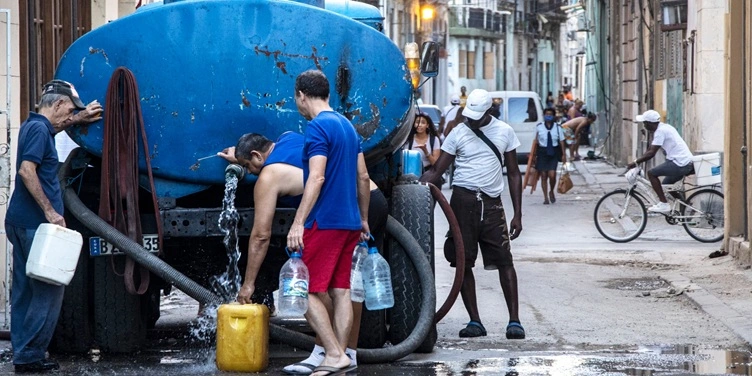
In social networks, pipes are offered at exorbitant prices, while thousands of people survive with the minimum.
Snatiago de Cuba, Cuba.- In full July, with temperatures that exceed 30 degrees Celsius, Santiago de Cuba Arde. The heat, combined with a suffocating humidity, becomes suffocating every day. In the center of the city, trees barely move; There is no breeze, just a heavy vapor that rises from the asphalt. People turn to towels and fans to dry sweat and avoid dizziness. In this already extreme scenario, the lack of water Multiply despair.
Water to cool off or hydrate is a luxury. Maybe a single bathroom a day – if perhaps – and a glass of hot water to drink, because frequent blackouts prevent the fluid from cooling.
A historical crisis, now more acute
Although water scarcity has historically been one of the main problems of the province, the situation has now reached a critical point. In social networks they circulate images of people running behind pipes, desperate to get even a little water. Publications also abound that offer to buy or sell the precious liquid.
In Facebook groups, messages such as: “I give 20,000 for a water pipe for 11 Mariana de la Torre”, “in Caney there are 10,000 Cup” are read, or “I have 500 pesos ice jaros domiciled.” Despair is measured in pesos and liters.

What do the authorities say?
According to official media, the main cause of collapse is the prolonged drought, aggravated by the deterioration of supplies of supply throughout the province, especially in the capital municipality.
A Report From the Caribbean channel on July 28, he pointed out: “The shortage of rain has caused an alarming decrease in the levels of reservoirs and aquifers, in a context already tense due to energy limitations and lack of fuels.”
The Charco Mono reservoir is completely dry. The same happened with Gota Blanca, which contributed 500 liters per second to the Northwest system, and which was extinguished on July 7. The Gilbert system also reduced the supply, and now barely contributes between 900 and 1,000 liters to the Quintero plant. Of the five conductors that integrate it, only one is working.
The most serious data: more than 80 percent of the city’s population depends on the system Quintero.
The pipe as power currency
Currently around the city circulates around 40 cisterns cars – state, of the company Aguas Santiago and private porters – which have been used to mitigate the deficit very slightly, especially in hospitals and productive centers. The communities, however, are finally forced to hire “on the left” at unpayable prices.
“I buy water pipe at the price,” public This week Alex Victor Mergares Legrá in a Santiago group of sale. The offer soon: “I am from the Maya, how much do you pay me and take it there?” Another user replied. Laimis Caridad Sanit Cintra also reacted: “Bring me to me, give it, I pay it well.”
In that same social network it is commented that pipe prices range between 12 thousand and 20 thousand pesos (30 to 50 USD to informal change). The price depends on the amount of tanks that pee in the car, considering that each tank is around 1,000 pesos. Some users have offered up to 25,000 to solve.
“They are killing us in installments”
“This is what they are looking for. Abusers. They are killing us in installments. Such a vital liquid. My God,” said user Elizabeth Ramos.
Others, such as Juan Antonio Hernando, went further: “Those are the people of the aqueduct they publish to sell pipes. The business of the chiefs of the aqueduct has arrived.” His comment points to an alleged corruption network directly linked with officials of the Aguas Santiago company.

The other face: those who cannot pay
While some pay anything, others simply can’t. Maritania Lemes, a 58 -year -old teacher in the El Salao neighborhood, has been obtaining water for two weeks thanks to the wealthiest neighbors. “Thank God I am a dear woman in the neighborhood and everyone helps me. Most have been my students,” he says.
But solidarity does not solve everything. “Every day is uncertainty. I try to save as much as I can. I bathe once a day and even endure the desires to do my needs to avoid spending water to download the toilet. Up to that point I have had to arrive,” he laments.
Carnival in the middle of the crisis
Despite the collapse of the supply system, the local government authorized carnivals from July 23 to 27. The decision has generated indignationwell contrast With the call of the director of the aqueduct company, Liudmila Rodríguez Barroso, who declared Recently: “At the moment savings is essential, the province is going through an extremely dry period and the reservoirs are mostly depressed.”