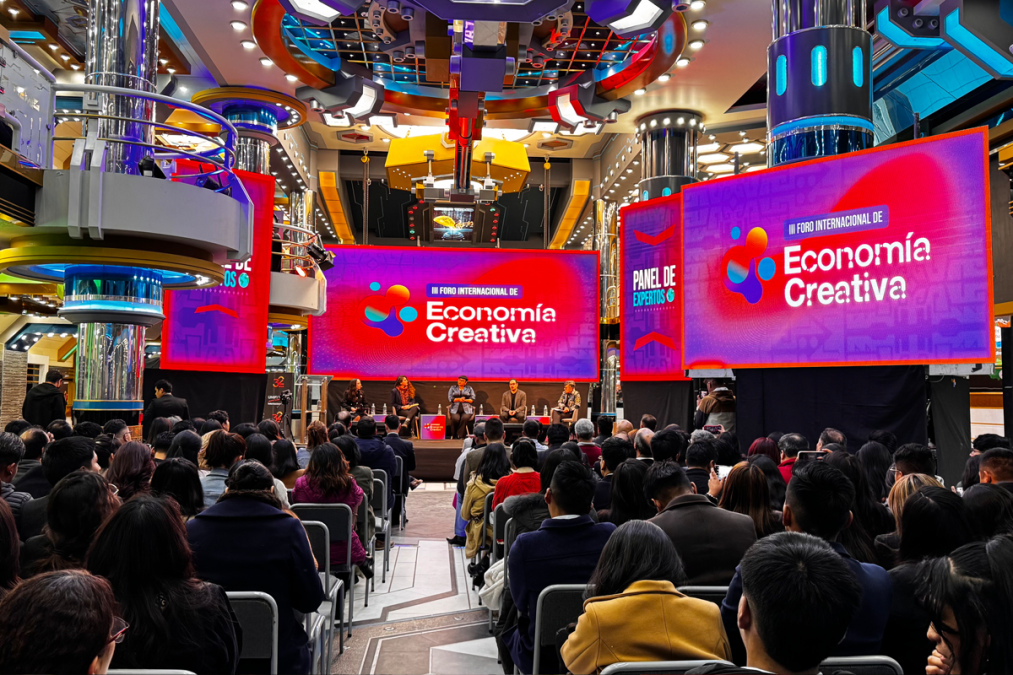
The Franz Tamayo University, Unifranz, closed on Friday, September 12, in El Alto, the III International Forum of Creative Economics, a space that put the necessary public strategies and policies to boost a key sector in the economic diversification of Bolivia in the center of the public debate. Experts, entrepreneurs, cultural managers and authorities agreed that the creative economy is emerging as a sustainable alternative to the extractivist model and as an engine of inclusion, innovation and territorial development.
“Expectations have been exceeded, not only for the profile of those who have attended as experts, but also for the participation of municipal and private sector authorities, which now have more tools to generate policies and expedite processes for those who wish to undertake,” said Eve Gómez, Vice Chancellor of Unifranz El Alto.
For the academic, the impact of the forum goes beyond the exchange of experiences: seeks that the conclusions translate into concrete decisions within the so -called “triple helix” – academia, company and state -, in order to consolidate a robust creative ecosystem.
The forum made it clear that creativity is not an accessory, but a strategic resource that requires planning, data and public policies to materialize. Participants pointed out that Bolivia must overcome the extractivist look and begin to invest in their human talent, cultural heritage and technological innovation. Creativity, in addition to generating economic value, also strengthens social cohesion and promotes sustainability, issues that crossed each of the panels.
In that line, Sumaya Prado, general manager of Gustu Gastronomy, emphasized the need for innovation not to lose sight of its roots. “It is important to make visible the creative economy efforts to sow a new horizon of sustainable development in Bolivia. We have all the richness, products and talent to occupy an honor seat within world gastronomy.”
For the manager, the key is to look inward, revalue biodiversity and recognize the work of producers that support food chains.
Sustainability, in this area, is not limited to environmental care, but also to social justice and respect the producer. Prado was overwhelming when pointing out that change begins with a cultural act of consumption: stop belittling the Bolivian.
“When we ask the producer reduction or do not value his work, we are subtracting future from the country. Sustainability requires that we learn to respect what we already proudly consume our products,” he said.
The business look also had a central space in the forum. For Gabriel Ágreda, Executive Director of Innovation Drinks SRL, the main challenge of undertaking in Bolivia is in constancy and planning.
“Having a business model is really the map that we will tell us what we want to do and how we are going to do it. If there is no planning, it is very difficult for an entrepreneurship to move forward in a country as hostile as Bolivia.”
Ágreda explained that the models must be flexible, capable of evolving according to opportunities and market changes, but always with a solid base that guarantees sustainability.
The cultural vision was represented by Patricia García, actress, theatrical director and cultural manager, who stressed that the forums fulfill a social and political role.
“Through spaces like this we can listen to experiences, generate questions and make visible what we are as a country, beyond our bubbles. The city of El Alto is reconfiguring a new identity, integrating the global and local in a creative transformative process,” he said.
Garcia also stressed that the Academy must assume a more active role, reviewing its processes and adapting to the demands of young people looking to insert themselves into a changing market.
The forum panels
For two days, the event addressed different angles of the creative economy. In the “Entrepreneurship and Business Models” panel, participants showed how gastronomy and Bolivian drinks can compete globally without losing identity. Technological innovation, collaboration between entrepreneurs and the articulation with producers were highlighted as keys to the sustainability of this sector.
In the “Innovation and identity construction panel in local creativity”, artists, muralists and designers agreed that cultural creation not only generates beauty, but also social cohesion and sense of belonging. There it was stressed that innovation does not always mean breaking with the past, but to reinterpret living traditions, such as the aesthetics of La Chola Paz or the employer festivities, to project them in contemporary key.
The debate “creative economy as a sustainable development engine” expanded the gaze towards the macroeconomic impact of the sector, highlighting the role of cultural and digital tourism as sources of employment, and the need for public policies to strengthen the value chain. The panelists agreed that, to advance, it is necessary to overcome the prejudices on cultural profitability, diversify the sources of financing and build alliances between state, company and civil society.
The general conclusion was that Bolivia has resources, but needs political will, research and institutional articulation to convert the creative economy into a sustainable development pillar. On that path, the academy is emerging as a fundamental actor to generate data, form talent and accompany the private sector in innovation.
When closing the forum, the Vice -Rector of Unifranz El Alto insisted that the creative economy is a unique opportunity
“The creative economy is an open gold mine in the talent of our young people and the opportunity generated by innovation. Unifranz has shown its commitment to be an active part of this process, articulating academia, company and state to build sustainable development,” he said.
With that statement, this house of higher studies ratified its role as a bridge between creativity and public policies, demonstrating that higher education can also be an engine of economic and social change.