In the last decade marked by political instability, which is reflected in the mandate of seven heads of state – when there should have been at least two – public policies have been considerably affected. As a consequence, state programs to reduce poverty, prevent anemia among children and school dropouts, among others, have not had the expected effect.
According to the report that evaluates what progress Peru has made regarding its commitment to the Sustainable Development Goals in the period 2015-2024, linked to childhood and adolescence, there is no significant progress but rather a setback or stagnation.
It’s not just about public funds.
For example, in 2015, the government allocated S/1,269 million to the Qali Warma National School Feeding Program and S/308 million to the National Crib Plus Program. In 2024, the first exceeded S/2,460 million and the second exceeded S/835 million. The budgets increased, but the goals were not achieved.
Ending poverty, the first of the 17 Sustainable Development Goals (SDGs), to which Peru committed at the United Nations Assembly, is very far from being met.
“The objective: end of poverty, shows a decline in child poverty levels after the pandemic. In 2024, 36.6% of girls, boys and adolescents lived in monetary poverty and 8.2% in extreme poverty, with deep gaps between urban and rural areas,” says the report prepared by the United Nations Children’s Fund (UNICEF) and the National Institute of Informatics and Statistics (INEI).
YOU CAN SEE: Businessman denies Sada Goray: “She introduced me to Congressman Darwin Espinoza”
The faces of poverty
“22.2% of this population had at least one unsatisfied basic need and less than a third resided in homes with adults affiliated with a pension system, which affects their access to future social security,” adds the document that should be considered by presidential candidates, as well as candidates for senator and deputy.
In any electoral debate these figures must be taken into account so that the candidates offer solutions.
But it’s not just poverty.
In a decade, according to UNICEF and the INEI, the figures are regrettable.
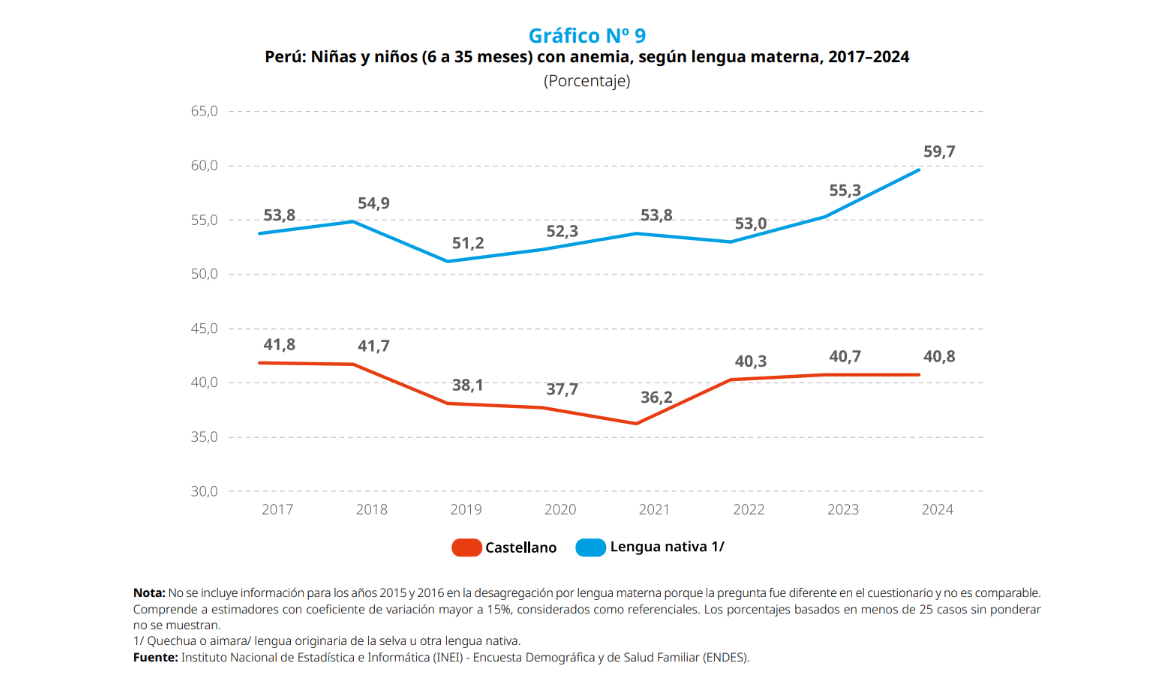
“Regarding the zero hunger goal, chronic malnutrition in girls and boys under five years of age was reduced from 14.4% in 2015 to 12.1% in 2024, although with important territorial and socioeconomic gaps. In 2024, the prevalence of anemia in girls and boys aged 6 to 35 months was 43.7%, without significant progress in the last ten years,” the document notes.
But when you look at the interior of the country, the figures are worse.
“The situation is more critical in rural areas, in households in poverty and with mothers who speak a native language or with primary education or without educational level,” the report states.
This indicates that those most affected by hunger are poor and illiterate indigenous women, or interrupted education.
YOU CAN SEE: Eguiguren: “The State must decide whether or not industrial fishing is allowed in reserved areas”
Democracy in crisis takes its toll
This evaluation of the SDGs reaches the governments of Ollanta Humala, Pedro Pablo Kuczynski, Martín Vizcarra, Manuel Merino, Francisco Sagasti, Pedro Castillo and Dina Boluarte. A stage of fragility of democracy and lack of political representation in Congress.
UNICEF and INEI recognize that an auspicious result has been recorded in terms of quality education, but there are still problems to be resolved.
“The completion rates of primary and secondary education increased between 2015 and 2024, going from 81.7% to 93.6% and from 68.6% to 84.4%, respectively. However, lags persist in learning levels: in 2024, only 18.4% of second-year secondary school adolescents reached a satisfactory level of competence in text comprehension and 11.3% in mathematics,” the report explains.
There are two other SDGs (gender equality, and peace, justice and solid institutions), in which Peru has not expressed positive results either, according to UNICEF analysis based on official figures.
In the case of gender equality, “violence against women and child marriage continue to be present problems, despite the reduction observed between 2023 (53.7%) and 2024 (38.0%),” the document states.
“Still approximately four out of every ten female adolescents aged 15 to 17 have suffered physical, sexual, psychological or verbal violence in the last 12 months,” it is explained.
“In addition, 17.9% of women (20 to 24 years old) declared having been married or in a stable union before turning 18. Despite regulatory efforts, girls and adolescents face multiple forms of gender violence in public and private spaces,” she notes.
Although physical and/or psychological violence decreased against girls, boys and adolescents aged 9 to 17 (from 39.8% in 2015 to 34.0% in 2024), Peru maintains high rates of attacks, which mostly come from members of their families.
“High levels of violence against children and adolescents persist: three out of every ten adolescents between the ages of 12 and 17 reported having suffered physical and/or psychological violence by the people they live with,” the report states in relation to the objective “peace, justice and solid institutions.”
YOU CAN SEE: Congressmen who voted in favor of eliminating the People’s Commission are “traitors”
insecure girls
Since the aggressors are usually members of the family group, the victims do not file complaints with the authorities, because they do not find the appropriate channels. The State has not developed mechanisms to channel the cases of children and adolescents.
“This shows the need to strengthen institutional protection and access to justice adapted to this group, since only 6.7% of adolescent victims of crimes file a complaint,” highlights the UNICEF and INEI report.
“In addition, the perception of safety shows a significant gender gap: 63.4% of men report feeling safe walking alone, compared to only 46.0% of women,” the report highlights.
The document is not addressed to a particular political group. It is a wake-up call for those who assume responsibilities for public policies. The great challenge is indicated in the conclusions of the evaluation of the UNICEF and INEI report.
“Greater public policy attention is required on SDG 1 (end of poverty), SDG 2 (zero hunger), SDG 4 (quality education), SDG 5 (gender equality) and SDG 16 (peace, justice and strong institutions),” it is precisely stated.
“It is recommended to deepen intersectoral efforts with a territorial, gender, intercultural and life cycle approach, as well as strengthen monitoring systems, targeted public investment and citizen participation mechanisms to guarantee compliance with the rights of children and adolescents,” he states in detail. These are issues that should be on the electoral agenda.
The SDGs pending fulfillment
- SDG 1: End poverty in all its forms.
- SDG 2: End hunger, achieve food security and improved nutrition and promote sustainable agriculture.
- SDG 4: Ensure inclusive and equitable quality education and promote lifelong learning opportunities for all.
- SDG 5: Achieve gender equality and empower all women and girls.
- SDG 16: Promote peaceful and inclusive societies for sustainable development.