The first time I really understood the word fatigue was not in a laboratory, but in my living room: an apparently new chair decided, without prior warning, to become four legs and a philosophical argument about gravity. Nobody had mistreated her. No one had overloaded her. Simply put, after thousands of loading cycles, a microscopic crack grew to reach its critical size and propagated, fracturing the material. And there I was: indignant, tempted to look for blame… and, at the same time, forced to admit the obvious: complex failures are rarely explained with an accusing finger.
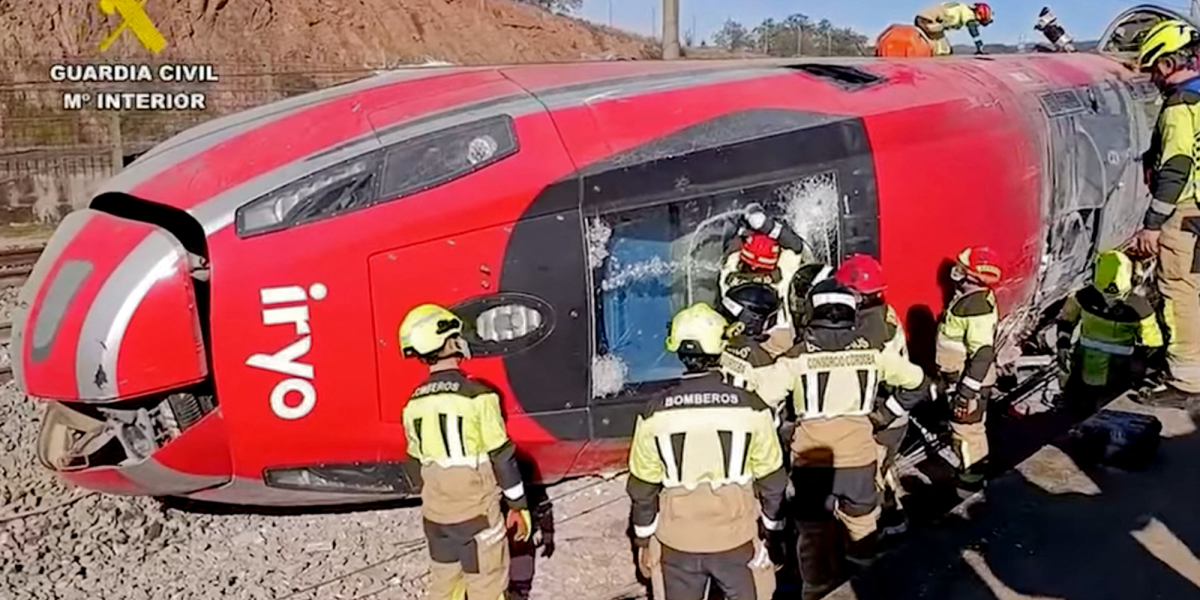
With the train accident in Adamuz Something similar happens, except that the chair weighs hundreds of tons, moved at 200 km/h and transported lives. In this case, the minimum required is not to turn the tragedy into a speculative bar gathering.
In search of a culprit
The rest – the root cause – is, by definition, an ongoing investigation. Even so, human beings need to close stories quickly: “it was the train driver”, “it was the track”, “it was the train”, “it was something with its own name”.
The information available indicates, precisely, that we are not facing the easy story of the single culprit: official sources indicate that they are being explored infrastructure or mechanism failures as signs of a possible anomaly (crack?) in the rail or in elements of the train. In any case, there is no need to think about sabotage, since, in that case, I would have derailed the whole train.
Simplified diagram of how a railway accident is investigated.
Research takes time
Serious investigations have an unbearable defect: they take as long as they take and they do not understand in a hurry. The European regulations require publish the final report within twelve months; If this deadline is not reached, an intermediate advance must be issued. That is, even with public pressure, the system is designed so that haste is not the intellectual author of the report.
To give us an idea, the Santiago de Compostela accident (July 24, 2013) obtained the final report in May 2014. In Hatfield (United Kingdom, 2000), the combination of technical analysis, accountability and operational reforms took years, because a material failure may be only the first domino in an organizational chain.
Safety is learned from past mistakes: analysis of lessons from three recent European accidents.
Three lessons from the past (no need to guess the future)
–Sometimes, the material is the train, not the track.
He Eschede accident (Germany, 1998) is the cruelest reminder that a fatigue crack in a component It can trigger a catastrophe, even if the rest of the system “seems” correct. The relevant detail is the idea of crack initiation and propagation under repeated non-critical loads and the importance of their detection before the critical threshold.
–Sometimes the material is the way, and the problem is invisible… until it isn’t.
Rolling contact fatigue is a poorly educated specialty of physics: it works silently, at the wheel-rail interface, with stresses that can reach enormous magnitudes in the surface area, and sows cracks. This is what happened in Hatfieldin 2000.
–Sometimes the dominant cause is not materials, but operation and barriers.
The 2013 incident in Santiago de Compostela shows another family: speed, human factors, transition between protection systems… and, above all, the debate about how many layers a system should have so that a single error is not fatal. It is not the same pattern as a straight line derailment after a recent renovation, but it does teach the same method: not looking for a silver bullet, but a chain of events.
Family tree causing the accident and different types of scientific expertise evidence that can be used to discriminate between them.
And Adamuz? Reasonable hypotheses
If the media spotlight insists that the track was modern and renovated and the train was recent, the technician must respond with humility: precisely for this reason, the plausible range includes sudden failures or defects that escaped routine inspections. Some hypotheses, or all of them, could respond to our curiosity:
- Possible rail joint-welding-fatigue problem: the evidence would have to be sought from the fractography (analysis of fracture surfaces): marks of advance due to fatigue versus sudden breakage. Also, in the history of non-destructive testing at the point and nearby welds, in the track geometry and settlements (auscultation records) and in field evidence (fragments, deformations, “start mark” of the derailment…).
- If it were rolling stock (wheel-axle-bearing/bogie), what usually gives it away are previous signals in the recorders (vibrations, alarms, bearing temperature), characteristic damage to the wheel or axle and its fracture surface and correlation with actual maintenance.
- If it were not a material problem, plausible hypotheses would still be plausible—until now not ruled out—collision with an obstacle on the track, a local geometry anomaly, the failure of fastenings or a nearby track device, as well as wind effects or local thermal stresses, less common in January, but relevant because the track responds to the cyclical variation in rail temperature.
In the constant interaction between railway wheels, cracks can form due to continuous wear, cyclical increases in temperatures and repetitive loads that cause fatigue of the materials involved.
The security of the future: more speed, more sensors, more humility
China has presented prototypes like the CR450which will operate up to 450 km/h. The promise of safety is not in the magic of the record, but in the ecosystem: instrumentation, predictive maintenance, automated inspection, digital twins and a culture where a small notice is not filed as a nuisance.
In the end, I return to my broken chair. If I had trusted intuition, I would have blamed carpentry, fate, or that lame leg. But when one analyzes it, the chain appears: a design with its compromises, a union that concentrates tensions, a microdefect, thousands of repeated loads… and, finally, a last cycle that was not the strongest, but the first to reach the breaking point.
Understand before judging
Forensic analysis forces us to read the traces of the failure as if they were a text, from submicrometric fractography to the macrocosm of the system, where each human and technical decision also leaves its signature.
With Adamuz, the only serious position is to understand before judging. Because if the great railway disasters of the past teach us anything, it is that progress in safety does not come from the fastest analysis, but from the most patient evidence. And that evidence, like cracks, is not easily appreciated… but it inevitably exists.