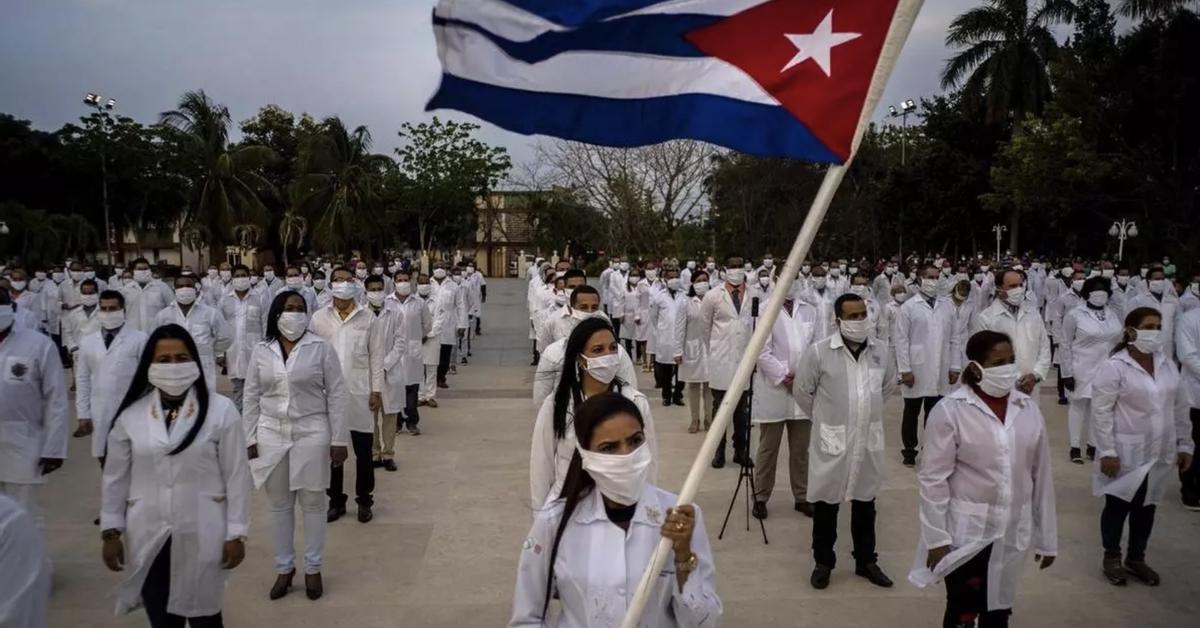
Havana/Since the early hours of this Saturday, when the United States intervention in Venezuela was announced, one of the questions that began to circulate in Cuba was what will happen to the Cuban doctors who remain on mission in that country. The Ministry of Public Health He assured in a brief message spread on social networks that all collaborators are safe. However, beyond this official statement, the immediate future of one of the Cuban regime’s main sources of foreign currency remains undefined.
After the military action took place, a retired nurse from Havana told this newspaper that a colleague in Venezuela assured her that “they have the Cubans from the missions quartered.”
Furthermore, a doctor stationed in Caracas told 14ymedio that, despite the messages of calm transmitted by their coordinators, nervousness is evident: “The bosses keep saying that everything is fine and that we have to wait for what Havana says, but they are very nervous.” At that moment, he was about to start the US president’s press conference from his residence in Mar-a-Lago, Florida. “I can’t talk much because we’re all trying to hear Trump’s speech. What I can tell you is that it makes me nervous because I’m about to finish and I have the children’s clothes bought. Imagine if they move us and I can’t take anything with me.”
“The bosses keep saying that everything is fine and that we have to wait for what Havana says, but they are very nervous”
Another Cuban collaborator, from Zulia, commented that “everything is quiet in the streets but there are people who are very happy.” Several Venezuelan reporters, who maintained a live broadcast on X for more than ten hours, also reported crowds in markets and gas stations to buy supplies, fearing business closures.
The concern has been strongly reflected on social networks, especially in the comments to the official call for a demonstration in the Anti-imperialist Tribune. In that digital space, numerous users demanded that the safety of medical personnel and their return to the Island be prioritized. “They are not soldiers, they deserve to be with their families,” wrote one of the participants. Other messages expressed anxiety and annoyance over the lack of foresight. “Now they have the relatives of those who are there going crazy here,” says another comment.
However, not all opinions coincide. Messages are also read that defend the permanence of the brigades in Venezuela and maintain that, in a context of crisis, the work of doctors is even more necessary. “In this imminent war, the Cuban health brigades will be more necessary in Venezuela,” states one of the comments, which calls for the continuity of the mission as part of a political commitment built over years.
Beyond the conflicting positions, a possible interruption of medical missions in Venezuela would have direct consequences for the already fragile Cuban economy. In the midst of inflation, shortages and the deterioration of basic services, the loss of one of its main sources of income in foreign currency would aggravate the internal crisis.
An eventual interruption of medical missions in Venezuela would have direct consequences for the already fragile Cuban economy
Although the Cuban authorities claim to maintain constant communication with the mission, so far no plans for transfer, refuge or return to Cuba have been made public, nor has it been explained what would happen if the conflict intensifies.
The presence of Cuban health personnel in Venezuela dates back more than two decades and has been central both in the political relationship between both governments and in the economy of the Island. Through these agreements, the Cuban State receives significant income, while the professionals work under state contracts that limit their remuneration and their personal lives.
Independent organizations have been denouncing the working conditions of these missions for years, including the withholding of salaries, political control and restrictions on personal freedom. In a scenario of military intervention and high regional tension, these complaints take on an even more critical dimension.