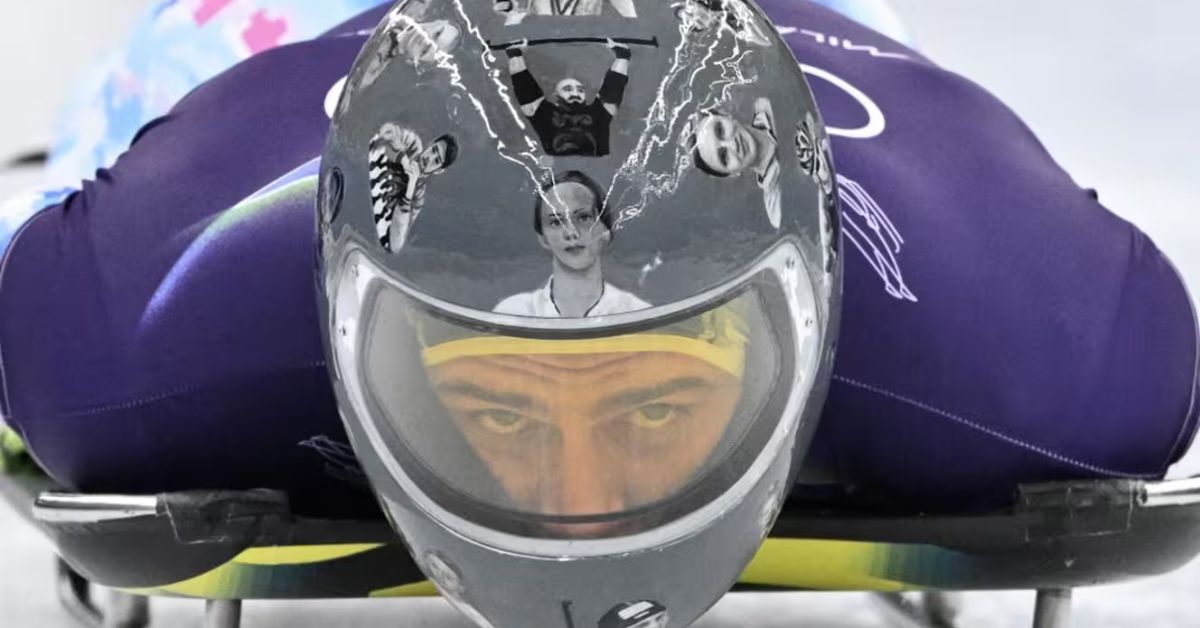
A Ukrainian athlete has been disqualified from the Winter Olympics for insisting on wearing a helmet in honor of those killed in his country’s war with Russia.
The International Olympic Committee said in a statement Thursday morning that skeleton racer Vladylsav Heraskevych, the Ukrainian flag bearer, “was not allowed to participate in Milano Cortina 2026 after refusing to comply with the IOC athlete expression guidelines.”
The decision was announced shortly before Heraskevych competed in the men’s skeleton competition, where he was considered a legitimate medal contender.
“This is the price of our dignity,” he said in a publication in X. Heraskevych indicated he would appeal the decision to the Court of Arbitration for Sport.
Kyiv called his disqualification a “moment of shame” for the IOC.
The IOC made clear earlier this week that it considered its “remembrance helmet” — which features images of Ukrainian athletes killed during the war — to contravene rules prohibiting any kind of political statement by competitors.
Heraskevych, who received support from President Volodymyr Zelenskyy, insisted the helmet does no such thing and wore it during training.
“Having been given one last chance, skeleton pilot Vladylsav Heraskevych of Ukraine will not be able to start his career at the Milano Cortina 2026 Olympic Winter Games this morning,” the IOC said on Thursday.
The decision was made, as reported by the IOC, by a jury of the International Bobsleigh and Skeleton Federation.
Heraskevych and IOC officials held multiple meetings and exchanges. However, the committee claimed the athlete “did not consider any form of commitment”, even after a final meeting with committee chair Kirsty Coventry at the sliding center on Thursday.
Olympic swimming champion Coventry made it clear she wanted a different result. “No one, no one, least of all me, disagrees with the message. It is a strong message,” he told reporters, with tears in his eyes.
“As you have seen in recent days, we allow Vladyslav to wear his helmet in training,” Coventry said. “The challenge we faced is that we wanted to ask for or find a solution solely for the pitch.”
Rule 50.2 of the Olympic Charter states: “No type of demonstration or political, religious or racial propaganda will be permitted on Olympic sites, venues or other areas.”
The IOC insisted that it “was very interested in Mr. Heraskevych competing” and offered him a compromise option: allow him to wear the helmet during training and display it immediately after the competition, or wear a black armband to symbolize national mourning, but set a limit: not allow him to wear the helmet while competing.
“The essence of this case is not the message, but where he wanted to express it,” the IOC said.
Heraskevych displayed a sign reading “No war in Ukraine” after his last appearance at the 2022 Winter Olympics in Beijing, which the IOC said did not violate its charter as he was simply calling for peace.
Russia launched its full-scale invasion days after the Games ended.
Heraskevych claimed that images on his helmet in Milan show figure skater Dmytro Sharpar, his teammate at the 2016 Youth Olympic Games, and boxer Maksym Halinichev, among others who died during the war. Some of them were Olympic athletes.
“I would say that it is painful that it seems like discrimination, because many athletes were already expressing themselves… They were not facing the same circumstances. So, suddenly, only the Ukrainian athlete in these Olympic Games will be disqualified because of the helmet,” Heraskevych declared on Thursday.
He has also been outspoken about the presence of athletes who previously represented Russia and Belarus at the Olympics, questioning their status and why the IOC cleared them to compete.
The Ukrainian Olympic Committee said in a statement after Thursday’s ruling: “Vladislav did not participate today, but he was not alone: all of Ukraine was with him. Because when an athlete defends truth, honor and memory, that is already a victory.
The country’s Foreign Minister Andrii Sybiha called it “a moment of shame.”
“The IOC has not banned the Ukrainian athlete, but its own reputation,” he said in a post on X.
“It is the Russians who should be banned, not the commemoration of their victims,” Sybiha added.