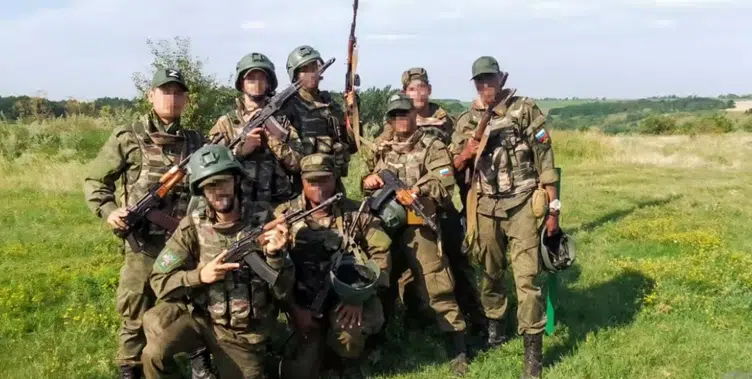
In addition to Cubans, nationals of Belarus, Tajikistan, Uzbekistan, Kenya and China would be joining the troops of the Russian Army.
MIAMI, United States. – Ukrainian Foreign Intelligence assured that Russia continues to systematically recruit foreign citizens to fight in the war against Ukraine and that in December alone it detected more than 150 foreigners from 25 countries incorporated into the Russian armed forces, in addition to nearly 200 people who would be preparing to join Moscow’s army.
Among the countries mentioned is Cuba, according to an official statement disclosed by the Foreign Intelligence Service of Ukraine (SZRU).
The information was offered by the head of the organization, Oleg Ivashchenko, who pointed out that the main sources of recruitment are concentrated in States of the post-Soviet space and in countries of the so-called Global South, including Belarus, Tajikistan, Uzbekistan, Cuba, Kenya and China.
According to Ivashchenko, Moscow takes advantage of structural conditions of economic and migration vulnerability to attract foreign fighters. “Moscow deliberately plays with the economic instability of poor countries and with limited avenues for legal migration, turning these factors into a means of control and pressure,” said the head of Ukrainian intelligence.
The official explained that among the incentives used by Russia include financial payments, facilities for obtaining Russian citizenship and amnesties for convicted people, elements that — according to the SZRU — are especially attractive to citizens of countries with fragile economies and few opportunities for legal migration.
In addition to the military component, Ivashchenko attributed a political and propaganda objective to the recruitment of foreigners. As he explained, the Kremlin seeks to present the invasion of Ukraine as a conflict of international scope and not as a bilateral war. “The presence of citizens from China, Cuba or African countries is actively used in propaganda narratives as proof of support from the ‘non-Western world’,” he stressed.
The Ukrainian intelligence note does not offer a breakdown by country of the number of recruits nor does it publicly identify the people involved, so it is not possible to determine how many Cubans are part of the more than 150 foreigners detected in December, nor under what specific conditions they would have been incorporated.
In September 2023, the Cuban Government announced the dismantling of an alleged human trafficking network that would have recruited citizens of the Island to fight alongside Russia, a case that led to several criminal proceedings.
In October of this year, the Cuban Ministry of Foreign Affairs rejected accusations from the United States about the presence of “Cuban troops” in Ukraine, while acknowledging the existence of nine judicial cases, 40 people accused of the crime of mercenarism and 26 convictions, with sentences of between five and 14 years in prison.
Last November, Ukrainian deputy Maryan Zablotskiy reported, during a press conference held in Miamithat the authorities of his country had identified the bodies of 39 Cuban mercenaries who died while fighting on the side of Russia. In addition, he assured that Ukraine could continue identifying and reporting to the families on the Island “what has happened to these men who have died.”
In addition to the 39 deceased and identified mercenaries from the Island, the Ukrainian legislator assured that there were “hundreds of dead Cubans who fought for Russia” whose identity was still unknown.
In February this year, Schemes, the investigative journalism unit of Radio Free Europe/Radio Liberty (RFE/RL) in Ukraine document the recruitment of Cuban citizens by the Russian Army. Among the testimonies collected, that of Frank Dario Jarrosay Manfuga, 36, stands out, who was captured by Ukrainian forces and assured that he had left Cuba under deception. “I never wanted to kill anyone. I never wanted to participate in a war. I have a family.” According to that journalistic work cited, Jarrosay Manfuga would have been recruited with the promise of a job in construction and, once in Russia, forced to enlist.
Ukrainian sources have assured that up to 20,000 Cuban citizens would have been recruited by Russia to fight in the war against Ukraine.