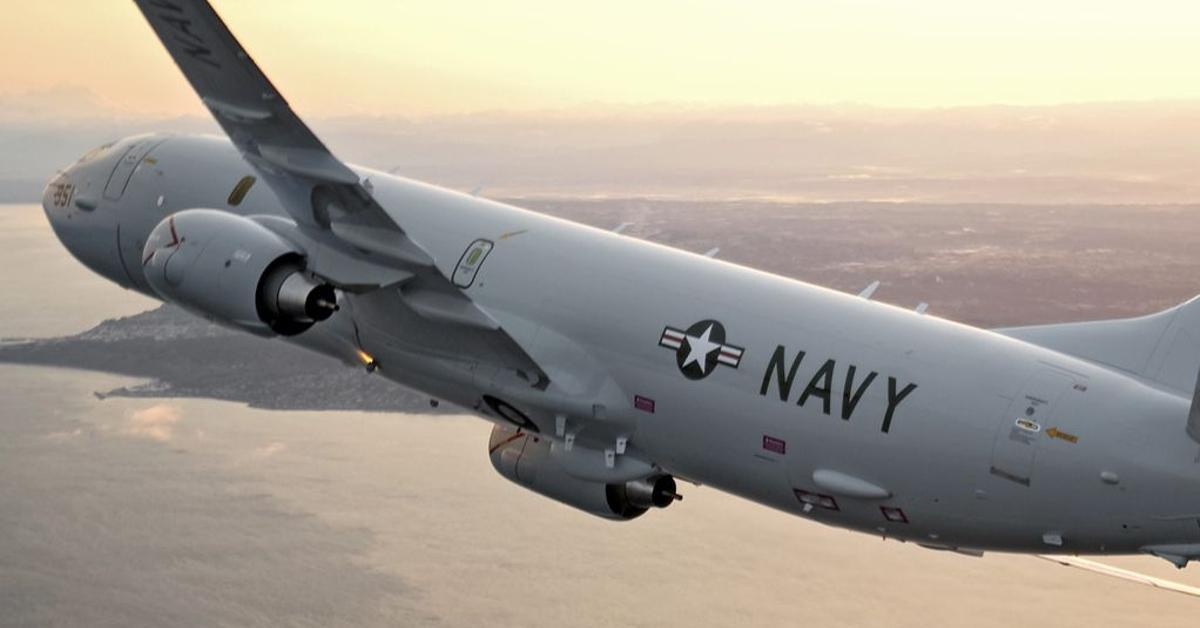
Havana/A Boeing P-8A Poseidon maritime patrol aircraft of the United States Navy was detected this Thursday carrying out prolonged surveillance maneuvers over the western Caribbean, in international waters near Cuba. Also, during Thursday and Friday, a US Air Force RC-135V Rivet Joint spy plane repeated a similar route, flying at high altitude off the northern coast of the Island, in a typical pattern of signal interception and electronic surveillance operations.
The flight of the P-8A, identified with the callsign BLKCAT5, was recorded on civil air monitoring platforms as Flightradar24where an irregular trajectory could be observed, characteristic of reconnaissance and intelligence missions. The visible data shows the device flying at an altitude close to 46,000 feet, well above normal commercial traffic, with a reduced speed – around 150 knots – and without public information about its starting point or destination.
The P-8A Poseidon is one of the most sophisticated aircraft in the US fleet. Derived from a Boeing 737, it is equipped with advanced sensors, synthetic aperture radars, electronic interception systems and capabilities to track both surface ships and submarines.
The Poseidon typically operates in coordination with other platforms, including high-altitude drones, to maintain continuous surveillance over areas considered sensitive.
The manufacturer itself, Boeing, defines the P-8 Poseidon as a multi-mission aircraft, capable of simultaneously operating in anti-submarine warfare, surface warfare and intelligence, surveillance and reconnaissance (ISR). In its technical documentation, the company insists that the device is designed to provide maritime domain awareness, that is, a comprehensive reading of what is happening in a given area: ship movements, electronic emissions, navigation patterns and possible military activities. This description fits the flight profile observed this Thursday in the vicinity of Cuba.
Elaborated studies at the Naval Postgraduate School, one of the US Navy’s leading strategic training institutions, describe the P-8A as an interoperable and future-oriented platform, key to modern ISR operations. These analyzes highlight that the Poseidon usually operates in coordination with other platforms, including high-altitude drones, to maintain continuous surveillance over areas considered sensitive, which helps explain the repetition of non-linear trajectories.
Also the Spanish newspaper The Confidentialin an analysis of this type of aircraft, points out that the P-8A combines autonomy, speed and permanence capacity with advanced sensors, which makes it a particularly effective platform for capturing electronic information and signals. According to this approach, its value lies not only in the detection of submarines, but in its ability to listen and observe what is happening in vast maritime areas.
Along the same lines, analyst Luis Martín-Crespo, specialized in military aviation and collaborator of the media Hispaviation, has described to the P-8A Poseidon as one of the US Navy’s main tools for electronic surveillance (ELINT) and coastal reconnaissance missions. Martín-Crespo emphasizes that this aircraft is usually deployed in scenarios where there is geopolitical or military interest, even without there being a declared conflict, precisely because of its ability to operate discreetly but persistently.
In the days before the capture of Nicolás Maduro in Caracas, very similar air operations were recorded near the Venezuelan coast.
The Boeing RC-135V Rivet Joint of the United States Air Force, also detected following a trajectory in the area around Cuba, raises the level of surveillance over the Island one more step. Unlike maritime patrol aircraft, this device is dedicated almost exclusively to electronic intelligence. It intercepts communications, identifies active radars and analyzes military emissions from high altitude, without the need to violate Cuban airspace. Its presence off Havana, flying steadily at more than 30,000 feet and describing routes parallel to the coast, responds to possible strategic listening operations.
This type of aircraft is usually deployed when Washington needs fine, real-time information about what is said, ordered and activated in the military apparatus of a country under observation.
In the Cuban context, this type of flights is not harmless. In the days before the capture of Nicolás Maduro in Caracas, very similar air operations were recorded near the Venezuelan coast, with US intelligence planes following prolonged and high-altitude flight patterns.
The Island, a historical ally of regimes opposed to Washington and trapped in a deep economic crisis, reappears on the regional board after the operation that left at least 32 Cuban soldiers dead in Venezuela on January 3. US President Donald Trump also signed a executive order declaring that the Cuban Government represents “an unusual and extraordinary threat” to the national security of the United States, warning against any oil support for the Island.
Havana’s response has been simultaneously belligerent and exhibitionist. In recent weeks, Cuban authorities have multiplied the military exercises every Saturday. In addition, the National Defense Council approved plans and measures that enable a transition to the “State of War”, without so far detailing what these measures will consist of or how they would affect civilian life on the Island.
In this scenario, the proximity of these flights over Cuba, although always in international airspace, sends a message of constant surveillance and pressure. The United States observes, measures and records, while the Cuban leadership reinforces its narrative of constant threat and increases repression against internal dissent.