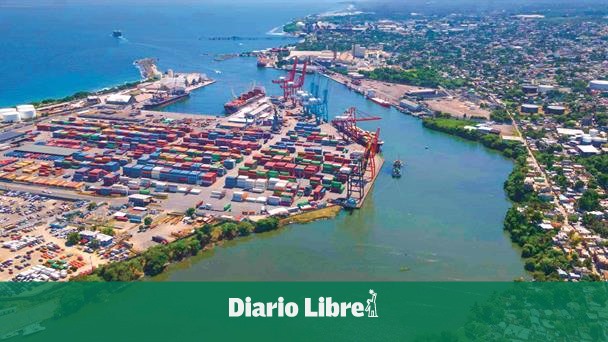
In moments in which from the Government the initiative to turn the Dominican Republic into a logistics hubthe country’s maritime exports and imports depend mainly on two terminals: that of the Haina and Caucedo Riverresponsible for moving more than half of the cargo that enters and leaves the territory.
More than 24.6 million metric tons of cargo passed through both ports last year, representing 67.6% of the merchandise that was moved through the ports. 15 springs that the country has, totaling 36.4 million metric tons together.
The dominance in the transportation of Dominican cargo by Caucedo and Haina continued during the first nine months of 2025. Through the aforementioned ports, located in Boca Chica and Saint Dominic West, respectively, transited 67.8% of the merchandise that entered or left the territory in that period.
29.5
Millions of metric tons of cargo transited through national ports as of September.
Haina It appears as the main entry, exit and transit door for cargo. 11 million metric tons passed through its two docks from January to September 2025, equivalent to 37.3% of the total for that period, which amounted to 29.5 million tons, according to statistics from the Dominican Port Authority (Apordom).
Likewise, last year that terminal was the one that greater quantity of loads moved, with 13.2 million metric tons, representing 36.3% of the total.
Apordom records locate the port of Caucedo in the second position in freight transportation in the Dominican Republic, moving nine million metric tons as of September of this year, equivalent to 30.5% of the cargo that passed through national ports in the first nine months of 2025.
Meanwhile, last year 11.4 million metric tons of cargo transited through that maritime terminal, representing 31.3% of the total for the period.
The other ports
The rest of the merchandise that was moved through the Dominican docks in 2024 are distributed between the terminals of Saint Dominic, San Pedro de Macoris, Catalina PointPuerto Plata, La Cana and Manzanillo, among others, some of those mentioned for exclusive purposes for a certain type of product.
In the case of the port La Canalocated in San Pedro de Macorisand whose purpose is the import, storage, transshipment and re-export of petroleum derivativesranked third in cargo handling last year, with 2.8 million metric tons.
This was followed Catalina Pointbuilt to supply mineral coal to the thermoelectric plant of the same name, receiving load for 1.9 million metric tons.
In addition to mastering the handling of cargo to and from the country, the Río Haina port, operated by the company Haina International Terminals, and the Caucedo port, under the responsibility of the company DP World Dominican Republic, controlled half of the flow of vessels that touched national waters during the past year.
In 2024, both terminals received 48.4% of the registered vessels, according to Apordom figures. 1,740 and 1,056 vessels were mobilized through the Haina and Caucedo river docks, respectively, last year. In general terms, the country’s ports received 5,781 ships of different classifications.