Relatives of the post -election political prisoners require the Supreme Court of Justice (TSJ) to review the cases of the post -electoral prisoners of the 2024 presidential elections. They affirm that many are sick and without adequate care in the different seclusion centers
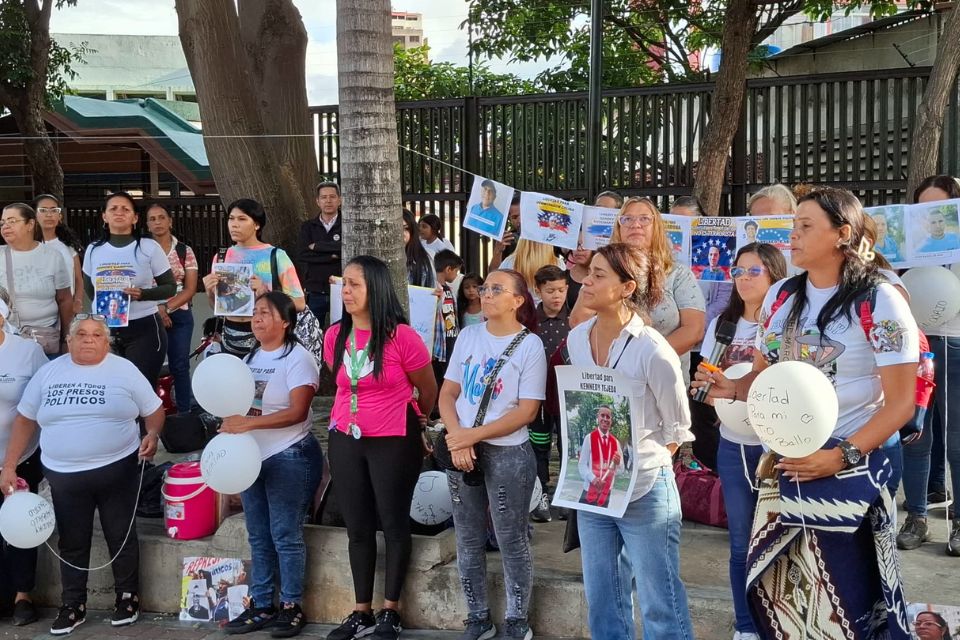
Relatives of post -election political prisoners of July 28, 2024 attended this Tuesday, August 5 to the Supreme Court of Justice (TSJ) to demand magistrate Elsa Gómez, president of the Criminal Chamber, to review the cases of citizens who remain detained. They also ask for answers about why releases are paralyzed since last March.
Members of the Mothers Committee in Defense of the Truth explained that on July 21 they met privately with the Attorney General, Tarek William Saab, and that he told them that the Public Ministry ordered the review of more than 2,000 measures and that the Judiciary has only agreed just over 1,700. However, in the TSJ they were assured that “the fault is not from here” and that many of the cases that should be in review are not. “In the ministry (public) they also lied to us,” said the mother of a detainee.
“They told us that here (TSJ) they do not have the last word because they are not in trial,” said Luisa Barrios, who said that explanation was given by Barbara Rojas, representative of the Criminal Chamber of the highest court.
The relatives who met with Rojas within the TSJ explained that many of the detainees after the presidential elections are accused of crimes that they did not commit, that many were taken from their homes, even by the so -called “collective”, which are currently sick, with depressive paintings and in a situation of carelessness by the competent authorities.
They assured that only in the Penitentiary Center of Aragua, better known as Tocorón, remains more than 300 post -election political prisoners; of which, “more than 100 are sick and they are not giving adequate care, nor in the (police) or chrysalide commands (female jail in the Teques).”
They detailed that the most common diseases suffered by detainees are: respiratory, diabetes, tension, stomach, abscesses, fungi and dengue. They affirmed that they have not received physical abuse, “but psychological, and many of them are medical because they have tried to take their lives.”
Luisa Barrios, mother of the post -election prisoner Luis González, recalls that his son was arrested on July 29, 2024 when he arrived at his home in Los Teques. “He was not protesting, they checked his bag, he was grabbed by groups and as in his bag he had a stone of Otá, which is his saint, took him.”
Barrios affirms that his 27 -year -old son “is depressed, has given him dengue, the tension is raised and is retaining liquids” and said that none of these pathologies had suffered them before being arrested. “The tension has risen three times to 160”, which would indicate that this young man would be at a level of grade 2 hypertension.
Luisa Barrios says that since last May the weekly visits and package reception were authorized. He summarizes that his life as a mother changed totally, that he had to leave the job, which currently sells meals and sweets and makes raffles to gather weekly $ 120 what he needs to be able to visit him and take his basic supplies.
“We ask everyone’s freedom because they are already a year and they are all innocent”Luisa Barrios insists, who says that in all the agencies they have attended they have been told that the last response is the TSJ.
The relatives of the detainees state to feel concern that it is close to starting the holiday period of the Supreme Court of Justice and that the cases are left unanswered in that period of time, what they say is “an unjustified extension of a huge injustice.”
This is the fourth time that relatives go to the TSJ to demand justice. They anticipate that if they do not receive satisfactory answers they will go back to Miraflores or the office of the Minister of Interior, Justice and Peace, Diosdado Cabello.
Family members compare the cases of the post -electoral detainees with the Venezuelans who were sent to the terrorism confinement center (CECOT) in El Salvador and ask the authorities why they denounce the violations of human rights in those cases, the conditions of seclusion and do not do the same with the situation of those who are imprisoned in the country.
According to the NGO Criminal Forum, in the country there are 807 political prisoners to date.
*Journalism in Venezuela is exercised in a hostile environment for the press with dozens of legal instruments arranged for the punishment of the word, especially the laws “against hatred”, “against fascism” and “against blockade.” This content was written taking into consideration the threats and limits that, consequently, have been imposed on the dissemination of information from within the country.
Post views: 445