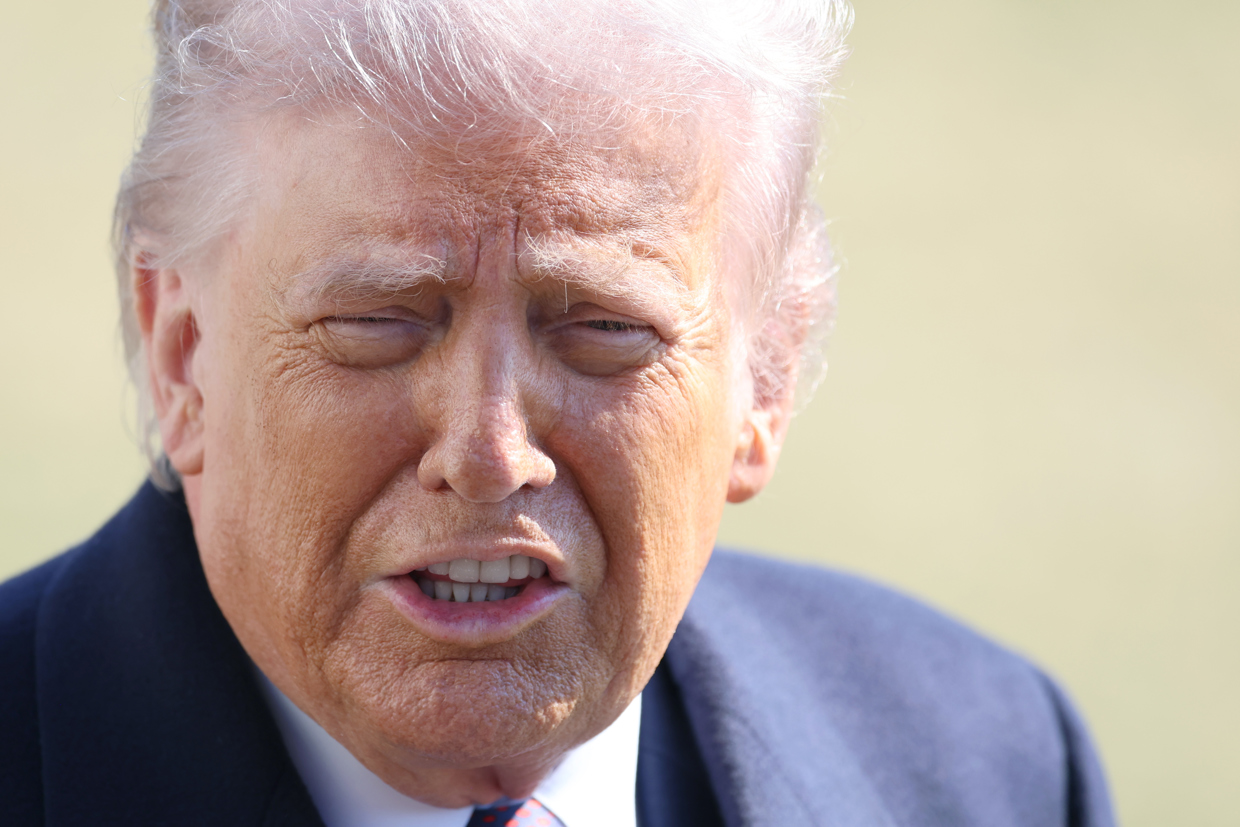
President Donald Trump surprised today with some statements that immediately shook the hemispheric political scene: when questioned by journalists at the doors of the White House, before flying to Texas, the president said that Washington could end up achieving what he himself called a “friendly takeover of Cuba.”
“The Cuban government is talking to us,” Trump said. “They don’t have money, they don’t have oil, they don’t have food. Right now it’s a nation in serious trouble, and it wants our help. We could end up having a friendly takeover of Cuba.” The president did not offer details about what exactly that formula would mean, but noted that it could be “very positive” for Cuban exiles living in the United States and that Secretary of State, Marco Rubio, is managing the matter “at the highest level.”
Pressures in crescendo
Trump’s controversial phrase, which spread in minutes to all the newsrooms in the world and which has triggered the debate between Tyrians and Trojans, is the most recent link in a chain of pressure that the Trump government has been applying on Havana since the first day of its second term, January 20, 2025.
On his first day in office, Trump signed an executive order rescinding dozens of Biden administration decisionsincluding those it had taken in its last days over Cuba. Among them, he reincorporated Cuba into the list of state sponsors of terrorismreversing the decision that Biden had taken just six days before.
With that single movement the financial sanctions associated with that designation were automatically reinstatedwhich severely restrict international banking transactions with the island.
The strategy escalated on June 30, 2025, when Trump signed a national security memorandum that prohibited financial transactions with Cuban entities linked to the military and security sector and expanded sanctions to third countries that did business with the military conglomerate GAESA, estimated at 60% of the Cuban economy.
In addition to restoring all entities that were already in the Cuba Restricted List Until the last week of the previous government – some 230 Cuban entities, including sub-entities allegedly owned by the army – a new one was added: Orbit, S.A.a company processing remittances to the island.
In July 2025, four years after the 11J protests, the United States government sanctioned President Miguel Díaz-Canel himself and other “key leaders of the regime”—the ministers of the Armed Forces and the Interior, respectively, and their families—for “serious violations of human rights.” The response from Havana was to reject this step and affirm that Washington “He does not have the ability to bend” to the Cuban people and their leaders.
After January 3
The hardest blow, however, has come through oil. Washington’s intervention in Venezuela – which culminated in the capture of Nicolás Maduro – cut off the supply of Venezuelan crude oil to Cuba, historically the most important for the island.
At the end of January 2026, Cuba I had fuel for only 15 to 20 days.. The Trump Administration began an oil blockade based on the threat of tariffs to any country that tries to supply oil to Cuba.
The result has been blackouts that last 20 hours, shortages of food and medicine, reduced work and school weeks, minimal collective transportation, among many other consequences that have made the daily lives of Cubans even more precarious, already subjected to a long multifactorial crisis for several years.
“In Cuba, the long economic crisis has been aggravated by recent US restrictions on access to fuel, which have pushed the country to the brink of collapse,” said Volker Turk at the 61st session of the Human Rights Council. “Nothing can justify the suffocation of an entire population.”
Summary: What have Trump and Rubio said about Cuba after the events of January 3 in Venezuela?
Friendly check?
It is in this context of extreme fragility for Cuba that Trump launches the idea of a “friendly takeover” —“friendly takeover”—, a formulation that is reminiscent, although in a different tone, of his references to Greenland or Canada, and that fits into his pattern of using economic pressure to force negotiations on his own terms.
The phrase Trump cannot be taken seriously as a recognized foreign policy category. It is, above all, an advertising concept: a label that sounds less threatening than “regime change” but, in practice, aims at the same thing.
To decipher what this formula could hide in the specific case of Cuba, we must read between the lines of what is already known about the ongoing negotiations, compare it with the Venezuelan precedent and consider the structural limits of Cuban power.
Regime change?
Before the Senate Foreign Relations Committee in Washington DC on January 28, Secretary of State Marco Rubio responded: “Oh, no. We would love to see a regime change there. We would like to. That doesn’t mean we are going to bring about a change, but we would certainly love to see it. There is no doubt that it would be a great benefit to the United States if Cuba were no longer governed by an autocratic regime.”
Rubio added: “The US embargo against Cuba is codified. It was codified in law and it requires a regime change so that we can lift the embargo.”
Analysts of the Quincy Institute for Responsible Statecraft point out that Trump senses that pragmatic compromise could work better than pure coercion, and that the White House could be exploring formulas that include investment in infrastructure, tourism or strategic resources in exchange for political concessions from the Havana government, including the release of political prisoners. Cuba has the third and fifth world reserves of cobalt and nickel, respectively.
“Month by month”
The Trump Administration applied in Venezuela a formula that its own advisors are already trying to replicate in Cuba: identify an influential actor within the ruling elite, offer guarantees, and use it as leverage to dismantle the existing government from within.
The profile of that figure would have to be that of someone with access to real power, but pragmatic enough to negotiate his survival.
In Venezuela, that role was played by Delcy Rodríguez, who remained in power as acting president after the arrest of Nicolás Maduro.
In Cuba, according to Axios, The Rubio administration is betting on Raúl Guillermo Rodríguez Castro, the 41-year-old grandson of Raúl Castro, known as “El Cangrejo.”
The essence of the deal that would be being discussed, according to multiple sources cited by the Miami Herald in his report on an alleged new meeting between Raúl Guillermo Rodríguez and members of Rubio’s team, during the Caricom Summit in Saint Kitts, it would be this: the United States would gradually lift sanctions — “month by month” — in exchange for Havana implementing concrete economic and political changes.
“Mature and realistic”
“Well, he status quo It is unsustainable. I had a meeting here today – Rubio explained to the press – with all the CARICOM leaders, and it was one of the points I raised, and I think practically everyone in the room agreed that Cuba’s status quo is unacceptable. Cuba needs to change. It needs to change. And it doesn’t have to change suddenly. It doesn’t have to change overnight. Everyone here is mature and realistic. “We are seeing how this process develops, for example, in Venezuela.”
The Trump administration’s emphasis, apparently and at least in the first phase, would be on opening the economy rather than demanding an immediate political transformation. Something that could be translated as expanding the private sector, dismantling GAESA’s monopoly on trade, allowing foreign direct investment without the intermediation of the State.
This is how he analyzes it the specialized portal US-Cuba Trade and Economic Council. The signal that Rubio himself has sent is: “First, change the economy. Second, invite American companies. Third, for now, the type of government doesn’t matter, just make it work like China or Vietnam.”
What exactly Trump meant by “friendly takeover” is deliberately ambiguous. But the message indicates that Washington believes that the pressure is working and that Havana, cornered, does not have many cards to play other than those available to the Administration in Washington. Whether or not this approach is wise remains to be seen.
As of the closing of this note, there is no known response from the Cuban government to these statements, although it is foreseeable that they will be rejected and a call will once again be made for national unity in the face of the foreign threat. The authorities have repeated on multiple occasions that Cuba “will never negotiate its political system under pressure or threat.”