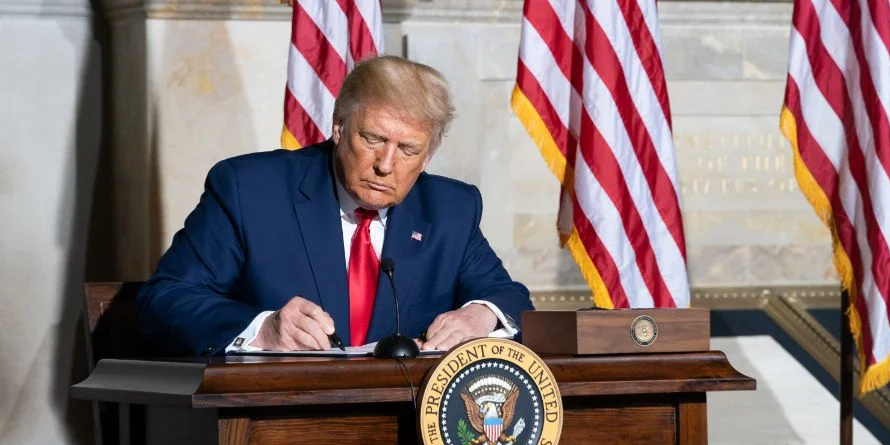
In an executive order signed this Thursday, Trump establishes a “tariff system” that would allow the imposition of an additional tax on imports from countries that “sell” or “provide” oil to Cuba.
MIAMI, United States. – The president of the United States, Donald Trump, declared this Thursday “national emergency” with respect to Cuba, considering that “the policies, practices and actions” of Havana constitute “an unusual and extraordinary threat” to the national security and foreign policy of the United States.
In the executive orderdated this Thursday, Trump maintains that Havana “aligns” and “supports” hostile countries and actors, in addition to pointing out organizations such as Hamas and Hezbollah, among others.
A published information by the White House details that Cuba hosts Russia’s largest overseas signals intelligence facility focused on stealing sensitive national security information from the United States and provides safe haven for transnational terrorist groups
In response to the emergency, the order establishes a “tariff system” that would allow the imposition of an additional tax on imports from countries that “sell” or “provide” oil to Cuba, directly or indirectly.
The document indicates that, “as of the date of entry into force,” this additional rate “may be imposed” on imported goods that are “products” of any country that supplies oil to the Island.
The mechanism defined by the order distributes functions among several agencies and leaves the final decision in the hands of the president. First, the Secretary of Commerce, in consultation with the Secretary of State and other senior officials deemed appropriate, must determine whether a foreign country, after the effective date, “sells or otherwise provides” oil to Cuba. After an affirmative determination, Commerce must inform the State. Then, the Secretary of State, in consultation with Treasury, Commerce, Homeland Security and the United States Trade Representative, must decide “if and to what extent” it is appropriate to impose the additional tariff on goods from that country and, if recommended, raise the recommendation to the president.
The order indicates that Trump will “consider” that recommendation and Commerce’s finding, “among other relevant things,” to decide “whether and to what extent” to impose the levy.
The text also empowers the Secretary of Commerce to issue rules, regulations and guidance to implement the order, and grants similar powers to the Secretary of State, in addition to allowing both to “make any other determination” or “take any other action” necessary for implementation. The order also includes a modification clause that authorizes Trump to alter the content of the decree based on “additional information,” recommendations from senior officials or “changing circumstances,” as well as in the event of retaliation from a foreign country.
Likewise, it contemplates that, if the Government of Cuba or another affected country “takes significant steps” to address the emergency and “sufficiently aligns” with the United States in matters of national security and foreign policy, the president “may modify” the order.
Regarding monitoring, the decree orders the Secretary of State to monitor the circumstances associated with the emergency and report to the president any situation that, in his opinion, may indicate the need for additional action. It also empowers him to recommend complementary measures if the provisions of the order prove ineffective.
The order defines “petroleum” as “crude oil or petroleum products,” and specifies that “indirectly” includes selling or providing oil to Cuba “through intermediaries or third countries,” with the knowledge that that oil “may be provided to Cuba,” as determined by the Secretary of Commerce.
Likewise, the document expands the concept of Cuba and includes not only the island territory, but also “any other territory or marine area”, such as the exclusive economic zone and the continental shelf, over which the Cuban Government claims sovereignty or jurisdiction, as long as it exercises partial or total “de facto control”, or derives a benefit from the economic activity carried out there in accordance with international arrangements.
It also defines “Government of Cuba” broadly, including agencies, instrumentalities, political subdivisions, and “any person” owned or controlled by, or acting on behalf of, that Government.
The decree sets its entry into force at 12:01 am (Eastern Standard Time).
The order cites as legal basis the International Emergency Economic Powers Act (IEEPA), the National Emergencies Act (NEA) and a provision of title 3 of the United States Code, and presents the creation of the tariff system as a tool to “address the national emergency” declared with respect to Cuba.
United States, Cuba, Mexico
The provision places Mexico at the center of the potential impact, given that in 2025 it became the main supplier of crude oil to the Island, with around 44% of Cuban imports, according to calculations by the consulting firm Kpler cited by Financial Times. In recent days, the Government of Claudia Sheinbaum acknowledged that at least “temporarily” it has paused oil shipments to Cuba and defended that it is a sovereign decision, not dictated by Washington.
The announcement about the national emergency and the tariff threat came the same day that Trump and Sheinbaum held a telephone conversation that both described as productive, focused on trade and security, on the eve of the review of the treaty between the United States, Mexico and Canada (T-MEC/USMCA).
Reuters reported that it was not clear whether that call discussed the tariff warning linked to oil to Cuba. According to the same cable, the trade agreement establishes that the three countries must launch a joint review before July 1, 2026 – the sixth anniversary of the pact – to confirm their intention to renew it for 16 years or introduce modifications.
In his morning conference this Thursday, Sheinbaum assured: “There is nothing concrete, but it is going very well.” Trump, for his part, praised the Mexican president on Truth Social after the call and described her as a “wonderful and very intelligent leader.”
Washington’s pressure on energy supplies to Cuba has become a sensitive issue for Mexico since at least the last week. This week it emerged that the Mexican Government was evaluating options—including the possibility of stopping or reducing shipments—due to fears of retaliation from the Trump Administration, in a context of bilateral negotiations on trade and security issues.
Shortly after, Sheinbaum avoided denying that Mexico had detained a shipment and defended that decisions are made under criteria of sovereignty.
This Thursday, the newspaper Financial Times He assured that the Island had “between 15 and 20 days” of oil available, which threatens to aggravate blackouts and fuel restrictions.