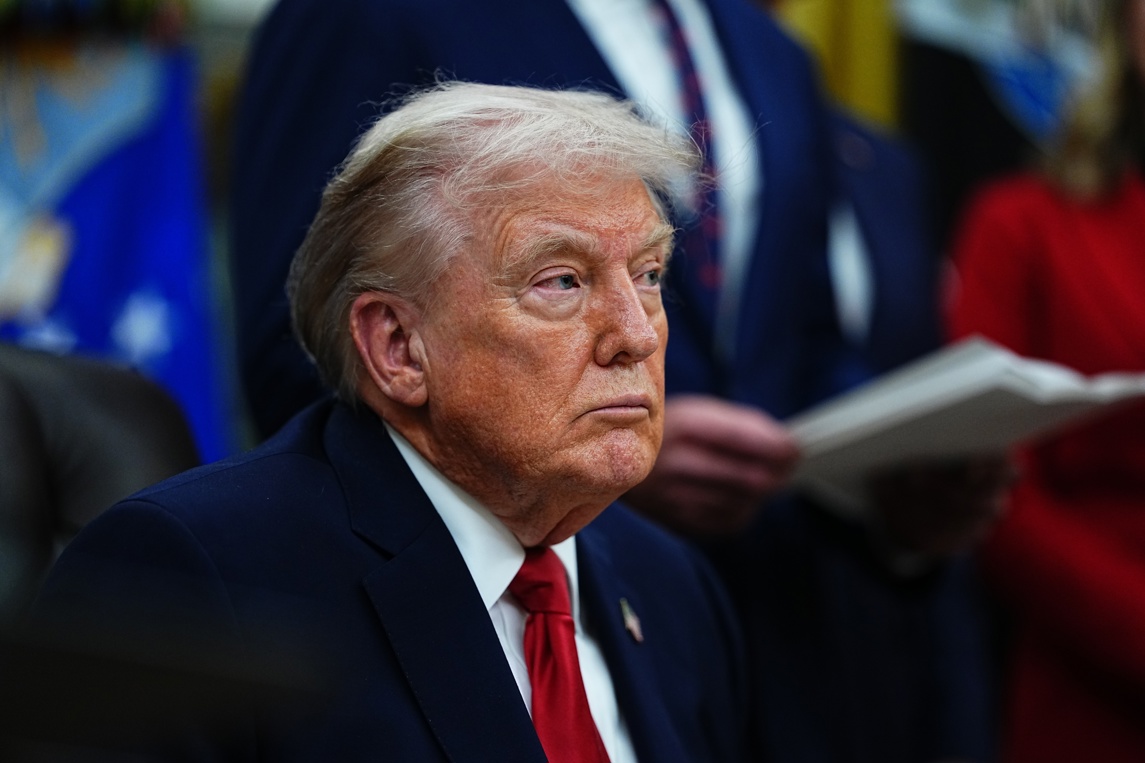
US President Donald Trump signed this Thursday an executive order that declares a “national emergency” due to the alleged threat that Cuba represents to the security of the United States, establishing a system of tariffs against any country that supplies oil to the island, in a move that could further suffocate the Cuban economy in the midst of an unprecedented energy crisis.
The executive order published by the White House considers that “the policies, practices and actions of the Government of Cuba constitute an unusual and extraordinary threat” to national security and US foreign policy, thus justifying the declaration of national emergency that comes into effect at 12:01 am on January 30.
I believe that the policies, practices and actions of the Government of Cuba directly threaten the national security and foreign policy of the United States. Such policies, practices, and actions are designed to harm the United States and support hostile countries, transnational terrorist groups, and malign actors seeking to destroy it. Likewise, such policies, practices and actions are contrary to the moral and political values of democratic and free societies, and contradict the foreign policy of the United States of promoting peaceful change in Cuba and democracy, the principle of freedom of expression and the press, the rule of law and respect for human rights around the world.
According to the document, the measure authorizes the imposition of additional tariffs ad valorem on imports of goods from countries that, directly or indirectly, sell or supply crude oil or derived products to Cuba. The system does not establish automatic fees, but instead enables a case-by-case evaluation process.
Commerce Secretary Howard Lutnick will determine whether a country sells or supplies oil to Cuba, including through intermediaries or third parties. Once that determination is made, the Secretary of State, Marco Rubio, will evaluate in consultation with other organizations whether it is appropriate to impose an additional tariff and in what magnitude. The final decision will be in the hands of President Trump.
Main accusations against Cuba
The executive order summarizes a series of accusations against Cuba that serve as the basis for this declaration of “national emergency.”
The Government of Cuba has taken extraordinary measures that harm and threaten the United States. The regime aligns itself with and supports numerous hostile countries, transnational terrorist groups, and malign actors adverse to the United States, including the Government of the Russian Federation (Russia), the People’s Republic of China (PRC), the Government of Iran, Hamas, and Hezbollah. For example, Cuba shamelessly hosts dangerous adversaries of the United States, inviting them to establish sophisticated military and intelligence capabilities in Cuba that directly threaten the national security of the United States. Cuba hosts Russia’s largest overseas signals intelligence facility, which attempts to steal sensitive U.S. national security information. Cuba continues to develop deep intelligence and defense cooperation with the PRC. Cuba welcomes transnational terrorist groups, such as Hezbollah and Hamas, creating a safe environment for these malign groups so that they can forge economic, cultural and security ties throughout the region and attempt to destabilize the Western Hemisphere, including the United States. Cuba has long provided defense, intelligence and security assistance to its adversaries in the Western Hemisphere, attempting to circumvent U.S. and international sanctions designed to ensure regional stability, defend the rule of law, and safeguard U.S. national security and foreign policy. Cuba continues to attempt to thwart United States efforts to address threats posed by hostile countries, transnational terrorist groups, and malicious actors, including in the Western Hemisphere.
Mexico in the center of the storm
The executive order places Mexico in a particularly delicate position. Just two days before the signing of the decree, President Claudia Sheinbaum He had defended the shipment of Mexican oil to Cuba as “a sovereign decision” which has been happening for many years for humanitarian reasons, referring to the historic blockade suffered by the island.
However, the threat of tariffs could have devastating consequences for Mexico, whose exports to the US market account for approximately 63% of its foreign trade. According to recent reportsMexican oil shipments to Cuba had already decreased significantly in recent months, going from about 20 thousand barrels per day in early 2025 to approximately 7 thousand barrels in recent months.
Cuba on the verge of energy collapse
The executive order comes at a critical time for the Cuban economy. After the capture of Venezuelan President Nicolás Maduro on January 3Cuba has lost its main source of oil supply. Venezuela sent approximately 30 thousand barrels of crude oil per day, representing about 30-40% of the island’s energy needs.
According to data from the consulting firm Kpler cited by Financial Times, Cuba only has oil reserves for “15 or 20 days”. So far in January, the island has only received 84,900 barrels of oil through a single Mexican delivery made on January 9, well below the average of 37,000 barrels per day it received from all its suppliers in 2025.
The energy crisis is already manifesting itself in the daily lives of Cubans with blackouts lasting more than 12 hours a day, while in many provinces they only receive between two and four hours of electricity a day.
Russia and China in the equation
The executive order also directly points out Cuba’s cooperation with Russia and China. According to the White House document, Cuba hosts “Russia’s largest signals intelligence facility abroad”which attempts to steal sensitive national security information from the United States.
However, in terms of oil supply, Russia has maintained modest shipments. According to energy researcher Jorge Piñón from the University of Texas, cited by cnnRussia sends an average similar to that of Mexico, about 7 thousand barrels per day, with one ship every quarter.
Since the summer of 2022, Cuba has experienced multiple massive blackouts, several of them leaving the island’s ten million residents without electricity for days and even weeks. Cuba’s total imports of crude oil, liquefied petroleum gas and fuels fell by 35% between January and October 2025 compared to the same period of the previous year.
Russia considers “alarming” information about a possible total blockade of Cuba by the US
The response of the Cuban government
Faced with this panorama, Cuban President Miguel Díaz-Canel has maintained a speech of resistance, blaming the US blockade for the crisis.
The Cuban population faces not only prolonged blackouts, but also a general shortage of food, medicines and medical supplies, with high inflation, high prices, a shortage of foreign currency for general imports and accumulated crises in all infrastructures and services in the country.
Cuban Government denounces threat of US naval blockade on its oil supplies
Trump’s executive order has implications that transcend the US-Cuba bilateral relationship. The document accuses Cuba of “providing defense, intelligence and security assistance to adversaries in the Western Hemisphere” and of attempting to “destabilize the region through migration and violence.”
Trump assures that Cuba “is about to fall” because it no longer receives oil from Venezuela
“The days numbered”
Trump has repeatedly stated that The Cuban government has “its days numbered” or what “hanging by a thread” since the US attack on Venezuela, considering that the end of the shipment of Venezuelan crude oil will cause a regime change in Cuba. Washington sees cutting off oil supplies as a tool to force a political transition on the island.
The measure also seeks to put pressure on other countries in the region. The tariff system is designed to prevent any attempt at oil triangulation.
Díaz-Canel says that “with coercion” there will be no understanding or negotiation with the US
Could be modified
The executive order includes modification clauses that allow Trump to adjust the measures as the situation evolves.
The document states that if Cuba or any affected country “takes significant steps to address the declared national emergency” and sufficiently aligns itself with the United States on matters of national security and foreign policy, the order could be modified.