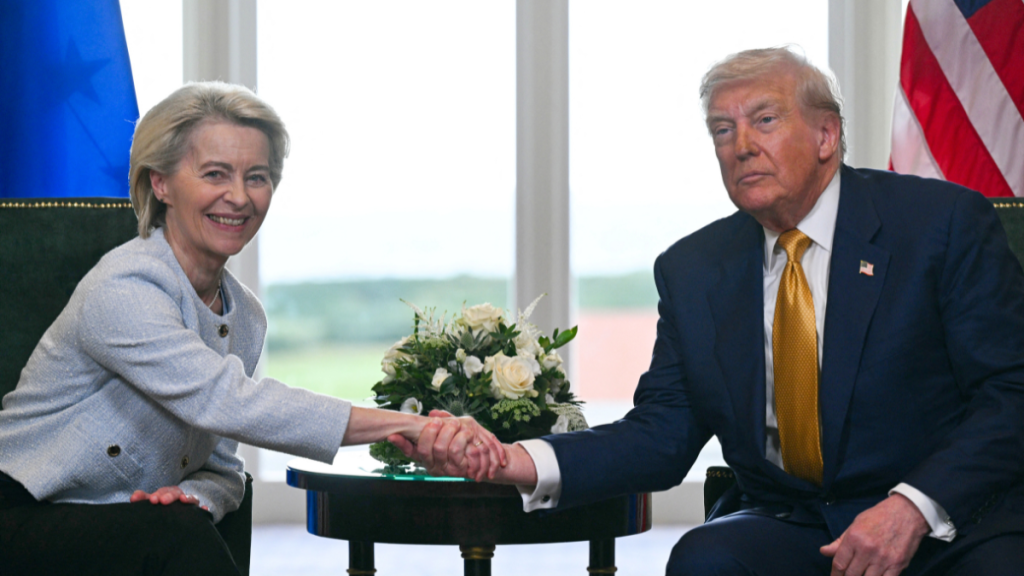
Donald Trump and the president of the European Commission, Ursula von der Leyen, announced last Sunday a commercial agreement between the United States and the European Union (EU) that prevented a tariff war between them from exploding between them. After knowing its terms it is evident that it is a deeply unequal pact, imposed by the force of the facts and threats of the US president. The EU gave almost everything; Trump got almost everything.
As of August 1, most European exports will pay a 15 % tariff when entering the US, including cars, medications, semiconductors, machinery and chemicals. In return, the EU will not impose import tariffs from the US. Worse: You must make massive American energy shopping – 750,000 million dollars in three years -, make industrial investments for 600,000 million in the US and acquire military equipment manufactured in that country. It is, in fact, a negotiated surrender.
In France, the outrage was immediate. Prime Minister François Bayrou described the agreement as “an act of submission.” The extreme right and radical left agreed to denounce what they consider a capitulation disguised as pragmatism. In Germany, where the automotive industry is key, the agreement was received with relief, but without enthusiasm. The powerful BDI business association called it “a disastrous sign.” The EU tried to present the pact as a temporary solution, but did not convince anyone.
Why did Europe accept? Because I didn’t have many options. Trump threatened to impose tariffs of up to 50%, with immediate effect. Germany, with two consecutive years of economic contraction, could not afford that blow. France is isolated. And several governments of the east European, closer to Trump, preferred to give up before climbing the conflict. The European unit was sacrificed in exchange for time and controlled damage. The result is a dangerous precedent: when EU presses with tariffs, Europe folds.
That same script is repeated with Mexico. Since February, Trump imposed a 25% tariff on all Mexican exports not covered by the T-MEC. And if an agreement is not reached before Friday, it will raise it to 30 percent. Although the products that meet the rules of the treaty are exempt, many key sectors face the risk of being out due to requirements of origin or traceability. And Trump has not hesitated to ignore the T-MEC when it suits him.
Yesterday, President Claudia Sheinbaum said she will be reached that an agreement will be reached this week, before the entry into force of the 30 percent tariff. “We continue to talk … the United States has its position, we our position, but we believe that we are going to reach an agreement,” he said. I hope you are right. But recent history suggests otherwise.
The coercion works. Trump knows it and has used it successfully. If the EU, with all its economic and political weight, beaten without obtaining almost anything in return, Mexico will hardly get out better. Our country has no room for the conflict. And Trump also knows. Therefore, except for a major surprise, Mexico will end up yielding. The only doubt is how much cost.
Facebook: Eduardo J Ruiz-Healy
Instagram: Ruizhealy
Site: Ruizhealytimes.com