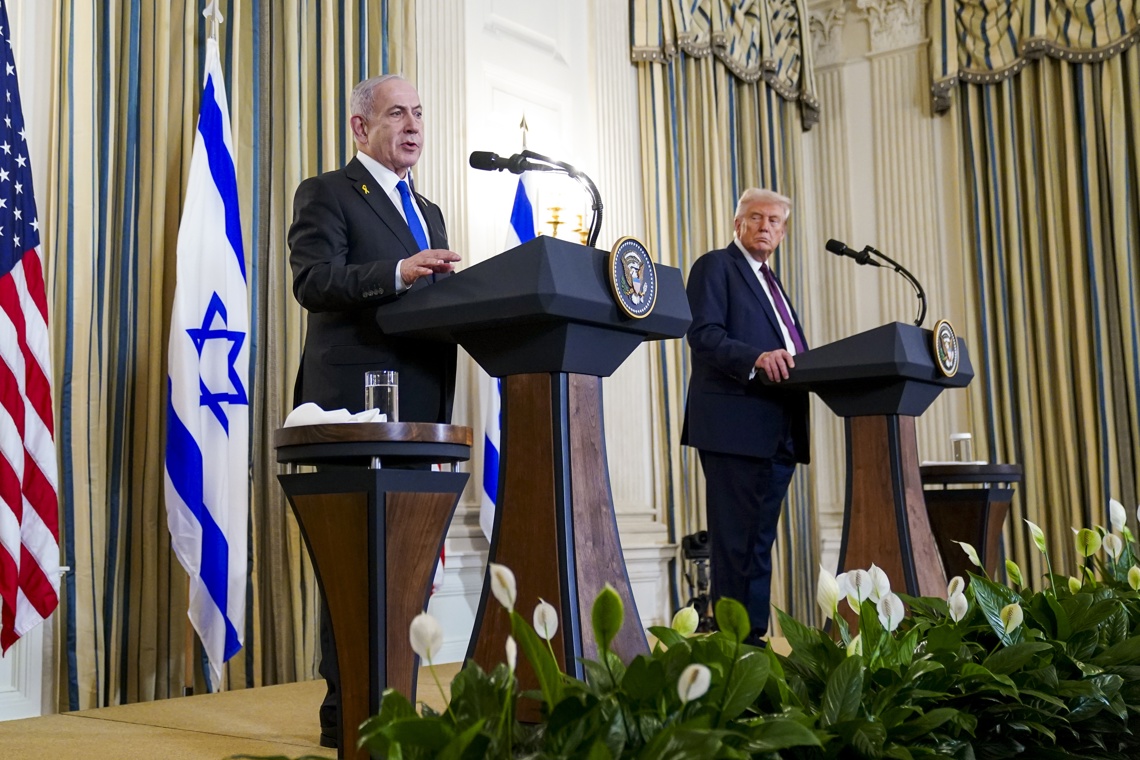
President Donald Trump and Israeli Prime Minister Benjamin Netanyahu announced on Monday an agreement for a peace plan of 20 points aimed at putting an end to the conflict in Gaza, which has as its main objective dismantling the military capacity of Hamas, freeing Israeli hostages and turning the enclave into an international protectorate.
Hamas reaction and regional mediators
The plan was delivered to Hamas by mediators of Qatar and Egypt, who met with their negotiators.
An anonymous spokesman declared that the representatives of the Islamic Resistance Movement Hamas will examine the proposal with “good faith” and will issue an answer soon. The group, which took power in Gaza after democratic elections in 2006, keeps dozens of hostages, a key point in the negotiation to guarantee any progress.
On the other hand, another active group in Gaza and with hostages, the Islamic jihad, considered the Trump plan “a recipe for aggression” against the Palestinians.
In a statement they described the agreement as a joint position between the United States and Israel that would perpetuate violence and aggression against the Palestinian people, completely rejecting the proposal and making it clear that they will continue with their resistance to the occupants.
Palestinian authority response
For its part, the Palestinian authority, an enemy of Hamas, showed a more favorable attitude. In a statement published by the Wafa agency, he expressed satisfaction with Trump’s “sincere and determined” efforts and trusted his ability to achieve peace.
They highlighted the importance of humanitarian aid, the liberation of hostages and the protection of the Palestinian population, in addition to asking to avoid the annexation of territories and the continuation of the Palestinian displacement.
Its final objective is the unification of Gaza and the West Bank under a modern, democratic and demilitarized Palestinian state, in peaceful coexistence with Israel.
Support from Islamic and Arab countries
Eight Arab and Muslim countries, including Egypt, Jordan, Saudi Arabia, Qatar, United Arab Emirates, Türkiye, Indonesia and Pakistan, supported the initiative.
In a joint statement, they greeted Trump’s role and expressed their commitment to collaborate in the implementation of the plan to ensure a lasting and effective agreement. This regional support is key to attributing legitimacy and political support.
European backups
European leaders also showed their support for the proposal. The president of the Spanish Government, Pedro Sánchez, who has been the singing voice in the old continent against Israel’s genodicio, said in the social network X that “Spain welcomes the peace proposal […]. You have to put an end to so much suffering. It is time for violence to cease, the immediate release of all hostages occurs and access to humanitarian aid for the civilian population is given.
For its part, the Italian Prime Minister, Giorgia Meloni, described the “ambitious” initiative and a possible turning point in the conflict, while the French president, Emmanuel Macron, greeted Trump’s commitment and requested a deep exchange between the parties to build a lasting peace based on the solution of the two states. Both countries expressed willingness to collaborate and coordinate efforts with the United States and regional partners.
In parallel, the British government supported the initiative: “We firmly support its efforts to end the fighting, free the hostages and guarantee the provision of urgent humanitarian assistance to the population of Gaza. This is our highest priority and must be carried out immediately,” said Prime Minister’s office, Keir Starmer, in a statement.
https://www.youtube.com/watch?v=nqwd-xkbc68
20 -point plan details
The 20 -point plan focuses mainly on “deradication” and demilitarization of Gaza, establishing a high to the immediate fire and the release of Israeli hostages within 72 hours.
It proposes a transitory technical government internationally supervised, with massive humanitarian aid and complete infrastructure reconstruction, while Hamas of power is excluded and a special economic zone is established to encourage investments. In addition, the creation of an international force is contemplated to stabilize internal security and gradual withdrawal of Israeli forces.
However, the future Palestinian state is relegated to the background, since the advances towards self -determination and the creation of an independent state would only be possible after a series of extensive reforms and under conditions established in the long term.
The plan establishes a political dialogue that seeks peaceful coexistence with Israel, but significantly postpones the effective and autonomous realization of Palestinian aspiration to a sovereign state.
Balance of Palestinian Victims this Monday
While negotiation, violence and attacks progress continue. The Israel Defense Forces (FDI) confirmed that their Air Force attacked more than 140 objectives in Gaza in the last 24 hours, including military cells, buildings and arms deposits.
According to the Palestine Wafa agency, these attacks caused at least 50 dead and 184 wounded, reflecting humanitarian gravity in the strip. Despite the political advance in the White House, reality on the field remains tragic and complex, with hundreds of thousands of Palestinians affected by war.
This Monday, the Gazatí Ministry of Health indicated that the total figures since the beginning of the Israeli offensive, unleashed after Hamas attacks on October 7, 2023, increased to 66 055 documented dead and 168 346 injured in the strip.