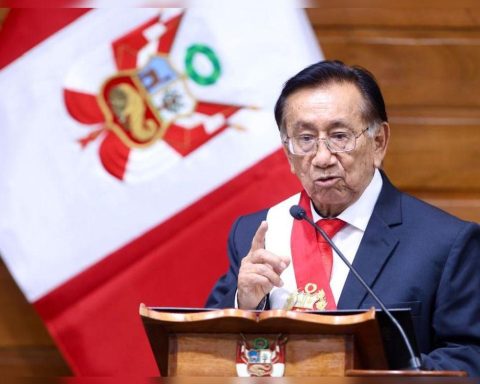
The minister of Foreign trade and tourismDesilú León Chempén, announced today that the projections of economic impact of tourism for the next holiday for Patrias Fiestas, would mobilize more than 1.8 million Peruvians nationwide and generate an economic impact of about US $ 216 million.
In addition, he explained that these figures largely exceed last year’s results, whose record was around 1.7 million trips and an economic movement of approximately US $ 200 million in all services associated with tourism.
This was indicated by Minister León, within the framework of the presentation ceremony of the Local Tourism Development Plan of the District of Mala, management instrument that will serve as a road map to boost tourism, boost the local economy, encourage productive inclusion and promote the circular economy in this part of the province of Cañete, Lima Region.
The headline of Mincetur reported that, through the Tourism Training Center (CENFOTUR), it is planned to provide waste management to more than 160 workers; And he announced that through Promperú, the participation of bad in the Gastronomic Fair Peru Mucho Gusto 2025 was managed, which will be held in Lima from October 30 to November 2.
The presentation of the PDTL of Mala was attended by the District Mayor of Mala, Julio Espichán; of the Executive Director of Profanpe, Antón Willems; and of the National Chief of Cenfotur, Graciela Seminar.
Impact study
The figures for the impact of tourism on national holidays are based on the projections of the study “Economic Impact of the Fiestas Patrias, 2025”, of the Ministry of Foreign Trade and Tourism (Mincetur), prepared based on surveys to men and women over 18 years.
The study also estimates an average expense per person of S/ 445 on trips for national holidays, which would be distributed mainly in transport, food, accommodation and leisure activities. In addition, he points out that tourists plan to stay four nights in a destination, which would contribute to boost the economy of the cities visited.
What are the most visited regions?
Similarly, it indicates that 31.4% of travelers would come from Lima, while the other regions would contribute 68.6%, which reaffirms the growing diversification and decentralization of internal tourism.
According to the study, among the most visited destinations at that time, Lima (24.1%), Ica (11.2%), Cusco (6.8%), Junín (6.4%), Arequipa (6.2%), San Martín (6.2%), Áncash (5.7%), freedom (5.4%). In addition, it is estimated that 68.2% of tourists will travel outside their residence region, reflecting a high disposition to explore new routes and experiences.
On the other hand, the study shows that trips would be mainly motivated by visits to family and friends (54.5%), search for recreation, vacations or leisure (44.4%) and other motives (1.1%).
Likewise, it is shown that tourists traveling for recreational purposes choose the destinations mainly for having a good climate (47.6%), the proximity (40.3%), the variety of tourist attractions and for having family or friends in the place (23.3%each).
It also indicates that 30.3% of Peruvians would move as a family, 29.5% would do it alone and 21.5% as a couple. In addition, he points out that most visitors would stay in family or friends houses (66%), followed by economic establishments such as hostels (12.6%), 1 or 2 star hotels (8.9%) and 3 -star hotels (7.6%).
According to the study, the interprovincial bus would be the most used means of transport (64.1%), followed by the home of the home (12.5%) and the particular mobility of a relative or friend (10.1%). It is also noted that 95.5% of travelers will organize their trip independently, while 4.5% will resort to travel agencies to acquire tourist packages.
The Mincetur continues to promote internal tourism as a key strategy to boost the economy, decentralize development and strengthen the connection of Peruvians with their culture and nature.