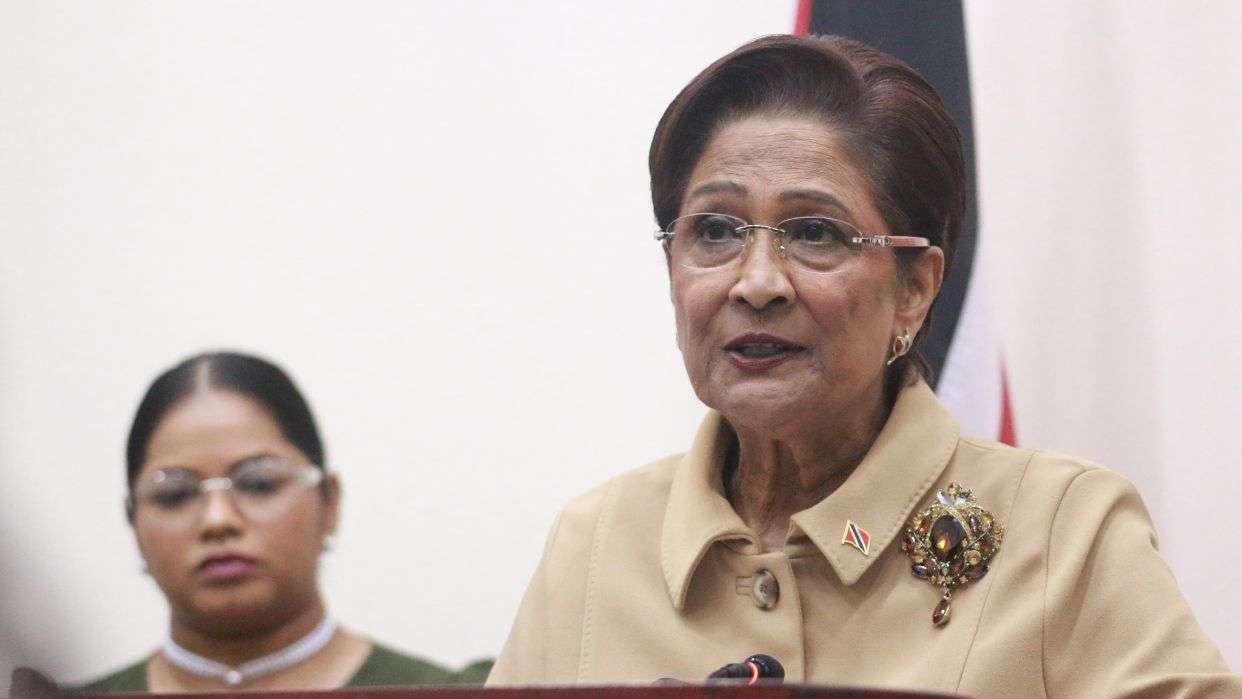
The Prime Minister of Trinidad and Tobago, Kamla Persad-Bissessar, firmly assured that her country “will not be used by the United States to launch attacks against the Venezuelan people.” However, his words contrast with the actions of his government, which has allowed the US military presence in the Caribbean and has signed agreements that compromise national sovereignty.
Persad-Bissessar responded yesterday to criticism from former Prime Minister Dr. Keith Rowley, who questioned the way his administration is managing the country’s position amid tensions between Washington and Caracas. At a press conference at his Glencoe residence, Rowley expressed concern about the apparent lack of coherence in the government’s foreign policy.
Acting Minister of Foreign Affairs and CARICOM Barry Padarath and Minister of Public Works and Infrastructure Jearlean John also spoke in defense of the Prime Minister. But the explanations offered did not dispel doubts about the true role of Trinidad and Tobago in the region.
When asked, Persad-Bissessar downplayed Rowley’s criticism: “As a citizen, you have the democratic right to express your opinions. However, the facts remain. However, the facts that she herself acknowledges seem to contradict her speech. The president recalled that Rowley signed an updated agreement last year, which requires Trinidad and Tobago to cooperate with the US military in military exercises in the region.
The arrival of the aircraft carrier USS Gerald R. Ford to the Caribbean and the landing of US Marines to train with the Trinidad and Tobago Defense Force have set off alarms. Although the prime minister insists that “the United States has never requested to use our territory to attack the Venezuelan people,” the North American military presence on Trinidadian soil raises questions about the true independence of the country’s foreign policy.
Persad-Bissessar stressed that “Trinidad and Tobago is a sovereign State and does not blindly follow the United States or any bloc like CARICOM.” However, in the same intervention he stated that his government “will not hesitate to support international partners who are committed to confronting drug trafficking and arms trafficking,” leaving the door open to cooperation that could have direct implications for Venezuela’s security.
The prime minister insists that “Trinidad and Tobago will not participate in any act that harms the Venezuelan people” and that it maintains peaceful relations with Caracas. But at the same time he supports the narrative of “free and fair elections” in Venezuela, aligning himself with the position of Washington and its allies.