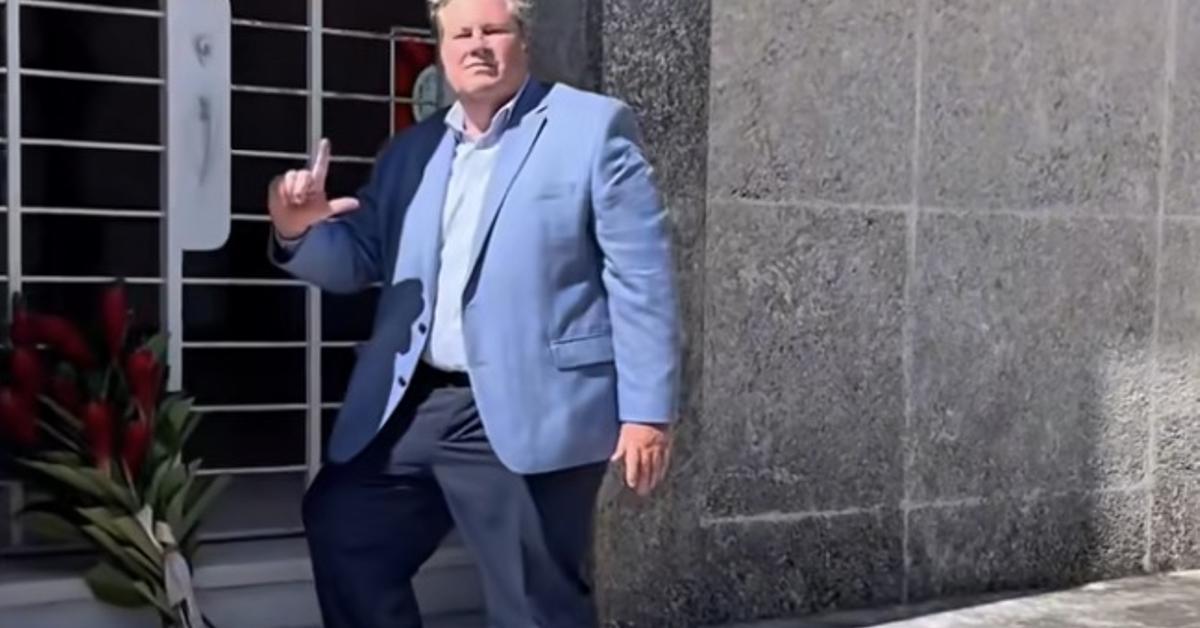
Madrid/The tomb where it is buried Oswaldo Payáin the Cemetery of Columbus, in Havana, he received on Tuesday, on the tenth anniversary of his death, the visit of the Mission Chief of the United States Embassy, Mike Hammer.
As we usually do with all its visits to people and places on the island, the diplomat was recorded and the video was disseminated through the Diplomatic headquarters. “This July 22 we remember and honor Oswaldo Payá and Harold Cepero, who sacrificed their lives for a better Cuba and in defense of human rights,” they published on Facebook accompanying the images.
Hammer, loaded with a dozen red ginger flowers, briefly explains the purpose of his visit and then deposits the bouquet before the pantheon fence, after which, in silence, he looks again at the target, in silence, while forming the l of freedom with the index and thumb fingers, a gesture widely used by the members of the Christian movement liberation (MCL) that Payá founded.
The NED delivered the medal medal at the service of democracy to the service posthumously
Outside the island, in the United States, other tributes to Payá were given Tuesday. The most prominent, the posthumous delivery of the medal at the service of democracy by the National Endowment for Democracy (NED), in an act attended by their daughter Rosa María Payá and her widow, Ofelia Acevedo.
In the video announced the event, Damon Wilsonpresident and executive director of NED, recalled, referring to Varela Projectthat Payá “led a Pacific Citizen Movement that mobilized thousands of people to ask for free elections and fundamental rights.” For that bravery, said Wilson, paid “the highest price.”
Similarly, he referred to June 2023 Report in which the Inter -American Commission on Human Rights (IACHR), belonging to the Organization of American States (OAS), sentenced that the person responsible for the deaths of Oswaldo Payá and Harold Cepero was the Cuban regime, expressing that “justice was finally done.”
This detailed text, which included the data provided by the relatives and by a direct witness of the accident in which the opponents lost their lives, on July 22, 2012, proved that the clash was caused by a state security car, which contravened the official version. The authorities concluded at the time that the driver of the car in which Payá and Cepero, the Spanish politician Ángel Carromero, of the Popular Party, was responsible for provoking the accident, and as such he was tried for involuntary homicide in a court of the island, but this, back in Spain, always said he was coerced to corroborate the hypothesis of the regime.
“Very soon this project will be voted in both chambers and it will be law that the Cuba Embassy is on Oswaldo Payá Street”
Another act in memory of Payá happened on Tuesday at the US Congress, where Republican Mario Díaz-Balart and Democrat Debbie Wasserman Schultz returned to introduce the bill to rename with the name of the opponent The street in front of the Embassy of Cuba In Washington. The legislators who support it are the Republicans María Elvira Salazar, Carlos Giménez and Nicole Malliotakis and the Democrats Frederica Wilson and Darren Soto.
Rosa María Payá, recently chosen member of the IACHR, He was hopeful in view of Martí News: “We believe that this time we will achieve it, that this project will soon be voted in both cameras and it will be law that the Cuba Embassy is on Oswaldo Payá Street.”
The activist, who heads Cuba decides, thanked the NED on behalf of her mother and her brothers the medal granted to her father, as well as another tribute that took place in the Senate, “when 13 years of that fateful Sunday, the state crime ordered by Raúl and Fidel Castro took place to try to close the path of liberation that my father pointed out, and for which he worked along with many other Cubans.”