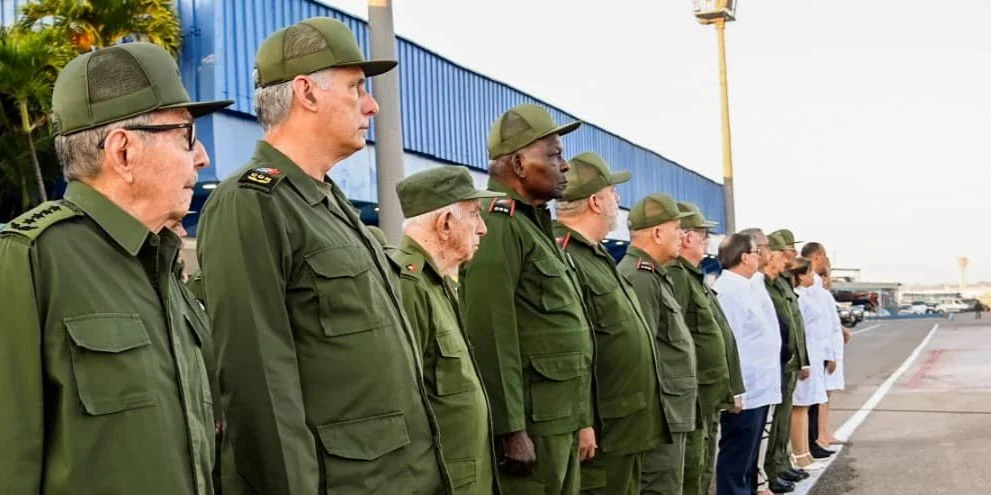
For three consecutive days—Wednesday, Thursday and Friday—students and workers in the state sector have been forced to participate in political events, marches and official rallies.
SANTIAGO DE CUBA. – Between forced tributes and threats, the island’s regime has organized a series of political events to pay tribute to the 32 Cuban citizens killed on January 3 during the US military operation “Absolute Resolution”, which ended with the capture of Nicolás Maduro and his wife, Cilia Flores.
For three consecutive days—Wednesday, Thursday and Friday—students and workers in the state sector have been forced to participate in political events, marches and official rallies to pay tribute to the deceased. Although the official discourse insists on calling them “combatants,” they are agents sent unofficially to Venezuela for years, outside of any public and transparent bilateral agreement.
They cannot be called “combatants”
At the time of their entry and stay in Venezuelan territory, these people were not recognized combatants nor were they part of an officially declared military mission. For years, the Cuban State itself denied the presence of military personnel in that country beyond medical collaboration. In 2019, Cuban diplomat Johana Tablada stated explicitly that Cuba had no troops or military security personnel deployed in Venezuela.
Only after January 3 arrive a partial and forced recognition, driven by political and media pressure. To this day, however, the exact conditions under which these agents operated, how long they had been there, or under what legal status they acted, are unknown. This absence of formal categories within international law forces us to question the official narrative that is now trying to be imposed, a posteriori.
Assistance without margin of choice
Despite these inconsistencies, the regime’s call has been massive and mandatory. In different provinces, students and workers have received explicit warnings: non-attendance can result in academic or work sanctions. Screenshots of messages sent by directors of educational and work centers have circulated on Facebook and WhatsApp groups, and have been shared by users outraged by threats of retaliation.
In Santiago de Cuba, the call begins this Friday in Plaza Antonio Maceo from 7:00 am, followed by a walk to the Santa Ifigenia cemetery, where the remains of the deceased from the territory will be buried.
“We have to walk to the square, lay flowers to the martyrs and then walk to the cemetery. They told us that if a bus appeared, they would return us to school,” he explained to CubaNet a third-year student specializing in Children’s Circle.
“There are no excuses. They threatened to not give us the ballots. Anyone who doesn’t go runs the risk of not being able to graduate,” added another young woman, a senior in the same major.
Both, ages 16 and 18, reported that on Wednesday they participated in a meeting at the provincial headquarters of the Communist Party, headed by Governor Beatriz Johnson Urrutia.
“We were there from 4:00 in the afternoon until after 8:00 at night, without eating or drinking. A colleague almost fainted from hunger; what we had for lunch was soup water,” one of them reported.


At Faculty No. 2 of Medicine, the rector’s office released a statement that left no room for ambiguity. “Comrades, we call on you to demonstrate once again the indissoluble unity of the Cuban people against the empire…” said the message sent by WhatsApp, which warned that the absent brigades would be subject to “analysis.”
This Friday the so-called “Operation Honor and Glory” takes place. The rally begins in the square and gives way to a political event around 9:00 am. Participants will have to remain standing, under the sun, for hours. The instructions were precise: students in full uniform, workers dressed in white or black, without “foreign symbols” or heavy bags.
After the ceremony, the transfer of the remains will take place until late afternoon. Although it is officially stated that attendance is voluntary, in each center the “consequences” of not participating have been made clear.
Parents who refuse
The communicator Yosmany Mayeta Labrada public on Facebook the anonymous message from a mother from Santiago who reported threats against students from the 1,200 pre-university school, in the José Martí district.
“My son came saying that tomorrow they have to be there at 6:00 in the morning for a march. Whoever is missing will be discharged,” the woman said. “My son doesn’t go, period. We’ll see if they take him out of school.”
“Whoever defends a dictator is another dictator,” he insisted. In the comments, dozens of parents expressed their support and assured that they would not allow their children to attend either, despite the threats.
Along the same lines, the exiled journalist José Luis Tan Estrada has spread similar messages sent to medical students in Camaguey and Villa Clarawhere it is warned that absent brigades will face disciplinary sanctions.

Guaranteed transportation amid the collapse
While the country faces an acute fuel crisis, sources consulted assure that public transportation has been totally or partially paralyzed to guarantee the mobility of the participants in the tributes. In Santiago de Cuba, the Provincial Transportation Company announced a “special plan” buses, with departures from at least 12 points in the municipality.
The waste contrasts with everyday scarcity. According to expertsapproximately half of the Island’s oil came from Venezuela before January 3, even though that volume had been drastically reduced in recent years. The paralysis of these supplies has deepened the daily restrictions, especially on electricity and transportation, which makes the use of scarce resources to mobilize buses in a state tribute particularly striking.
“Without wanting to sound heartless, I think that moving so many buses, spending so much fuel, when we are almost at zero, to pay homage to 32 deceased people, is a mockery,” said Dr. Roberto Serrano, from La Maya. “Meanwhile, there are people who die because there are no ambulances,” he highlighted.
Tribute to the deceased, repression of the living
In parallel with official events, there has been an increase in repression against opponents, independent journalists and citizens who have expressed critical opinions on social networks.
In Santiago de Cuba, the young Selena Lambert Ortega—known as Ojos Bellos Lambert—was cited and questioned after publishing an informal survey on Facebook that compared a hypothetical presidential race between Marco Rubio and Miguel Díaz-Canel. The publication exceeded 44,000 reactions before being deleted, the majority in favor of the United States Secretary of State. Hours later, it was also aforementioned his brother, without any connection with the publication.
Contacted by this means, Lambert simply responded: “Yes, I’m fine. Thank you for asking,” and did not respond again. Neighbors informed Mayeta Labrada that she was evicted from the home she rented in the Veguita de Galo neighborhood.
In Havana, the journalist CubaNet Camila Acosta denounced a permanent surveillance operation in front of his home to prevent him from leaving. The method, recurrent in his case, has been intensified on sensitive dates for the regime.
This Thursday, colleagues they denounced the disappearance, for more than 24 hours, of the journalist Henry Constantín, director of Cuba Time. In the morning, his apartment was found open and empty, with his telephone out of service, while a State Security agent monitored the outside.