The result obeyed, in large part, to a lower public spending to programmed, since the total income was also below what is approved, although to a lesser extent, with missing 94,672 million pesos. The net expenditure accrued in the first half of the year was 4,570 billion pesos, while what was approved by Congress at the end of last year was 4,857 billion.
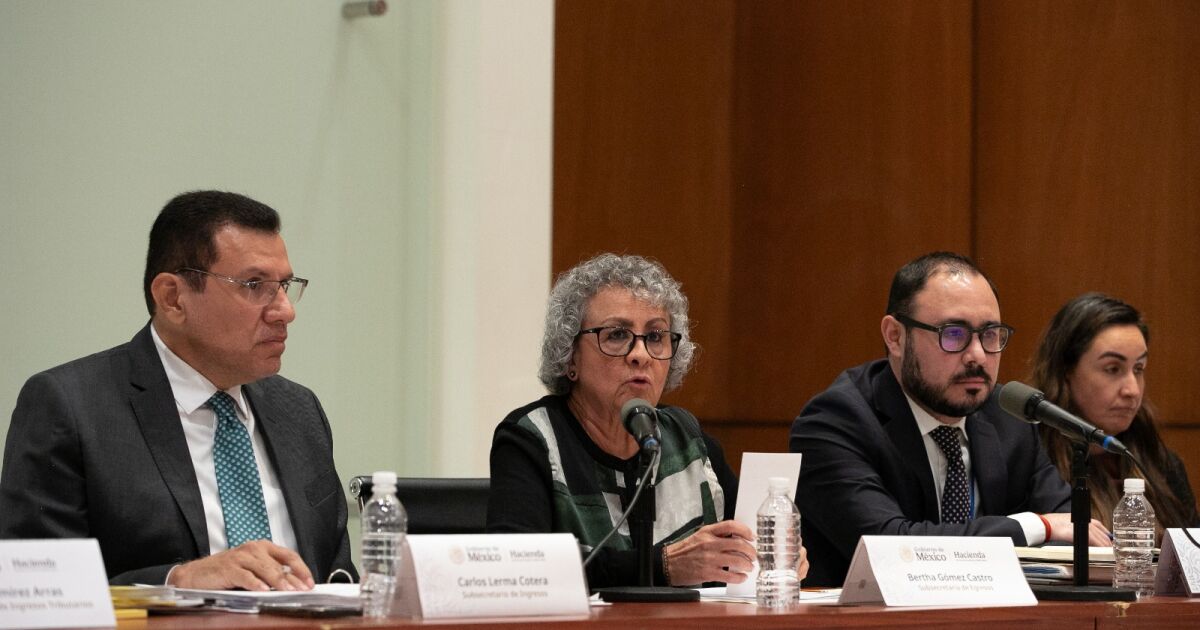
In this regard, the Undersecretary of Expenditures, Bertha Gómez Castro explained that in the Ministry of Finance they do not qualify as cuts the fact of adjusting to a certain income and a determination of deficit.
“Public finances are worked in a coordinated manner in the Secretariat, the part of the entry, the part of the discharge, the part of the debt, to determine which is the path that will be followed; in that way, by 2025, the part of the income is determined, the necessary graduate is determined to be able to meet the goals established for this year, and in that way we reach the need for a deficit,” said the public official.
The report explained that the greatest adjustment was to programmable spending, which includes budgets for autonomous branches, which report lower budgets to those approved in the 2025 economic package; Also, all federal agencies observed cuts, with the exception of governorate, foreign relations and public estate, tourism, public function and women, which reported expenses above what is scheduled for the first half of the year.
“We are not talking about cuts, but of adaptation, the determination of the expense necessary to comply with that it has been set for this year, and as you can see, in the evolution of the expense we are as it was scheduled; then, there is no claim to make absolutely some cut, but of strictly complying with the authorized, and fulfill, above all, with the established goals,” said the undersecretary of expenditure.
The draft to programmable expenditure was for 281,076 million pesos, while the unchanging, which is for the financial cost of the debt, shares for the states and debts of the previous fiscal year (ADEFAS) was lower by 20,081 million; The financial cost was the only concept that reported a greater budget to that scheduled for 32,018 million.
The Treasury stressed that at the end of June, the public debt measured by the historical balance of the Financial Requirements of the Public Sector (SHRFSP) was 49.5% of GDP, compared to 51.3% observed at the end of 2024, “reflection of a responsible management that has optimized the maturity profile and contributed to preserve the long -term fiscal stability,” he said.
According to the agency, the exchange variation allowed a saving of 297,000 million pesos in the balance of the public debt, equivalent to 0.8% of GDP. This evolution was accompanied by improvements in sovereign risk indicators, he reported.