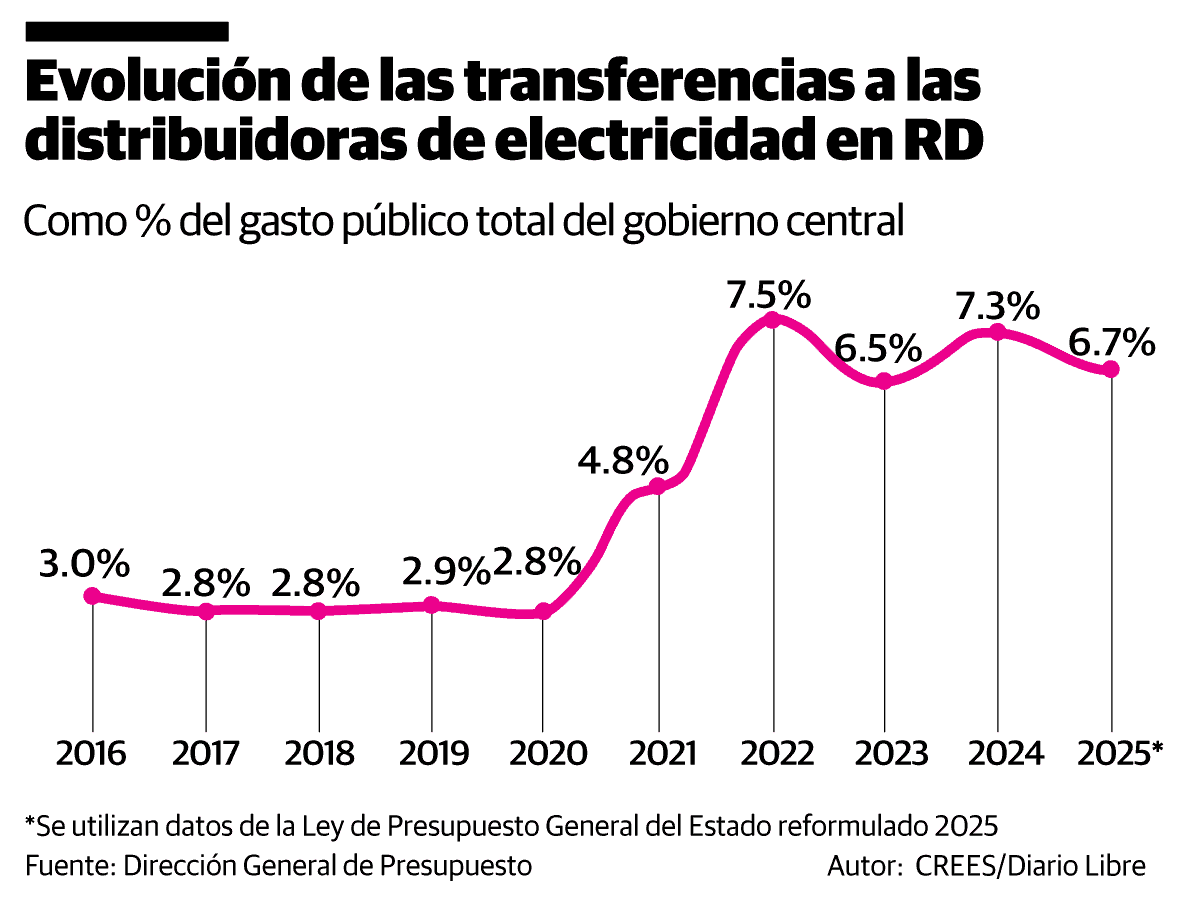
In recent years, transfers from the Central Government to electricity distribution companies (EDE) have remained one of the main components of the public spending.
According to official data, in 2024 they represented 7.3% of total spending, and by 2025 they are projected to be equivalent to 6.7%. In terms of gross domestic product, these transfers in 2025 would be equivalent to 1.3%, a proportion higher than the average of the last decade.
Despite the resources allocated, the EDE They continue to operate with high levels of losses. According to the latest available data, as of July 2025, total losses amounted to 43.3%: 39.1% corresponds to lost energy and 4.2% to unpaid energy.
This forces a considerable part of the costs of the electrical service to be financed with taxpayer money. In other words, taxpayers end up paying not only for the electricity they consume, but also for the electricity that is lost or not charged.
The problem of distribution companies is not only accounting or financial, but also incentives. When a company does not depend on its efficiency to survive, and losses are covered with foreign resourcesthe incentives to improve are weakened. It is not about a lack of technology or resources, but about responsibility for the result. In this case, it is the taxpayers who assume the costs of a inefficient managementyear after year.
Move towards management schemes where operators assume risks, respond for results and the electricity system is depoliticized. Dominican Republic It would be an important step to alleviate the burden of transfers and improve the sustainability of the electricity system.
__________
A collaboration of Regional Center of Sustainable Economic Strategies (Do you believe).