According to the Ministry of Health, the Official Mexican Standard NOM-020-SSA3-2023 – published in March 2025 – seeks to integrate the dirty to the national system to reduce maternal and neonatal mortality, as well as establish guidelines for safe and coordinated care with hospitals.
Among its positive points, according to federal authorities, is the formal recognition of the activity as part of the first level of attention and the possibility that the midwives issue birth certificates, although midwives denounce that it is not so.
Tarrio practitioners point out that the authorities in civil records do not yet accept the certificates they issue, which forces them to have the support of a doctor who certifies that they accompanied the birth; And that in cases where women have to go to hospitals due to complications in childbirth, they face the rejection of medical staff to provide attention.
Midwives interviewed by Political expansion They emphasize that there is recognition of their activity, but they question that they were not taken into account in the elaboration of the norm and their requests are not included.
Carla Castañeda, co -founder of the sexual and reproductive health center Yolocihuacalliamuzy indigenous woman, originally from Jalisco, affirms that the process of creating the norm It was “deeply arbitrary” and that many invitations to dialogue tables were only for “Fulfill the requirement” without integrating the guild’s proposals.
“We want to pigeonhole in a single regulatory box, that is violence and attentive against our human rights,” he warns.
Among the slopes, they point out the lack of differentiation between traditional, autonomous and professional guttering; the imposition of requirements and certifications without considering community realities; the absence of clear transfer and communication routes with hospitals in emergency cases; and the limitation of access to birth certificates for unregistered midwives.
Therefore, they argue that with the new NOM, discrimination towards their work is still in force and their work is judged as well as women who decide to attend them.
Hannah Borboletadirector of the Center for Comprehensive Sexual and Reproductive Health Care Violet abode, In Mexico City, he assures that the norm is “a continuity of public policies that have sought to restrict midwifery for almost 200 years,” disguised concern for women’s and newborn safety.
“It restricts the options for women, makes midwives cannot exercise with freedom from our care model,” he says in an interview.
We want laws and policies that recognize us, not to regulate us to adapt to a system that has historically violated women’s rights.
Hannah Borboleta, Director of the Center for Comprehensive Care of Sexual and Reproductive Health Violet.
Empty
On September 1, this standard that regulates public, private and social health establishments that provide maternal and neonatal care, and contemplates the creation of levhe houses and low -risk childbirth units, spaces that must have health professionals, guarantee comprehensive care and allow the accompaniment of the traditional partner of confidence of the pregnant person.
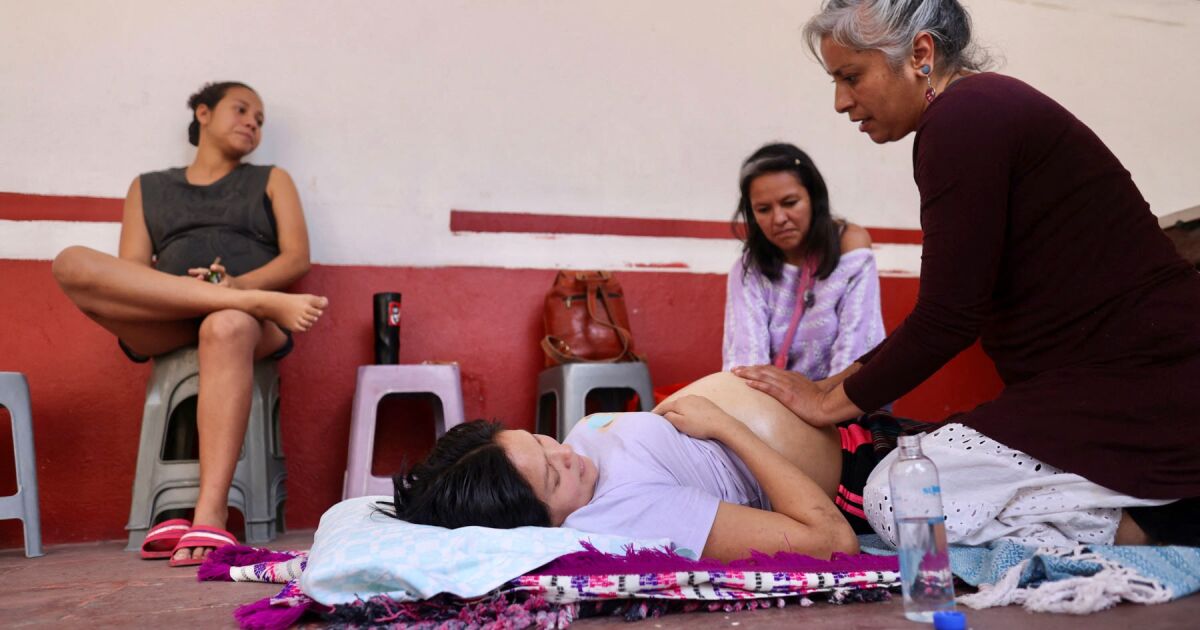
(Photo: Reuters)
However, it will start with some gaps. Mar Valdezprofessional and co -founding midwife We are tribe, Collective that offers these services in the CDMX at home, warns that the NOM prioritizes professional guts and leaves out autonomous and traditional midwives, breaking the cohesion work between the different models that had been achieved in recent years.
“If you are going to regulate theion, you have to know first what guys exist in Mexico and what your needs are,” he says.
In the country, midwifery is exercised by traditional, autonomous and professional midwives. Traditional midwives are women with knowledge transmitted from generation to generation and who serve pregnant women mainly in rural and indigenous communities.
While professional midwives have academic training in nursing and obstetrics, or in medicine, and that combine their knowledge with a humanized approach to birth. While autonomous midwives are trained women and who obtained their knowledge either in courses or through other midwives, and who offer their accompaniment and care outside the health system.
Valdez expresses his discontent because in the NOM he also does not contemplate the attention of births at home, where midwives like her, exercise their work, for what she says, they have stayed without having the support of the authorities.
“It was a surprise because childbirth at home had a boom from the pandemic and the one that was not considered for this standard because it was very surprising because it is a valid work space and a birth option that many women are looking for and that was completely set aside,” he says.
That was precisely the case of Gabriela, who for fear of a caesarean section and anesthesia led her to look for a gynecologist-partner to prioritize vaginal births. She had her first child in a hospital and years later, with that same midwife, the support of a neonatologist and a doula – professional who accompanied her during pregnancy and childbirth, giving her emotional containment – could realize her second childbirth at home, without there were greater complications.
She points out that this experience kept her away from unnecessary caesarean sections and obstetric violence. According to INEGI, between 2016 and 2021, 7.8 million women between 15 and 49 who had a birth or caesarean section in public or private hospitals reported having lived some kind of violence.
Among the benefits of prying, the rapid physical recovery is raised after childbirth, because invasive procedures are not used that can alter their physical and mental health, and the most economical, satisfactory and safe alternative for women and their families, with humanized and respected models at the first levels of attention and within reach of the most vulnerable populations.