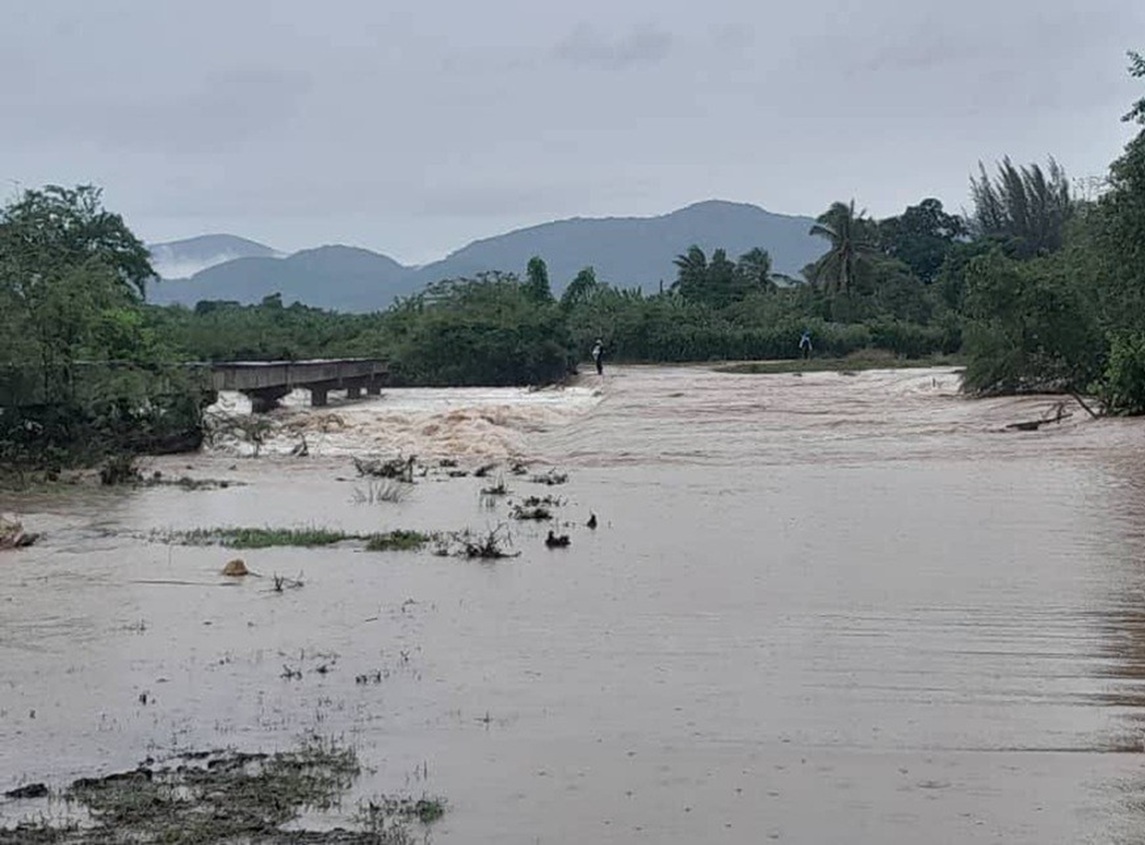
Thousands of evacuated, floods, landslides, grown rivers and incommunicado areas have been the preliminary balance due to heavy rains still persist in the eastern part of Cuba after the passage of a tropical depression baptized this Sunday as an Imelda storm.
The tropical storm had won in organization and intensity this morning, increasing its maximum sustained winds up to 75 kilometers per hour while the pressure had decreased up to 996 Pascal hect, according to the forecast center of the Cuban Institute of Meteorology (INSMET).
The intensity of the rains has caused landslides, rivers outside its channels, fallen trees and effects on electric service.
Given the situation, the local authorities suspended classes at all levels of teaching in Santiago and Guantanamo. In addition, they insisted on avoiding recklessness such as the crossing of flooded urban and rural areas and maintaining the preventive measures recommended by the civil defense.
17 incommunicado communities in Santiago
The most significant accumulated had been reported in Guantanamo and Santiago de Cuba, as well as in some towns in Las Tunas, “although the rest of the provinces also maintains close surveillance, with organizational measures,” said a report of the newspaper of the newspaper Granma.
In Santiago de Cuba alone, 17 communities in which more than 24,000 people reside were incommunicado by floods and landslides after the Charco Mono reservoir began its dump after five months without operating. The eastern city received 250 millimeters of rain for 24 hours, according to the Official Gazette.
In addition, 22 electrical circuits ended up affected by the falls of posts, rock impacts and landslides, misfortune that adds to the already serious electro -energetic situation of the country.
Evacuated Guantanamo
In Guantanamo, 18,000 people evacuated were reported, mainly in family and friends houses, and the town of Paraguay is incommunicado due to the runoff runoff from the mountainous areas, according to a state television report.
In the Hatibonico town, of that province, more than 500 millimeters of rains had fallen in the last 48 hours. Other reports reported accumulated above 300 mm in Santiago areas, where several communities of Baconao are incommunicated and there have been at least partial housing landslides.
Specialists from the Hydraulic Use Company of Santiago de Cuba, have referred that the numerous rains of these days have caused an increase of 8.2 million cubic meters in the total volume of water stored in the 16 reservoirs of the province, which is impacted by a severe drought.
It will continue to generate instability
The storm, which already claimed the life of a person in Santiago, will continue to generate instability over our area, which together with the high values of relative humidity, the local scale factors, the orography and the heating of the day will favor the occurrence of showers, rains and thunderstorms in the central and eastern regions of the country.
“These rains can become strong in some locations, mainly in mountainous areas,” according to Insmet.
Cuban meteorologists have warned that the current cyclone season in the Atlantic Ocean, the Gulf of Mexico and the Caribbean Sea 2025, in force from June 1 to November 30 will be “very active”, with the possible formation of eight hurricanes, he remembered EFE.
Landslides, closure of teaching activities and reservoirs favored by heavy rains in east of Cuba
In addition, they have pointed out that the chances of originating and intensifying at least one hurricane in the Caribbean is high (75 %), while it is 50 % for one of Atlantic origin to penetrate the Caribbean Sea and affect the island.
In the 2024 cyclonic season, two hurricanes hit the island strongly, one of them -óscar-, touched land with category 1 by the Guantanamo province. Its winds were up to 130 km/h. Then he degraded tropical storm and left eight deaths, damage to 12,000 homes, floods that isolated communities, losses in agriculture and other ravages.
The other was Rafael, category 3, who punished the Cuban west, mostly to the Artemisa province -with sustained winds of 185 km/h -although also affected the neighbors Havana and Mayabeque- and caused the total collapse of the national electrical system, which affected 10 million people.