Thousands of passengers have been affected as a result of the suspension of international airline flights to Venezuela, following the security warning from the United States Federal Aviation Administration on November 21 regarding Venezuelan airspace, an action that is part of the air-naval siege against the country.
From Spain, five airlines have canceled (Iberia, Air Europa, Plus Ultra, Laser and Estelar), which represents approximately 6,000 passengers per week; from Panama there are 2,200 passengers and in Colombia there are 1,500 passengers a week, “also considering that we are entering one of the highest seasons for our industry due to Christmas and New Year,” according to figures from the regional vice president of the International Air Transport Association (Iata), Peter Cerdá, when consulted by the EFE news agency.
The largest number of those affected are stranded at airports in Spain as a result of the decision of the Spanish State Aviation Safety Agency to comply with the alert from the gringo organization.
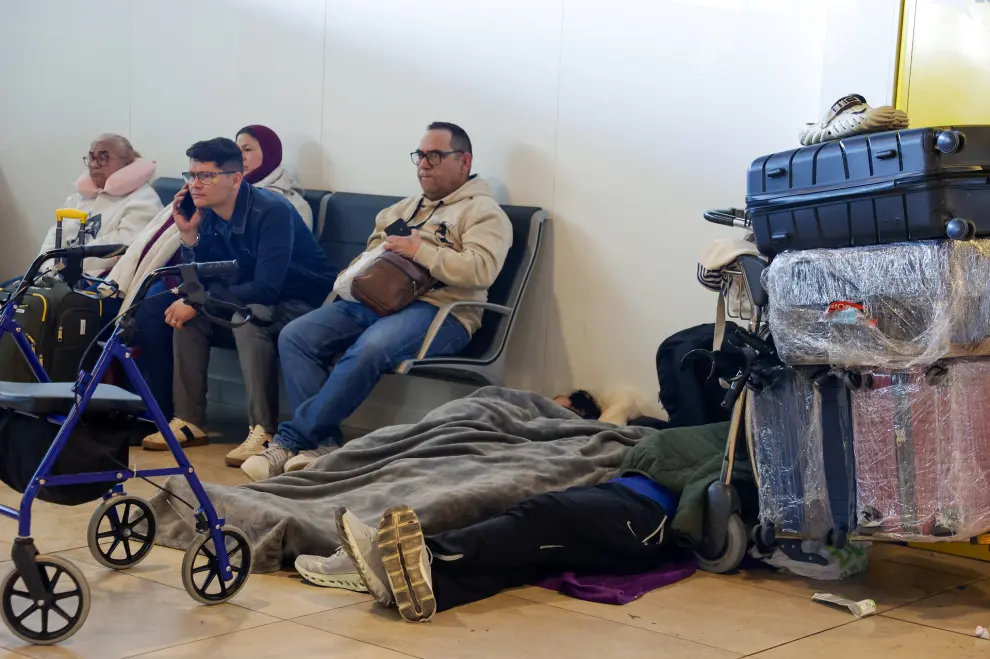
sleeping at the airport
One of those affected, 71 years old, was trying to return from Portugal, after visiting his family. Now, unable to return, he wanders with his suitcase at the Madrid airport looking for a place to rest. “I just wanted to go back to my house. I didn’t think I would end up sleeping in an airport,” he commented, while revealing that he cannot return to Portugal nor does he have the money to pay for accommodation.
Other passengers have been sleeping at the airport for up to five nights and some even rest on the luggage carts. “Hours go by and no one gives us a solution,” protested a woman.
Those stranded at the airport are helping each other. Those who have a little more resources have bought food to share with others, even if it is a sandwich, because they have already been there all day waiting for a response.
Many have lost connections, jobs, medical appointments or family commitments. Others fear that the situation will continue indefinitely. Among those who have been stranded in Madrid, at a brother’s house, is Clementina Urosa, 75, who was visiting her family in Spain and was blocked with no return date. “They say that they are going to open the flights on December 31, but I don’t see myself jumping there that day and then going to Bogotá; one does not have the money to pay for the ticket to Venezuela. One’s pocket is hitting one (…) I am in suspense,” he said.
What was going to be a month-long vacation to Spain for Coromoto and her sister turned into an ordeal when flights to Venezuela were canceled, leaving dozens of travelers stranded with no official response.
While some take refuge in friends’ houses, other compatriots have not had the same luck and have been sleeping for days at the Adolfo Suárez Madrid–Barajas Airport, in precarious conditions and without clear information about when they will be able to return to Venezuela. The situation affects dozens of people, including children and older adults.

Suspensions and alternatives
Those affected by flight cancellations only have the option of Colombia to return to the country, through another flight to Cúcuta, border with Venezuela, which they must pay with their own funds. Given the suspension of the Cup, Panama is no longer an option. The Colombian state-owned Satena also canceled its flights.
Avianca, Latam Colombia, Caribbean Airlines (Trinidad and Tobago) and Brazil’s Gol also stopped flying to Venezuela at the end of this month, when the FAA issued a Notam. Currently, only routes with Colombia remain served through the Venezuelan airlines Laser, Avior and Turpial.
Turkish Airlines also suspended its operations, leaving Europe and Venezuela virtually without connectivity. Turkish offers Venezuelans the option of Bogotá, but those who accept it must also pay an additional ticket.
Cyber attack reported
Although Copa and Wingo airlines reported intermittency in navigation signals and therefore suspended their flights, the Minister of Transportation, Ramón Velásquez Araguayán, was cautious when stating that “our pilots in their flight phase have not reported any interference in the navigation systems, but foreign airlines have.” For her part, the Minister of Transportation of Colombia, María Rojas, called these interferences cyberattacks and accused the United States. “Deceptive signals are being issued, cyber attacks, signals that aim to deceive positioning equipment, GPS. I believe that this exceeds any limit.”
35 new routes
In this situation, Venezuelan airlines have committed to guaranteeing the service, as indicated by the Minister of Transportation, Velásquez Araguayán, since they will take on 35 new international routes.
He explained that this is due to the refusal of foreign airlines to fly to our country, many of them alleging disturbance of the GPS navigation system. “We have a great opportunity for the national and international market to now take on our airlines.”
Return plan orders Maduro
Vice President Delcy Rodríguez, in a message on Telegram, reported that President Nicolás Maduro ordered a “special plan” for the return of Venezuelans stranded in other countries due to the suspension of flights by several foreign airlines, “as well as facilitating the exit itineraries of those who must travel outside our territory.”
The vice president added that Venezuela has activated all multilateral mechanisms in accordance with international law for “the immediate cessation of this illegitimate and illicit action.”
The contingency plan was articulated, mainly, through the airline Conviasa and in coordination with the Venezuelan embassies abroad.