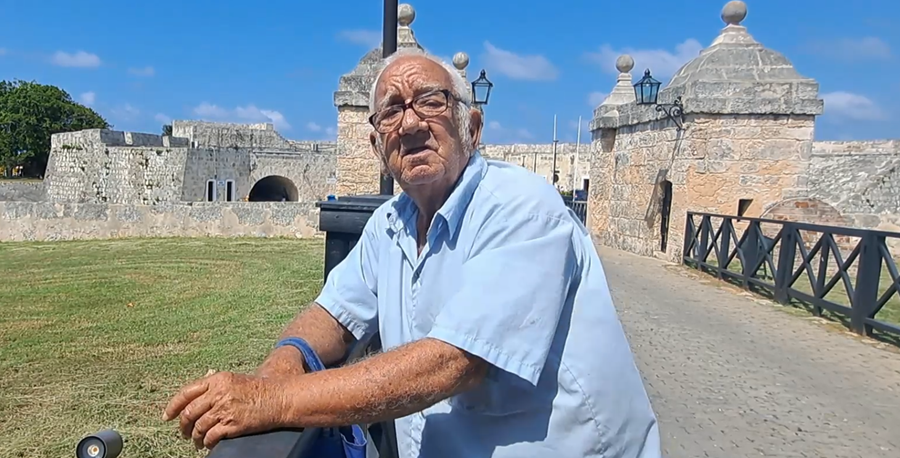
Vicente Hernández Brito, who was a soldier in the strength of the cabin during the first years of Castroism and today lives in misery, reveals how the shootings were executed “in the name of the revolution.”
Madrid, Spain.- For decades, Vicente Hernández Brito was part of the repressive gear that marked the first years of Castroism. He was one of the men in charge of fulfilling the death sentences in the fortress of San Carlos de la Cabaña. Today, aged, sick and mired in misery, he observes bitterly how the ideals he swore defended were diluted in a reality of abandonment and hunger. His testimony, collected by Cubanet, It reveals not only the horrors of the “revolutionary” repression, but also the destiny of those who were instruments of it.
In his story, Hernández Brito reconstructs the stages of fear from the cabin: “First bridge with the cage, when we brought the prisoners to take them to the chapel, to take them to execute. There the order was heard: ‘Executor official, comply with the judgment of the revolutionary court. In the name of the homeland and the people, proceed.’ Thus the prisoners were shot. ”

Vicente Hernández Brito also details how the wall logistics worked: “In the second bridge, there was a stick in a corner, with sand bags People shouted ‘Killer!’ When they saw that they took someone to the wall, almost always at dawn. ”

“This place was full of prisoners. Now this is for tourists, but this was bad times since you entered. It was a terrible place. Nothing good entered here. Do you know how much they threw someone for having a legal belonging in foreign exchange? Three years. To another, for having two or three dollars in the pocket, six years for currency traffic.” recalls.
In the chapel, before the wall, the ritual of the end began: “They took their belt to the prisoners and the cords so that they would not hang them. From there they went down a ladder where they were shot, down there.” He also mentions another place inside the cabin, which they called “El Saladito.” “It was a punishment cell under the water tank, where you dropped a drop in your head for hours. Twelve hours there they drove you crazy, but you couldn’t move or remove the drop. Hence the name. People went crazy.”

The story continues in the Prince’s castle, another emblem of the Cuban prison system: “The public climbed on the visits. On the right was the reception. Then one folded to the left and entered the prison. There was what they called the star. On the right was the company 2, where the yellow prisoners were or the so -called ‘planted’, political prisoners.

It was there that he witnessed the agony of one of Cuba’s most recognized political prisoners: “That’s where Pedro Luis Boitel died. I was with a checkpoint that morning and went up to coffee to the nursing post. And they tell me: ‘That one who is there is dying.’ I asked: ‘Pedro Luis?’ They told me: ‘Yes, it’s Pedro Luis.’ My brother told me a lot about him. When he died, I asked the lieutenant for permission to close his eyes. And it was there when all the prisoners began to sing the national anthem. They are locked to all. No one could move. No one could leave. ”
Decades later, he learned that in honor of Boitel a International Human Rights Award: “I was very excited. I didn’t know that this recognition existed. He proud.
His testimony also touches his stage as a “internationalist worker”: “To be an internationalist worker you have to pass military training before going to a civil mission. Here they say no, that doctors who go to Venezuela are not military, but to be able to go to work in Angola, for example, I had to train as a soldier.”
The story ends in the present, where the “combatant” faces an old age that has nothing to do with the one who expected: “My colleagues and people come and eat from the garbage dumps. This has given a radical change, which is not for what we fight. Where would I be.