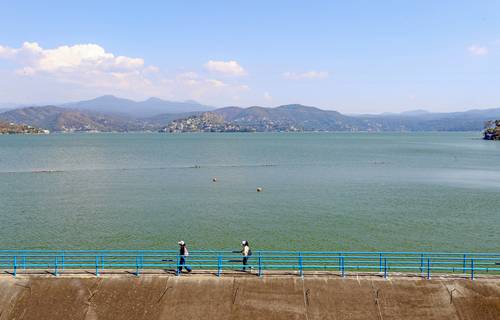
▲ Important pieces will be renewed, which were ordered to be made in Asia, reported Citlalli Peraza, director of the Water Basin Organization of the Valley of Mexico. The image, in the Los Berros water treatment plant.Photo Luis Castillo
Jared Laureles
Sent
La Jornada Newspaper
Tuesday, February 10, 2026, p. 13
San José Villa de Allende, Méx., With more than four decades of uninterrupted operation, for the first time in its history the Cutzamala System entered the modernization phase, with an investment of more than 680 million pesos, reported Citlalli Peraza Camacho, director of the Water Basin Organization of the Valley of Mexico (Ocavm).
The objective, he said, is to guarantee its useful life for at least 20 more years and provide drinking water to 5 million inhabitants of the Valley of Mexico. He assured that the supply of the liquid is guaranteed for the next two years.
In a tour of the Los Berros water treatment plant, he highlighted that this hydraulic complex – the core of the Cutzamala system – is the largest in Latin America, with the capacity to pump the liquid through its 225 kilometers of pipeline and take it 1,100 meters high to the Valley of Mexico.
Hence, electricity consumption is one of the highest in the country, representing an average annual expense of 3 billion pesos, he indicated.
Through a diagnosis, the National Water Commission (Conagua) detected that in the 35 pumping equipment there were “important parts with considerable wear” that require replacement, mainly 10 spherical valves, which were sent to be manufactured on the Asian continent, and 259 million pesos will be allocated for this.
Another 188 million pesos will be channeled to renew seven rotors, in addition to four pumping equipment of 1,700 liters per second.
“The Cutzamala System has been in operation for more than 40 years; it consists of the largest pumping equipment in the world and normally has a useful life of 15 to 20 years… no piece of these dimensions had been replaced, they are even exclusive and have not been made anywhere else,” he stressed.
In interview with The Day, Peraza stressed that even though they were working, early diagnosis serves “to avoid any strikes in the future,” because the production of these spherical valves requires 24 months.
The project, which is in its first phase and started in 2025, will also allow the renovation of other key areas, such as the Supervisory Control Center, which is the “brain of the Cutzamala System”, whose equipment is obsolete, dating back to 2000; The purpose is to “migrate” to the SCADA (supervision, control and data acquisition) automation system.
The purpose of this system, which will cost 157 million pesos, is to reinforce the “operational reliability” of the Cutzamala, and it is expected to be ready in 2026.
The official explained that the water collected from the Valle de Bravo, El Bosque and Villa Victoria dams travels 125 kilometers to the Los Berros plant, where it goes through a purification process that includes flocculation, sedimentation, filtration and disinfection with chlorine.
Subsequently, it is pumped to the oscillation tower, from where it descends by gravity another 95 kilometers and reaches Mexico City and the state of Mexico, to whose authorities the resource is delivered in block with quality suitable for human consumption, in accordance with standard 127, he pointed out.