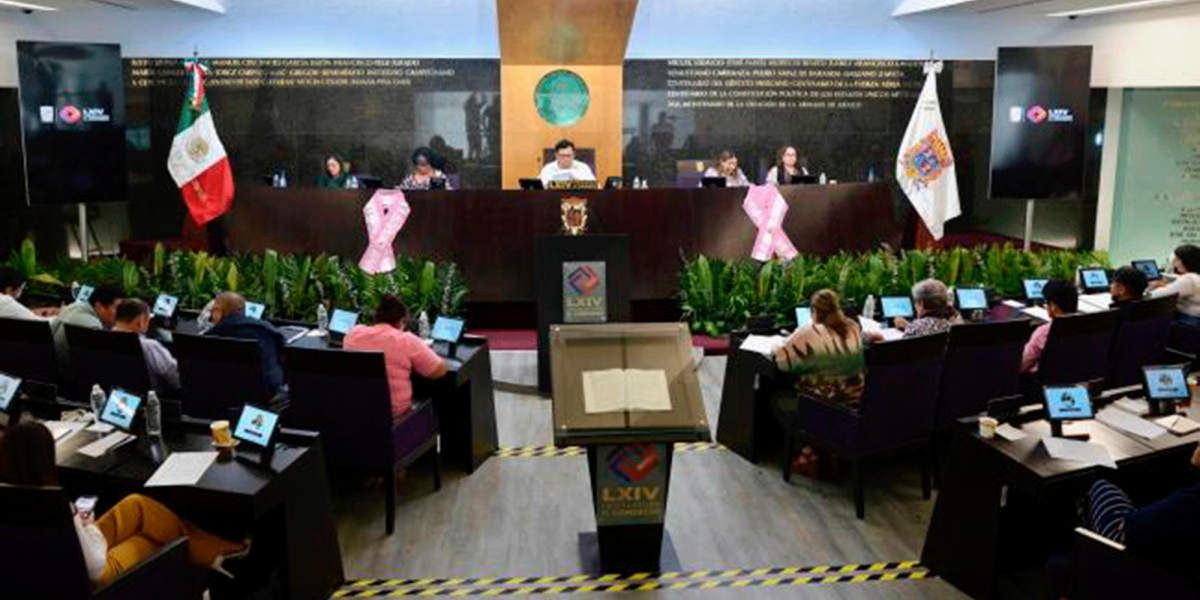
Opposition deputies in the Campeche Congress They seek to promote an unconstitutionality action, to put back the reform to the State expropriation law, approved last week, according to which, the amount of compensation will be calculated based on the value of the last transaction of the expropriated good; Those affected only have five days to present resources against the declaration of public utility; does not admit administrative resources; and allows the government to occupation and the beginning of works immediately.
Although during the days after the presentation of the initiative both deputies of the official bloc and opposition suggested that this reform would have as a dedication the national leader of the PRI, the Campeche, Alejandro Moreno Cárdenasbecause the state government could expropriate some assets, legislators point out that, rather, the governor, Layda Elena Sansores San Románintends to have all the legal instruments necessary to make expropriations that require and have no impediment for the execution of public works.
For example, with that newly renovated law You can do the expropriations you need for the construction of the Economic Development Pole for well -being Seybaplaya, Campeche, which is a strategic work of the federal government and that aims to be built on an area of just over 99 hectares.
The project must be communicated with the federal highway Mex-180, the ports or Seybaplaya and Campeche, as well as with the Campeche International Airport and the Mayan Train.
According to the federal government, the properties that make up the project area They are state public property.
According to him Coordinator of the Legislative Fraction of the Citizen Movement in the Local Congress, Pedro Armentía Lópezit could also be used for the expropriation of land affected by the passage of the Mayakan gas pipeline, which will have 372 kilometers in Campeche territory.
Ejidatarios de Santa Cruz, Hemelchacán have demonstrated against the project for the compensation that the company Mayakan intends to pay them for affecting their plots.
In addition, in works of the Kox public transport system in the city of Campeche or the light harrow that goes from the center of the capital to the station of the SAN FRANCISCO DE CAMPECHE train.
The orange party legislator said that party seeks the support of PAN and PRI deputies to promote an unconstitutionality action against reform.
In order to file this resource, the support of at least a third of the deputies of that representation is required, that is 12.
MC has 10; PRI Tres and Pan Dos. Morena has 16; Pt two and the PVEM Dos.
Legislators of these three games have already started conversations in this regard.
It was approved and promulgated in nine days
On Wednesday, August 27, 2025, Governor Layda Elena Sansores San Román, presented to the State Congress the initiative to reform articles 1, 7, 8, 9, 13, 18, 20, 22, 29, 38, 43, 44, and 50 and add articles 1 bis, 1 ter and 44 bis, of the law of expropriation and other limitations to the right of ownership of that entity, with which it establishes the causes of public utility. such as the procedures, modalities and execution, of the expropriations, temporary occupations, administrative servants and domain limitations of existing private goods within the territory of that entity
The initiative was approved during an extraordinary session of the Local Congress on Thursday, September 4 and published in the Official Gazette of the State on Friday, September 5.
The law already renovated indicates that the declaration of public utility will be published in the Official Gazette of the State and will be personally notified to the holders of the assets and rights that would be affected.
In case of ignoring who the holders are, or their domicile or location, a second publication of the declaration in the official newspaper of the State, which must be carried out within the five business days following the first publication, will have personal notification effects.
Those interested will have a period of five business days from the notification or the second publication in the Official State Newspaper to express before the Secretariat of Government what suits their right, and present the evidence they estimate relevant.
In its case, the authority will quote an audience for the relief of evidence, which must be verified within eight business days following the reception of the demonstrations.
Submitted the allegations or after the deadline without being presented, the authority will have a period of ten business days to confirm, modify or revoke the declaration of public utility.
Only admits amparo appeal
The resolution will not admit any administrative appeal and may only be challenged through the amparo trial. The latter was practically the only thing that the opposition achieved during the discussion of the initiative in the Plenary of Congress.
In this regard, the PRI local deputy, Jorge Salim Abraham Quijano, He considered that the reform violates fundamental rights and places the Campeches in a field of legal uncertainty.
Specifically he remarked that he cuts the defense deadlines of 15 to five days so that the affected people can present evidence and allegations.
In his opinion, that means limiting the Hearing right and due process that the Constitution and international treaties force to guarantee.
“You can’t talk about justice when citizens are given less time to defend their assets, which takes the State to answer a trade,” he said.
It also caught the attention in which the reform establishes that the procedure is unappealable by administrative route, leaving as the only way the amparo.
In that tenor he said that in the respective law of Yucatán and Quintana Roo They offer administrative departures which also allows federal courts not to be saturated. “Here the opposite path is chosen: close the doors to the dialogue and the immediate resources.”
Compensation will be calculated with the last purchase-sale value
Article 18 says that the expropriation and notified the interested party, the Government Secretariat, In the case of movable property, or that of urban development, mobility and public works, in the case of real estate, it will proceed to the immediate occupation of the expropriated good and the execution of the projected works.
The 22 says that, prior declaration of public utility, the holder of the State Executive Power may decree the temporary, total or partial occupation of real -owned real estate, for the causes of public utility referred to in article 4 of this law, and by paying the corresponding compensation.
Article 44 indicates that the appraisal that is carried out to set the amount of the corresponding compensation must consider the commercial value of the property in question, based on the value provided for in the last transaction, the corresponding inflation must be considered, the corresponding inflation.
On this matter, Jorge Salim Abraham Quijano He considered that this formula can result in payments well below the market, since it does not consider capital gains, improvements, for the simple fact that in many sales they are declared to minor values. ”
The PRI legislator also considered that the fact that, if in three years the affected one does not charge compensation, the money passes in favor of the State is serious. “This is confiscatory and has no background in federal law, or in a good part of state laws.”
Immediate occupation; compensation for up to 10 years
For its part, the Deputy of Morena, José Antonio Jiménez Gutiérrez, He stressed that it is not about expropriating for expropriating. “The State will not have the power to go to the colonies to expropriate right and left, but there are causes that have to be fulfilled. The State has to delimit, show what the cause and one of them is also the inequitable distribution of the richness monopolized or monopolized with exclusive advantage of one or several people with the prejudice of the community in general or of a particular class.”
In turn, the MC deputy Paul Alfredo Arce Ontiveros, He mentioned that article 18 allows the State to immediately occupy an expropriated good and compensation may take up to 10 years.
“While the Federal Law establishes a maximum period of 45 days, Campeche institutionalizes the wait until a decade. Thus the occupation is immediate for the State but compensation becomes a distant promise for the citizen,” he said.
That is not a fair expropriation, it is a disguised confiscation. How can anyone call fair compensation prior and equivalent to compensation that arrives up to 10 years late? He abounded.
Another trap, he added, is in the appraisals. Article 44 bis grants the power to set the value of the goods to the Ministry of Finance, so that it exproprians is the same as it values.