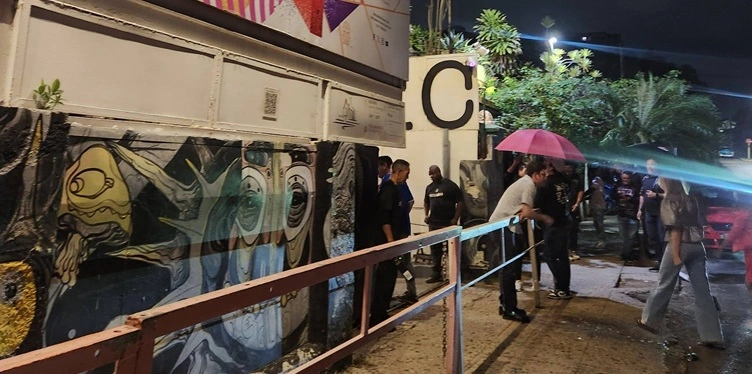
The denial of access was based on the “right of admission” without offering an explanation, while other attendees, mostly foreigners, entered normally.
MADRID, Spain.- The young Cuban Alejandro Bridon Mesa denounced in a Facebook post an act of racial discrimination that occurred on the night of December 26 at the Fábrica de Arte Cubano (FAC), one of the best-known cultural centers in the Cuban capital.
According to his testimony, around 10:00 at night he arrived at the place accompanied by two friends with the intention of celebrating the birthday of one of them. After standing in line “like anyone else,” Bridon Mesa says he observed how those in front—“all foreigners or white people”—accessed without problems. However, when their turn arrived, an entrance worker informed them that they could not enter due to “right of admission,” without offering any explanation.
The young man said that he asked to know the reason for the refusal and explained that it was a birthday celebration, but the response was silence. In her publication, she added that another black woman was also prevented from entering until she clarified that she was not Cuban, at which time she was allowed access.
“The so-called ‘right of admission’ should protect security and order, but in practice it becomes an arbitrary mechanism that legitimizes discrimination,” wrote Bridon Mesa. In the absence of an explanation, he stated, the perception remains that the refusal was motivated by his condition as black and Cuban, elements that – he stressed – are part of his identity and pride.
The testimony generated dozens of reactions and comments on social networks. Rubén Padrón Garriga pointed out that the FAC, although it is privately managed, operates in a public building and maintains links with the Ministry of Culture, so – in his opinion – some state agency should respond to what he described as an act of racism. For its part, Osmel González Darlington He claimed to have had previous experiences of despotic treatment by the same entrance worker, while other users expressed outrage and shame at what happened.
The Cuban Art Factory is located in the Nuevo Vedado neighborhood, in an old industrial complex known as El Cocinero. The space brings together art galleries, concert halls, cinemas, cafes and bars, and has been promoted both inside and outside the Island as an alternative and diverse cultural project.
The F.A.C. It has been presented repeatedly as a “personal initiative” of the musician X Alfonso. However, from its beginnings it had logistical and financial support from the Ministry of Culture, which has generated criticism about the truly independent nature of the project. In the Cuban context, no large-scale cultural initiative receives institutional support without prior approval from the authorities and without adjusting to the ideological frameworks established by the Communist Party.
In his complaint, Bridon Mesa stressed that the most painful thing was not only the denial of entry, but the treatment received: “as if we did not even deserve an explanation.” In his opinion, silence and lack of transparency reproduce dynamics of exclusion deeply rooted in Cuban society, even within spaces that are presented as open and plural.
“The ‘right of admission’ without transparency becomes a right to exclude and humiliate,” he stated, while calling for its application to be regulated with clear and fair criteria. For the young man, what happened transcends the personal and constitutes a “political and human” complaint about the racism and marginalization that persist in Cuba.
So far, the Cuban Art Factory has not issued a public statement in response to the complaint. The case revives the debate about racial discrimination, privileges and institutional responsibility in cultural spaces that operate with the support of the Cuban State.
an ijoint report from the Institute on Race, Equality and Human Rights and the Cuban Observatory for Human Rights, presented last year, documented that people of African descent in Cuba face precarious living conditions marked by high levels of poverty, social exclusion and structural discrimination.
The document pointed out that they have barriers to accessing basic rights such as housing, employment and health services, and that they are often invisible in official statistics, which makes effective public policies difficult.
The report also denounced unequal access to the judicial system, with harsher sentences for people of African descent after the protests of July 11, 2021, and highlighted that the Cuban government denies the existence of racial discrimination, which is why it does not implement specific measures to combat it. Surveys cited show that a significant majority has stopped consuming essential foods and perceives the health system as deficient, while remittances and other external aid are also less frequent for this population group.