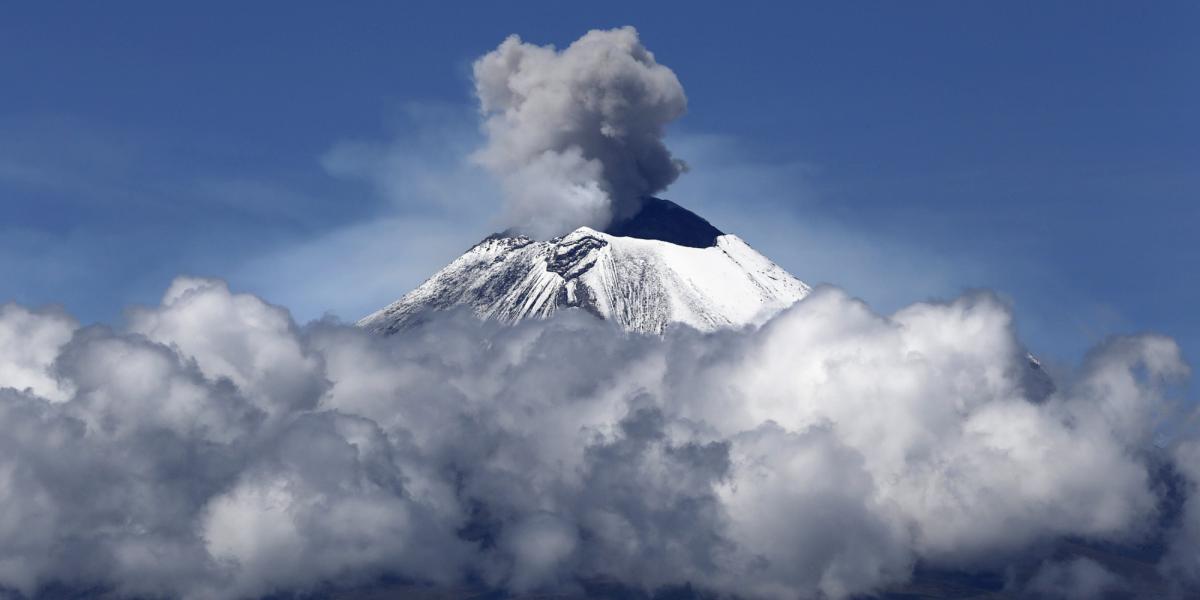
A scientific team from the Institute of Geophysics from UNAM managed to observe with an unprecedented level of detail the interior of the Popocatépetl volcano, thanks to a seismic tomography carried out with the support of artificial intelligence (AI).
The results allow us to describe two of the three known magmatic chambers of the colossus, located at depths of up to 10 kilometers.
The research was presented by Karina Bernal Manzanilla, doctoral student in the Earth Sciences programwho explained that the work was developed from the analysis of seismic records generated between January 2019 and December 2024 by the National Center for Disaster Prevention (Cenapred), complemented with previous data. The objective: improve the resolution to more accurately understand the internal configuration of the volcano.
“We were able to see two magma reservoirs that are closer to the surface, and that previous studies had already suggested,” he noted during the conference Advances in seismic tomography of Popocatépetl from automatic catalogs.
Magma that moves every day
According to Bernal Manzanilla, who works together with the researcher Marco Calò, the material that protects “Don Goyo” It is not completely liquid: it is partially crystallized as rock due to confinement, although it can reheat and become mobile again.
This constant movement is evident in the volcano’s daily emissions, he explained. This leads specialists to two possible scenarios: that there is activity at deeper levels, or that internal mechanisms allow the magma to be reactivated within these chambers.
However, the third magma chamber It has not yet been able to be visualized with this technique, so other monitoring systems are required to know what is happening in deeper areas.
A machine that “learned” to read tremors
The advance was possible thanks to a computer model trained to differentiate and recognize different types of tremors associated with the volcano. With this “automatic classification” a tomography was constructed that covers internal structures that reach up to 30 kilometers below sea level, almost to the limit of the Earth’s mantle.
The first results have already been published in the study Automated seismo-volcanic event detection applied to Popocatépetl using machine learning, in Journal of Volcanology and Geothermal Research. Additionally, a second article is under review for the Journal of South American Earth Sciences.
Next objective: measure the energy of the volcano
The next step of the research will be to analyze how much energy seismic waves lose as they rise to the surface. This parameter will allow us to confirm whether the hottest areas within the volcano coincide with the AI-generated tomography.
“If a material is too hot, the waves lose more energy than when it is cold,” explained Bernal Manzanilla, who continues to evaluate this data to verify the validity of the applied model.