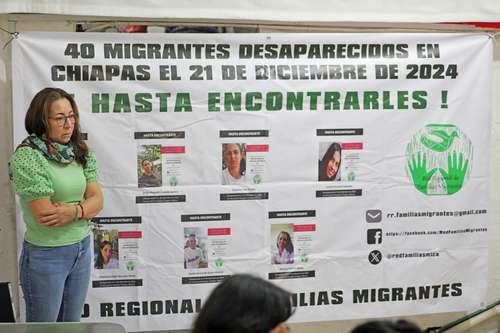
▲ The Regional Network of Migrant Families is providing support in this matter.Photo Jair Cabrera Torres
Jared Laureles
La Jornada Newspaper
Sunday, October 26, 2025, p. 5
Almost a year after the disappearance in Mexico of a group of 40 migrants of different nationalities, including Cuba, Honduras and Ecuador, the Attorney General’s Office (FGR) has not initiated any formal investigation into the case despite the multiple complaints that have been made, relatives of the victims said.
On the contrary, they stated that they have encountered institutional obstacles because in addition to not being able to start the search for their loved ones in Mexico, due to the “bureaucracy” to obtain an immigration document, there is an “indifference” from the authorities and they have suffered “a path full of extortion and threats.”
From their countries of origin, and through a virtual conference, mothers, sisters and grandmothers of the victims explained that the group of people left San José El Hueyate, on the coast of Chiapas, and boarded two boats heading to Juchitán, Oaxaca, but no trace of them was lost on the morning of December 21, 2024.
Their purpose was to reach the United States and first stop in Mexico City.
From Cuba, Graciela Ramos, mother of Dairanis Tan, one of the 40 missing migrants, pointed out that the FGR “has shown an alarming indifference to the disappearance of our loved ones,” because to date, she indicated, it has not opened any investigation folder.
He added that families face difficulties in filing complaints with the consular authorities of their countries, but also in Mexico due to the lack of communication and advice.
“The inaction of the Prosecutor’s Office (General) not only prevents us from finding our children, but also allows impunity to be perpetuated,” he reproached.
For her part, Lilia Hernández, sister of Honduran Ricardo, mentioned that the families have carried out, with limitations, their own investigations; However, the FGR’s Crimes Against Migrants Investigation Unit has not responded to the complaints or carried out search operations.
Given the complexities, the families have received support from organizations such as the Justice Foundation, through which they requested the United Nations Committee against Forced Disappearances to issue urgent search actions for Mexico.
In this sense, they reiterated their demand to the governments of Mexico and the other countries mentioned to coordinate and carry out immediate and exhaustive investigations, so that those responsible are punished and the whereabouts of their loved ones are found.
Ana Enamorado, founder of the Regional Network of Migrant Families, another of the organizations that accompanies the case, pointed out that almost a year after the events, the authorities continue to define whether the case is the responsibility of the FGR or the Chiapas Prosecutor’s Office. This situation, he indicated, prevents families from being recognized as victims, as there is no investigation file.
He warned that after the tightening of the United States immigration policy, the disappearances of migrants now occur mostly on the southern border, and families are the ones who receive calls demanding money in exchange for releasing their loved ones.