Recently, the United Nations (UN) met at its headquarters in New York to review, once again, the Global Plan of Action against Human Trafficking. Among other issues, something very specific is at stake: how the international community understands human trafficking today, who it recognizes as a victim and who it dares to point out as responsible.
Cuba Archive and the Independent Trade Union Association of Cuba (ASIC) have presented a written contribution to this meeting. We intend for the Global Plan of Action to explicitly recognize that States can also be human traffickers and that, when they are, exploited people should receive the same protection as any other victim of trafficking.
Not only mafias are traffickers, but also states
In recent years, the Global Plan of Action and a good part of anti-trafficking policies have focused, rightly, on criminal networks and the complicity of state agents with criminal organizations. But what happens when the State itself designs, administers and benefits from an exploitation scheme that fits the definition of trafficking for forced labor?
That is the gap we seek to make visible. This is not a theoretical discussion. There are concrete examples in different places around the world. In our experience, the case of Cuban workers exported by the State, especially in Cuban internationalist missions—and, in particular, medical brigades—is one of the most serious and best documented. At Archivo Cuba and ASIC we have been documenting the abuses for years with the testimonies of professionals who have paid and pay a very high price.
Cuban medical missions: exploitation disguised as solidarity
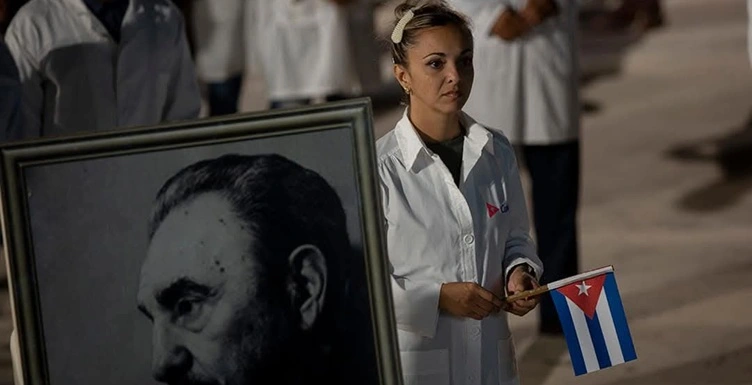
For decades, The Cuban State sends tens of thousands of professionals —doctors, nurses, other health workers, but also teachers, athletes or artists—to work abroad. What is presented as “cooperation” and “international solidarity” is, in reality, a large business of exporting Cuban government services that generates the main income officially reported by the Cuban State. It is a business absolutely lacking in transparency, by the way.
Contracting mechanisms vary: bilateral agreements between Cuba (or its state service marketing companies) and recipient States; triangular agreements with international organizations such as the Pan American Health Organization itself; and agreements with private entities in third countries. What remains constant is the opacity and almost absolute state control over the work and life of these people.
According to official Cuban data, currently—and from 2024—there would be some 26,000 workers in these medical brigades in 56 countries. Our research indicates that this figure approximately coincides with the sum of data from host governments and local press. What does not coincide, and is almost never published, are the real conditions in which these professionals work and live.
Reports from the Rapporteur against Human Trafficking and the Rapporteur against Slave Labor of the UN Human Rights Council, the International Labor Organization (ILO), the Inter-American Commission on Human Rights, the United States Government and the European Parliament have pointed out repeated patterns of abuses in these missions. Inter alia:
– Withholding or forced capture of between 50% and 95% of the salary paid by the receiving States or employers.
– Freezing part of the salary until the return to Cuba, with the risk of not receiving it if the professional “fails to comply.”
– Exhausting days, which can exceed 60 hours per week.
– Confiscation or control of passports and study certificates, restrictions on freedom of movement and curfews.
– Threats and sexual harassment.
– Impossibility of freedom of movement at the destination and extreme surveillance.
– Censorship of freedom of expression.
– Prohibition of any type of friendly or sentimental relationship with local people.
– Contractual prohibitions on subsequently residing or working in the destination country and forced family separation for years.
– Criminal sanctions of up to eight years in prison for “abandonment of mission” and stigmatization as “deserters” or “traitors” for those who do not return and reprisals for their families.
– Harsh disciplinary regulations.
When a State imposes these abusive working conditions, It appropriates most of the salary, threatens criminal punishment and persecutes those who try to leave the program, we are no longer talking about just any abusive employment relationship. We are faced with a situation that responds to elements of forced labor and practices analogous to slavery, recognized as such by international standards.
But the responsibility does not end with the Cuban regime that organizes this system of exploitation. It also reaches recipient governments, which are direct participants in trafficking. Thousands of Cuban professionals are today in the most diverse countries and regions of the world. It can be exemplified by Venezuela, Mexico, Guatemala and Honduras in Latin America, Italy in Europe, Qatar and Saudi Arabia in the Middle East, Algeria, South Africa, Angola and Mozambique in Africa, and Timor Leste and Vietnam in Southeast Asia. These governments cannot claim ignorance when they sign agreements about which it is already publicly known that they allow the violations of rights described and, even more so, when they allow the extraterritorial application of Cuban legislation that per se implies violations of rights.
No government committed to human rights can continue to hide behind the word “cooperation” while legitimizing, with public resources, a system of coercion that violates basic norms of international law.
A victim is a victim, even if the aggressor is a government
The big problem is that global programs do not address this reality. The Palermo Protocol, which complements the Convention of the UN against transnational organized crime, was originally intended to combat criminal networks. But its Article 3 definition of trafficking is based on what happens to the victim – recruitment, transportation, receipt and retention through coercion, deception or abuse of power, for the purpose of exploitation – not on who commits the crime.
If a criminal organization applies these mechanisms, we are undoubtedly talking about trafficking. But if the scheme is designed, imposed and administered by a State, the topic becomes taboo. This double standard leaves thousands of people in legal and political limbo. They are not treated as victims, they do not have access to effective protection and, in many cases, they could even be returned to the hands of the government that is their perpetrator.
Our contribution to the High Level Meeting specifically proposes that the Global Plan of Action and the UN inter-agency group against trafficking (ICAT) explicitly incorporate the category of “trafficking committed by States” and “state or parastatal schemes for the export and exploitation of workers”.
This implies recognizing those who are exploited by state entities as victims of trafficking, with access to assistance, protection and reparation, without discrimination; and promote the direct hiring of professionals by the receiving States with equal labor rights with respect to their local peers. Likewise, the international community must be required to investigate and sanction the responsibility of officials, state companies and networks of interstate complicity involved in these schemes.
None of this is abstract. Each agreement lacking transparency that legitimizes the abusive intermediation of a government over the work of its own population translates into concrete lives marked by fear and exploitation with direct impact on their families.
The High-Level Meeting of the General Assembly is an opportunity for States to stop looking the other way. Nobody disputes the need for international cooperation in health or in other fields. But true cooperation cannot be built on the silencing of those who support health systems with their work and their bodies, without rights, without voice and under conditions of serious rights violations.
The international community has already recognized that trafficking, forced labor and contemporary forms of slavery are serious human rights violations. It still remains to admit that these crimes can also be state policy – which makes the issue much more serious both from a moral and international law point of view – and to act accordingly.
Today we ask governments to do something as basic as not making exceptions when talking about trafficking.
A victim of trafficking is the same, even if her exploiter has a seat in the United Nations.