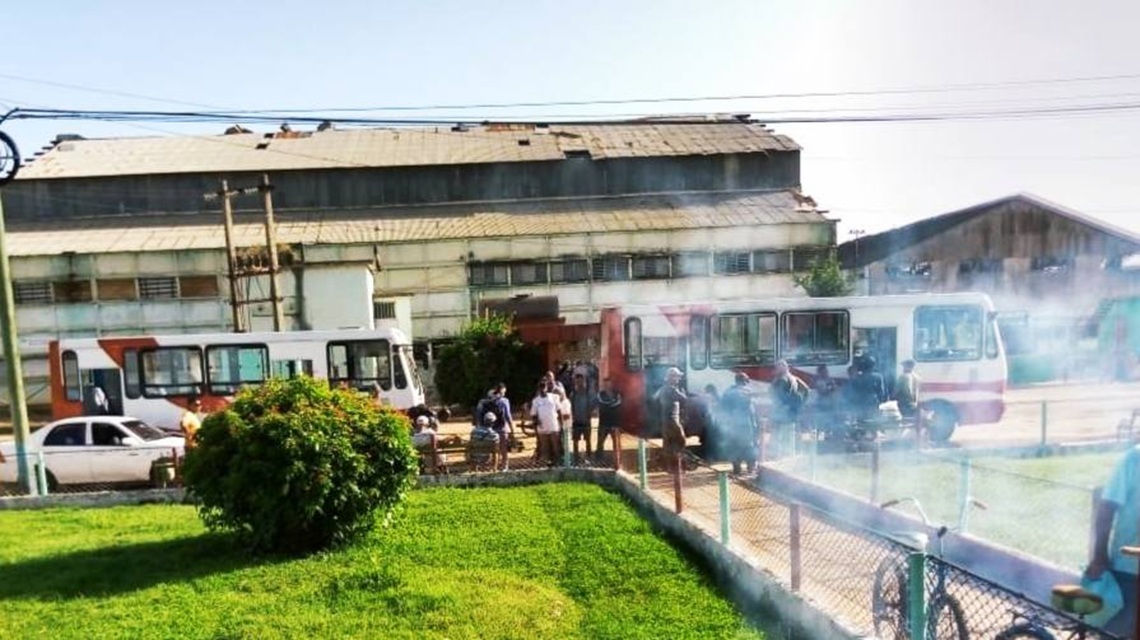
The health authorities in Matanzas alerted today about an outbreak of Chikungunya in the town of Republican Spain, in the Perico municipality, which triggered “immediate” actions to contain its spread.
The Pedro Kourí Institute of Havana confirmed the presence of the virus, transmitted by mosquitoes Aedes aegypti and albopictu. Patients reported intense fever and severe joint pain, he said in Facebook The journalist Lázaro Manuel Alonso.
To control the outbreak, the authorities have intensified fumigations, treated water deposits with abate and cleaned areas to eliminate mosquito farm.
Likewise, active clinical evaluations and hospitalizations are carried out according to the severity of the cases, in a context of surveillance reinforced by the activity of the mosquito Aedes, also transmitter of dengue, zika and oropouche.
Prevention focuses on the use of repellent, protective clothing and breeding ranges. There is vaccine or specific antiviral treatment.
The Ministry of Public Health indicated that the infection grants permanent immunity, but did not specify the number of cases or the duration of the outbreak.
The disease, identified in Tanzania in 1952 and present in more than 110 countries, also causes cutaneous eruptions, fatigue, nausea and muscle aches.
Although 98 % of cases are treated at home with medications to relieve symptoms, children under one year old, over 65 and people with chronic diseases such as hypertension or diabetes, face risks of complications that can extend joint pain for months.
Epidemiological situation
Just two weeks ago, the Ministry of Public Health (MINSAP) He acknowledged that “it is very possible” that the new subvariant of the COVID-19 that is currently expanding around the world is already on the island.
In his weekly television speech to address the epidemiological situation, Dr. Francisco Durán practically gave the XFG Subvariant, also called Stratuscurrently circulated in the country and alerted Cubans about their symptoms.
“We must have it. It is very possible that it is in Cuba because it is very widespread in the world, and it is very difficult to detect in a person arriving [al país] In an asymptomatic period, ”admitted the National Director of Epidemiology of Minsap.
However, he did not refer to his detection in laboratory tests or a possible search through studies and sampling of patients with symptoms.
As for the dengue and the Oropouche feverDr. Durán recently said that these arbovirosis remain “more or less stable”, although he acknowledged “an expected increase” due to the heat and rains of the summer season, which favor mosquito infestation.
According to the specialist, currently five provinces – Pine Del Río, Santiago de Cuba, Guantanamo, Las Tunas and Camagüey – have dengue transmission, distributed in six municipalities and the same amount of health areas.
Due to this disease, 4659 people are admitted to hospitals or their own houses, although none is in critical or serious condition in intensive therapy rooms, he said.
In the case of Oroopouche, said Minsap’s director, “there is a larger number” of affected territories and people, although he did not specify the figure.