On July 17, 1936, Francisco Franco and other soldiers revolted against the republican constitutional order. This caused, after almost three years of war, the fall of the Second Spanish Republic on April 1, 1939 and its violent replacement by a totalitarian regime.
The new regime was characterized by the militarization of politics and public order, by the economic direction of the oligarchies, by the defense of ultra-Catholic, anti-democratic and especially anti-communist postulates and by harsh repression on the defeated and their families.
The repression – which was configured as a constitutive element of the new regime, essential for its survival – consisted mainly of the physical elimination of a part of the republicans and opponents of the regime.
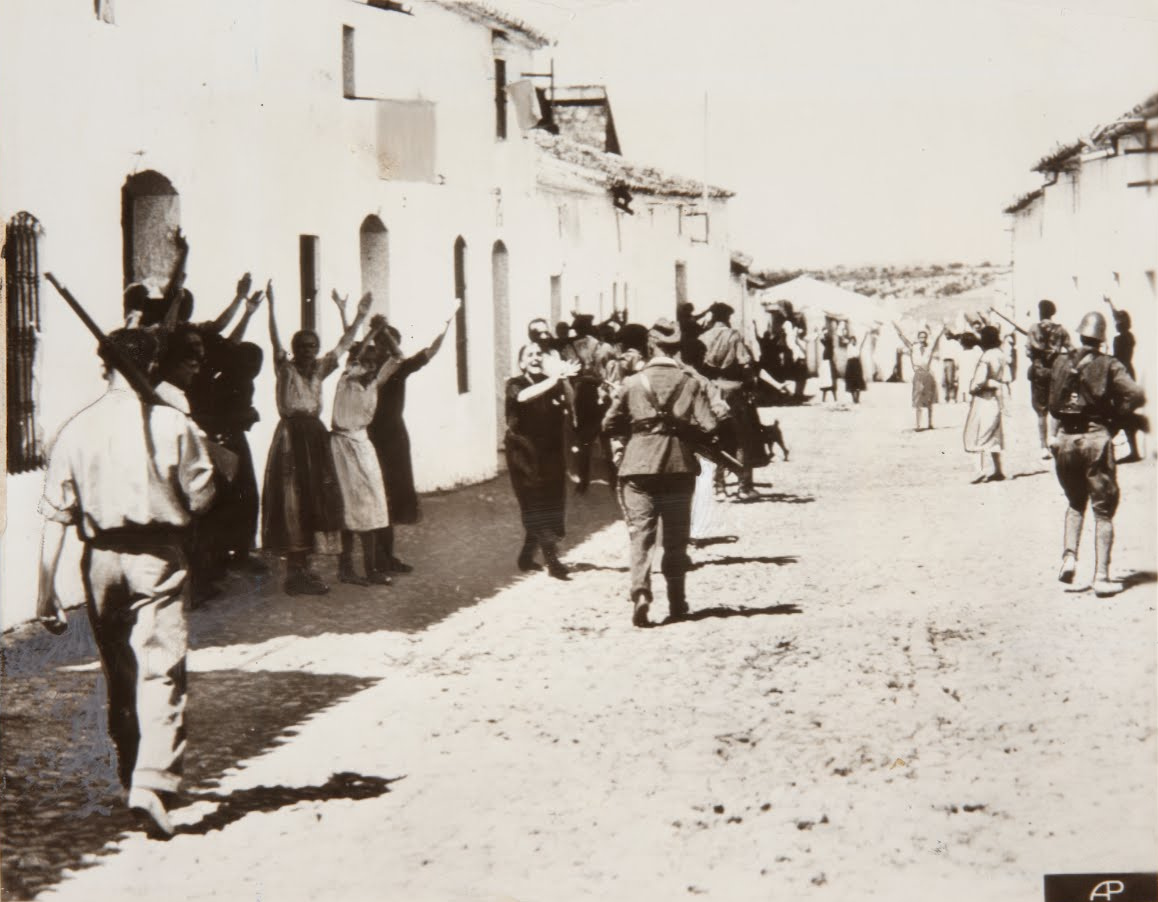
During the first months of the conflict, extrajudicial murders predominated, carried out by rebellious soldiers and members of the Civil Guard – many also remained loyal to the Republic -, Falangists, Requetés, local chiefs and other far-right elements.
Councils of war and “walks”
In fact, the few councils of war that were articulated in these first moments and that imposed the death penalty were carried out to prosecute the soldiers who did not revolt. The rest, the leaders and militants of the Popular Front organizations, trade unionists, intellectuals, teachers, and even relatives of those without political affiliation, were detained and “paraded”, that is, murdered without cause, next to the walls of cemeteries, in ditches or in the middle of the field next to a grave.
It was from 1937 onwards that numerous war councils were launched in the areas conquered by the coup plotters, who acted through summary processes of urgency, characterized by the absence of guarantees for the defendants. These imposed and carried out the death penalty by firing squad on numerous republicans, mainly in application of the crime of military rebellion provided for in the old Military Justice Code of 1890.
In this way, the defenders of republican legality were precisely and paradoxically condemned as rebels by the true rebels who had taken up arms against the legally constituted regime. Like the Franco leader Ramón Serrano Suñer himself he later admitted in his memoirs –Between silence and propaganda. History as it was. Memoirs–, “justice in reverse” was applied.
In any case, extrajudicial executions continued to be carried out throughout the war and even during Franco’s regime. Above all, in the repression of the anti-Franco guerrilla movement – the maquis – during the 1940s, in application of the unofficial Leakage Lawa practice consisting of the agents in charge of guarding the detainees justifying their execution by alleging an alleged escape.
The end of the war did not bring peace
In this way, the end of the war did not mean peace, but rather the beginning of another kind of war against defeated Spain. The aforementioned Code of Military Justice of 1890 and its successor continued to be used, approved in 1945. New special criminal laws were also used that contemplated very harsh punishments – including death – for opponents of Francoism and that tended to attribute knowledge of the infractions provided for in those regulations to the partial military jurisdiction, hypertrophiing it.
All of these regulations included capital punishment in their catalog of sanctions: State Security Law of 1941the Decree Laws of 1947 and from 1968 –both on repression of the crimes of banditry and terrorism– and the Decree Law of 1975on prevention of terrorism. The latter was approved in August, a few weeks before the dictator’s death.
The Law on the Suppression of Freemasonry and Communism of 1940 It was the only important repressive norm of the first Franco regime that did not include death among its sanctions, opting for those of major and minor confinement.
Total repression
However, to guarantee the total domination of the enemy and the neutralization of any attempt at revolt against the unpopular regime, the repression had to be total. All opponents who had survived death or had not been exiled from all spheres of social life had to be expelled.
And that was done first with the imposition on numerous Republicans and opponents of very high custodial sentences, including life imprisonment. Overcrowding in prisons, as well as the need to have cheap labor both for companies and for the State itself, meant that since 1938, in the midst of the civil war, the regime developed a system of redemption of sentences for –forced– work.
Also since 1936, several provisions were issued aimed at purging civil servants who did not prove their loyalty to the Movement. The purge hit teachers especially hard, and also significantly affected university professors.
By virtue of the purification rules, among which the Law of February 10, 1939thousands of workers from the new Franco Administration were expelled. Many of them were replaced by mutilated supporters of the rebel side, ex-combatants, ex-captives and relatives of “the national victims of the war and those murdered by the Reds”, under the Law of August 25, 1939.
“Dangerous” homosexual acts
Furthermore, the regime did not repeal the republican Vagrants and Criminals Law of 1933but in fact he used it to repress with security measures, including deprivation of liberty, certain subjects dangerous to the social order: habitual vagrants and beggars, pimps…
In fact, the Franco regime added in 1954 the performing homosexual acts as a new dangerous state, so that several homosexuals were interned in the Agricultural Penitentiary Colony of Tefía (Lanzarote). The aforementioned Vagos Law was replaced in 1970 by the Law on dangerousness and social rehabilitationwhich continued to include the performance of homosexual acts among the categories of dangerous state.
Finally, the repression also had a marked economic character, mainly with the Political Responsibilities Law of 1939approved in February, shortly before Franco’s victory. It included, among other sanctions, total or partial loss of property (seizure) and payment of a fixed amount (fine). Furthermore, these sanctions became effective even after the death of the person responsible. Then they were executed on their heirs, unless they had provided “eminent services to the National Movement” or demonstrated their “previous and public adherence” to its postulates.
Without a doubt, the conglomerate of elements of Franco’s repression whose main means have been exposed here not only operated as an instrument of political cleansing, but also served especially to generate a state of terror in broad layers of the population. This was essential for the political disaffection that made it possible for Francoism to persist for almost 40 years.
Cristian Sanchez Benitezassistant professor of criminal law, University of Jaen
This article was published in The Conversation. Read the original.