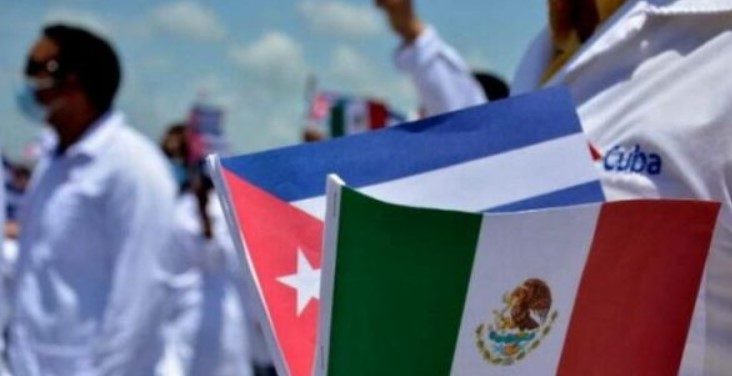
The Aztec country has paid about 2,019,980 Mexican pesos (more than 100 million dollars) for Cuban doctors since 2022.
Lima, Peru – since the Cuban regime began exporting doctors to Mexico in 2022, the Aztec country has paid some 2,019,980 Mexican pesos (more than 100 million dollars) to bring, distribute and keep the doctors in their territory.
According to the media The Universalalthough the services of Cubans have not been cheap, informative opacity has prevented health authorities in Mexico from determining whether collaboration has been beneficial or not for the past three years.
In that sense, the Ministry of Health (SSA), the Mexican Social Security Institute (IMSS) and IMSS-Bienestar have indicated that they do not have metrics, indicators or reports that evaluate the performance of the Cuban brigades from 2022 to date.
The three institutions notified the Mexican newspaper that they do not know the capacities, productivity and level of specialization of Cuban doctors, and the responsibilities on performance monitoring are referred among them of the island professionals.
When consulted, the aforementioned units wash their hands when it comes to metrics or evaluations of the Cuban doctors. The SSA, at least, offers some details on the evaluation criteria of the agreement originally signed between former president Andres Manuel López Obrador and the Government of Cuba.
The emulation consists of three parts: initial, intermediate and final, which consists of an external assessment in the damage and safety of medical care that would allow to know the degree of satisfaction of patients.
“The initial phase is a diagnosis that will serve as a reference basis, intermediate identifies the progress and improvement actions to be implemented, and the final measures the results obtained at the end of cooperation,” says the report.
Ultimately, informative vagueness and data fragmentation between Mexican institutions and Cuban doctors hinders the control of the program, also maintaining in the shadows the way in which public resources are managed to this international cooperation scheme.
Among other relevant data, to date the number of consults served, covered days or the specific areas of attention in which Cuban doctors work is unknown.
On the Cuban part the control is iron about doctors
In conversation with Cubanet, The director of the Cubalex Legal Information Center, Laritza Diversent, said that what Cuban doctors face in international missions – including Mexico – fits fully into the definition of modern slavery according to the agreements of the International Labor Organization (ILO) and international law.
“Forced labor and modern slavery are defined, among other things, by Extreme vulnerability of the person, “Diversent explained.” And every person who lives in Cuba today is in a vulnerability situation, thus being graduated from the university. “
The lawyer emphasizes: “When you threaten someone with her salary, to return it to a place where she has worse conditions, there you are abusing and using your power.” And he adds: “You implement a whole system where the threat is to return it to a place where there are 72 hours of blackout, where people have no food, where they have no money to access food or medicines … that is to take advantage of you.”
Diversent, who has interviewed numerous doctors who have participated in missions in different regions of the world, points out that control over workers is systematic: “After 6:00 in the afternoon, [en algunos de los países donde cumplen misión] They have as a kind of curfew. That curfew is not written, but from the Medical Mission Operations Center they call the houses where they are staying and make a list pass. ”
The sanctions, he states, include from “a public warning in front of their peers” to the deduction of 10% of the salary. In addition, the doctors must report their movements and, in some cases, they are forced to betray colleagues who have defected. “If that is not control and lack of freedom, I don’t know what it will be,” said the lawyer.
For Diversent, it is particularly serious that doctors be forced to carry out activities outside their profession, such as “talking about the work that does the medical mission” or participating in propaganda acts. This, he warns, has a political impact: “Medical missions influence the electorate (…). If they are taking them to rural regions where other doctors do not want to go, that already influences the vote. Therefore, it is a political benefit for those who are in power.”
Diversent concludes: “They do not share their salary voluntarily, they do it because they are in a condition of poverty. That is the basis of slavery. It is a form of modern slavery. You have to read the ILO agreements on forced labor to understand that what the Cuban doctor lives in these missions is not cooperation, it is exploitation.”
“They [los médicos cubanos] They are the last link in the chain, “says the lawyer.” The only solution is for them to go out and talk [denuncien]. Unfortunately they are under the threat that they return them to Cuba and process them – their reality is cross -border repression – but all they can do is keep talking to the independent press. ”