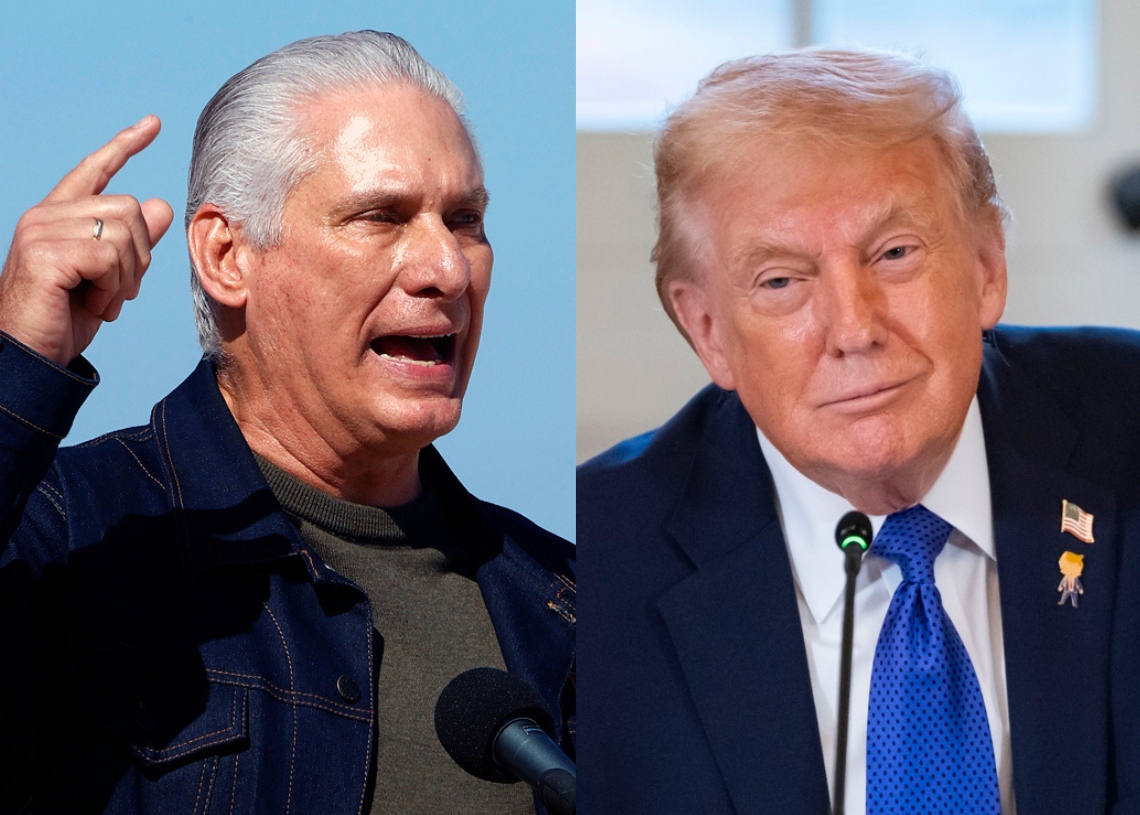
At the end of a Sunday marked by allusions to Cuba and the responses of the island’s government that were immediate, US President Donald Trump surprised with a statement last night when he flew back to Washington.
“We are talking to Cuba,” he told reporters, and in his peculiar style, mixing suspense and spectacle, aboard Air Force One he promised to reveal details very soon. Before, he stressed that he will especially protect Cubans who were forced into exile and are great American citizens at this time.
There are no conversations with the US government, except for technical contacts in the immigration field.
1/6
— Miguel Díaz-Canel Bermúdez (@DiazCanelB) January 12, 2026
His statements, however, were denied this Monday by President Díaz-Canel, who from X wrote: “There are no conversations with the US government, except for technical contacts in the immigration field.”
“Pushed by a failed policy”
“We have always been willing to maintain a serious and responsible dialogue with the different US governments, including the current one, on the basis of sovereign equality, mutual respect, principles of International Law, reciprocal benefit, without interference in internal affairs and with full respect for our independence,” said the Cuban.
Díaz-Canel also referred to Cuban residents in the United States, alleging: “The origin and extreme tightening of the blockade have no relationship with Cuban residents in the United States, pushed there by that failed policy and by the privileges of the Cuban Adjustment Act. They are now victims of the change in policies towards migrants and the betrayal of Miami politicians.”
“There are bilateral Migration Agreements in force that Cuba scrupulously complies with. As history shows, relations between the United States and Cuba, to advance, must be based on International Law instead of hostility, threats and economic coercion.”
Sunday’s exchange
A day before, all the media echoed the statements of President Díaz-Canel and Foreign Minister Bruno Rodríguez, who responded almost in unison to Trump’s messages and jokes from their social network.
Trump said that he thought it was good that his Secretary of State, Marco Rubio, was president of Cuba, whose government he asked in another message to make “a deal, before it is too late.”
In the same text, he warned that the island would no longer receive money or oil from Venezuela, and noted that the Government of Havana has been “living for years” thanks to Venezuelan money and crude oil in exchange for “security services” for the “last two dictators,” in reference to Hugo Chávez and Nicolás Maduro.
Next, the Cuban president alleged from
Furthermore, he added: “They have no morals to point out Cuba in anything, absolutely nothing, those who turn everything into business, even human lives (…) Those who blame the Revolution for the severe economic shortcomings that we suffer, should remain silent out of shame. Because they know and recognize that they are the result of the draconian measures of extreme asphyxiation that the United States applied to us six decades ago and threatens to overcome now.”
The response was reproduced by the newspaper Granma.
Cuba in the sights
The leader of the White House points to a cable EFEhas suggested that he could focus on Cuba after the United States military intervention on January 3 in Venezuela, where he captured Maduro and his wife, Cilia Flores, to transfer them to New York, where they face accusations related to drug trafficking and terrorism.
Venezuela has been Cuba’s main energy supplier, recalls the Spanish agency, based on a bilateral agreement, through which Caracas has received professional services from Havana (mainly doctors and teachers, but also security and defense experts) in exchange for crude oil.
The US interceptions of sanctioned oil tankers from the South American country and the announcement by the US president that Washington will have total control over the sale of Venezuelan oil threatens to put Havana in maximum tension.
“No one really knows what is going to happen with Cuba”: Trump in meeting with US oil companies
In addition, Cuba has been suffering a profound energy crisis since mid-2024 due to the frequent breakdowns of its obsolete power plants and the lack of State currency to purchase the fuel necessary for its generation units, which causes power outages of 20 or more hours a day in large areas of its territory.
Trump has indicated that among the people “in charge” of the South American country is Rubio, whom the press has designated as “viceroy of Venezuela”, which adds to his positions as Secretary of State, National Security Advisor, and former head of the United States Agency for International Development (USAID), he underlined the cnn.