Havana/ Madrid/The Government holds its breath in the face of the populations that remain incommunicado 24 hours after the passage of Hurricane Melissa. So far no deaths have been reported, but Miguel Díaz-Canel, who last night accused those who wonder if there are fatalities of being “scavengers”, does not close the door on that possibility – “there may be some deaths and we are going to report it with all honesty” – and has launched a diatribe against those who “are thinking or looking for the people’s pain as an argument to try to demoralize, to try to disunite, to try to discredit what has made this country with its heroic people.
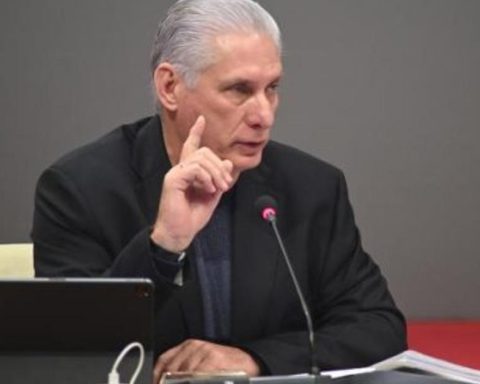
The Cuban president was in charge of a meeting of the National Defense Council, broadcast on the Mesa Redonda program, in which the material damage was quantified. The testimonies collected in the east of the Island were shocking, such as that of Eliécer, 43 years old, and interviewed by the Spanish agency EFE, who said he had given himself up for dead several times when he saw the zinc sheets of his house in Guamá move “like a maraca.” “The house wanted to shake and I said: ‘Well, Lord, put your powerful hand on it. You know what you are doing’. If I die, at least I die alone,” he said. His company was his cat and his dog, who drowned when the height of the water exceeded one meter.
His wife was among the more than 735,000 evacuees – to Santiago in this case – but he, he claims, “underestimated the cyclone.” The EFE correspondent, who was able to reach the area, speaks of a devastating panorama, full of trees fallen on the road and the great darkness that loomed last night due to the lack of electricity, which complicated, at the same time, the reconnection of the hundreds of thousands of people who are without telephony in the area affected by the meteor.
“If I die, at least I die alone,” he said. His company was his cat and his dog, who drowned when the height of the water exceeded one meter.
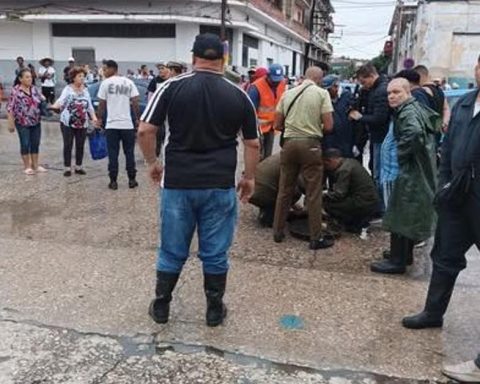
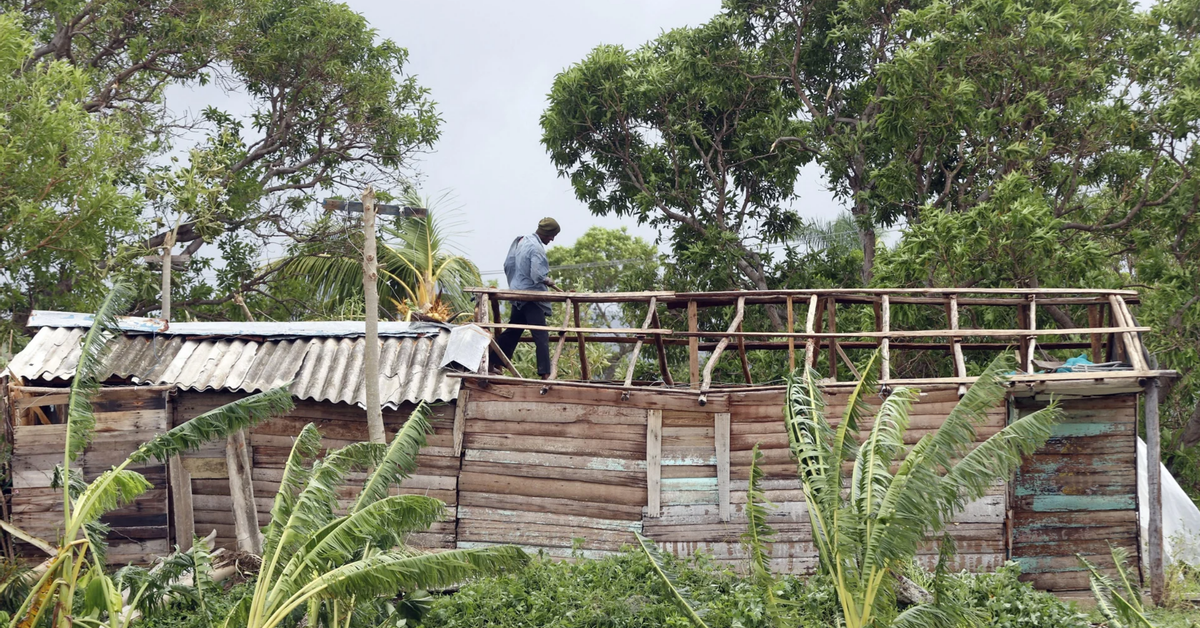
In some cases, the roofs have been blown off, in others, the entire house has been blown off. The harsh situation of Vilma Cabrera fits into the second category of cases, whose miserable housing arrive and put – her entire heritage, located in the mountains – was crushed by a banana tree in the middle of the mud that surrounded her. “My blood pressure went up in the morning,” he says. Their home had not yet recovered from Sandy in 2012, and now, this. The rest of its neighbors are in the same situation.
It is strange when it is known that the National Sanctuary of the Virgin of Charity of Cobre, a building more robust and cared for than the precarious houses in the area, has been “very damaged” and needs help, according to Rogelio Dean Puerta, rector and parish priest of the sanctuary. The religious, who mentioned – without details – the death of an elderly person in the area in a note made public yesterday, has not spoken again about victims, neither to the official nor to the foreign press, with which he has contacted, either because the death was not linked to the event or for any other reason.
The church will resume religious activity, he said hopefully, although the meteor “damaged half of the basilica’s stained glass windows, the carpentry, tore out doors and windows,… It has been a night of great pain and great tension. Hurricane Melissa hit the town of El Cobre with incredible force. The elders say they had never seen anything like it before,” he described. The municipality was, in his words, “devastated, practically only the houses with masonry roofs remained undamaged.” However, the rescue teams were able finally arrive yesterday afternoon and took the neighbors to shelters.
The preliminary damage assessment was carried out province by province, despite the fact that there are still isolated mountain and rural areas.
The preliminary damage assessment was carried out province by province, despite the fact that there are still isolated mountain and rural areas
In general terms, the hurricane left about 400 millimeters of water in six locations and 72 with more than 100. The waves reached six meters at the worst times and the winds were devastating. On its way to the Bahamas, Melissa is still raining, but conditions will improve throughout the day, said the president of the Institute of Meteorology, Celso Pazos Alberdi.
The floods have been severe in Granma, where, in the words of the first secretary of the Communist Party, Yudelkis Ortiz, “all the rivers are gone from their banks.” There are more than 126,000 people evacuated and around fifty trapped people had to be rescued. The worst has been in Bartolomé Masó, Guisa, Yara, Buey Arriba, Campechuela, Niquero and Bayamo, but there are up to 13 more municipalities with damage.
Beatriz Jhonson Urrutia, president of the Provincial Defense Council of Santiago de Cuba, mentioned the 17 trapped in El Cobre to whom a doctor gave shelter, all of them finally safe. Palma Soriano, San Luis, Guamá and the capital city are the most affected populations, although there are seriously damaged economic sectors, including coffee and cassava, as well as tourism, which has saved the initial damage to the Antonio Maceo airport (which is already operating), but is suffering the effects on hotel infrastructure, such as the Gran Piedra.
On Holguín, which had to protect 275,572 people, more than half in family homes, and 1,900 tourists, 109 million cubic meters of water fell in eight hours of rain. A record for the province, said the first secretary of the Party, Joel Queipo Ruiz. In Cueto there are more than 30 homes completely submerged, although the families had been evacuated.
Finally, Guantánamo, which had 34% of the population protected (152,180 people), suffered the reservoirs flooding by 85% in just 12 hours. Coffee and food, along with problems in telecommunications and, of course, housing, are for now the most affected. Meanwhile, Las Tunas was spared the worst, and although some homes had partial problems, such as some crops (banana and corn), the rains have almost been a relief, filling dams empty due to the drought.
The Minister of Energy and Mines, Vicente de la O Levy, appeared to ensure that there was no damage to the thermoelectric plants in the area – Antonio Maceo, Renté, in Santiago de Cuba, and Lidio Ramón, Felton, in Holguín – and that both were reconnected. However, 3.5 million people were left without electricity, in addition to those who had blackouts lasting many hours. The official congratulated himself on the result of protecting the solar panels, since, he affirms, the impact has been minimal (four in total were damaged in Las Tunas).
However, 3.5 million people were left without electricity, in addition to those who had blackouts for many hours.
Other infrastructure affected were the Etecsa lines, both fixed and mobile such as fiber optics, and it will take days to repair the infrastructure, on which branches and trees, as well as poles and towers, fell. In total, 75% of the inhabitants of eastern Cuba are without connection. Hospitals, educational centers and roads are also damaged.
The program was extended for many more minutes in which recovery was addressed, including in sectors such as education, which still does not have a calendar to resume classes. It will take many days to assess the damage and begin to prepare a response program that many distrust, since they have spent 13 years waiting for aid after Sandy, as did the person interviewed by EFE, Vilma Cabrera, who returns to the starting box without having barely left it.
However, there was much more program for the epic. With the satisfaction of not having any deaths to mourn so far, the vote of the UN General Assembly on the resolution against the embargo was mixed, which once again won by 165 votes in favor, 12 abstentions and seven against, a bitter victory for the regime, which despite having an overwhelming majority in favor of its request, achieved its worst historical result.
“Everyone also knows how some of those votes were obtained, because there are always submissive, enthusiastic ones, like those who promise to make their country great again in the image and likeness of the god they have already chosen to serve and we know well who we are talking about. There are also those who are under the weight of economic needs who chose to abstain,” Díaz-Canel considered. The president later made a very long speech thanking the officials involved in the Civil Defense and the ministers. And he concluded, of course, by quoting “Fidel and Raúl, creators, builders and defenders of the Revolution that unites us and makes us proud.”