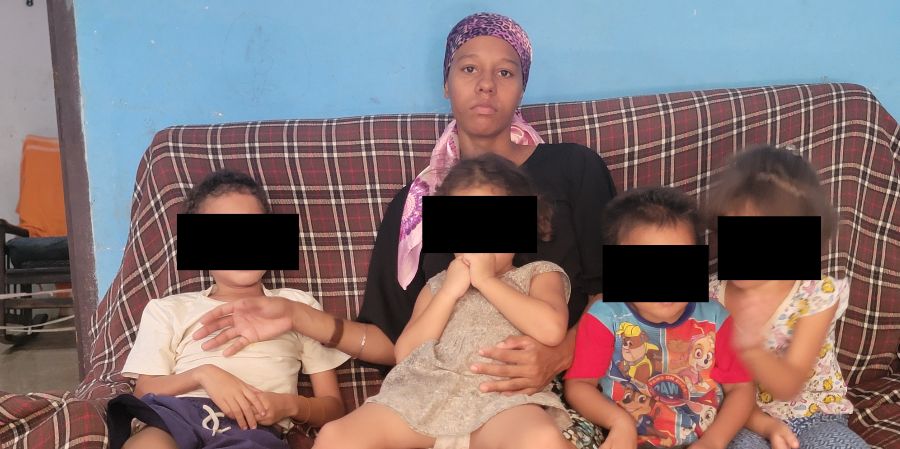
Madrid/Yosvany Rosell García Casowho has been on hunger strike for 26 days in the Cuba Sí prison, in El Yayal (Holguín), has declared that he will also stop drinking liquids. tells it to 14ymedio his wife, Mailin Rodríguez Sánchez, after finding out about it this Monday.
The situation of the political prisoner, sentenced to 15 years in prison for participating in the peaceful demonstrations of July 11, 2021, “is more critical every day,” says his wife, who claims to feel desperate. “They are even transferring him in a wheelchair because he cannot stand up,” but despite that, he complains, “he has not been transferred to a hospital.” García Caso suffers from several pathologies, such as heart disease, hypertension and chronic gastritis.
The daily life of Rodríguez Sánchez and his three children is now complicated, in addition, because they have all been infected with chikungunya, one of the arboviruses spread throughout the Island in an epidemic. “We are all suffering from the virus, recovering, this is terrible,” he says. “Here on my block we are all lying down.”
“They even transfer him in a wheelchair because he can’t stand up”
Various international bodies have spoken out in favor of the political prisoner in recent weeks. This same Monday he did it United States Embassy in Havanathrough their social networks, by condemning “the abuse and mistreatment suffered by political prisoners in the prisons of the Cuban regime.” It is alarming, indicates the diplomatic headquarters in
García Caso communicated in a letter written in his own handwriting that as of October 23 he would go on hunger strike and demand that he be transferred to a punishment cell, as a “new form of protest” for the “continued confinement of all political prisoners.” In his letter, the activist expressed his “unequivocal support for maximum pressure from the United States Government on the narco-terrorist Cuban Government.”
And he concluded with a postscript: “What you do just for yourself fades when you die, what we do for others is our divine legacy.”
/ Courtesy
Several organizations have also spoken out about the prisoner, such as the Cuban Observatory of Human Rightswhich on Friday sent an alert “about the serious risk to his life with every passing minute,” demanding “adequate medical attention and his immediate release.” Cubalex, for its part, recalled that hunger strikes are “an extreme measure that people deprived of liberty resort to when they are denied effective means to report abuses or assert their rights.”
García Caso himself had already made many similar protests to denounce his conviction, which he considers unjust and the consequence of an arbitrary process. These hunger strikes – six until September 11, 2022 – are, Justice 11J notes in its list of prisoners, what caused the gastritis that he suffers from.
Arrested at his home on July 10 for being hit with a cacerolazo, according to the same NGO, García Caso was arrested again for his participation in 11J. Almost a month later, he was transferred to the Holguín Provincial Penal Prison. With an alleged history of drug trafficking, he was charged with attack, public disorder, spread of epidemics and incitement to commit a crime and was sentenced, first, to 20 years in prison and, in a cassation trial, to 15 years.