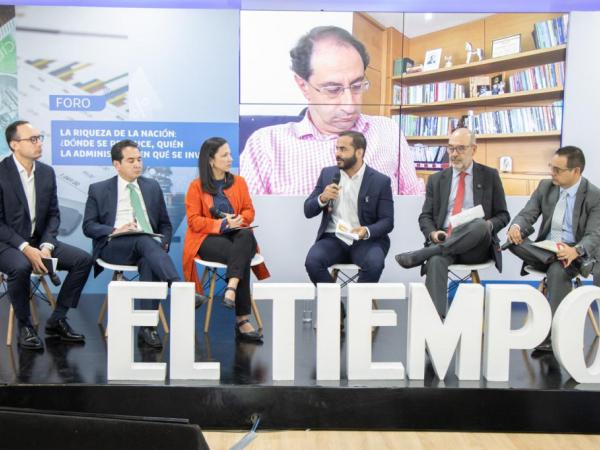
Guild leaders, experts from several sectors of the business and industrial fabric and governors of the country, among other economic actors, were part of the forum this Wednesday ‘The richness of the nation: where does it occur, who manages it and what is invested?’convened by the National Federation of Departments.
In this space, the main leaders talked about how wealth and the importance of knowing how to distribute the resources for the development of the regions.
Likewise, the governors made some warnings about the general budget of the National 2026, raised by the Petro government, and On several decrees and resolutions that are blocking the execution of $ 28.4 billion from the General Royalties System and threatening the job stability of health system professionals, among other problems due to lack of management.
For its part, in the installation speech of the forum, Didier Tavera, executive director of the Federation, He emphasized that Colombia is still a highly centralist country.
“Of the total tax that are collected in the Republic, 81% are administered by the National Government, while the departments have access to only 5% and the municipalities at 14%. Additional to this, the nation spends 68%, the departments 9% and the municipalities 23%”Tavera said.
He added that regional rulers must “Put the magnifying magnifying glass on the challenge of the extractive economy and the alternatives we have. For example, in internal tourism, today, only 1.6 million Colombians travel through the country; 5.5% less than last year, about 550,000 people less than those traveling before the pandemic. This situation is partly due to the high costs derived from the taxes to the tickets and the hotels. Air and higher accommodation “.
Where does wealth occur?
Likewise, during the panel Where does the richness of the nation occur?moderated by Francisco Miranda Hambuger, director of Portafolio, and in which the governor of Córdoba and president of the FND, Erasmus Zuleta participated; the vice president of Anif, Luz Magdalena Salas; the president of the Guild Council, Camilo Sánchez; the executive president of Fenalcarbon, Carlos Cante; the former Minister of Finance and Public Credit, José Manuel Restrepo, and the Vice President of Strategy and Regulatory Affairs of the ACP, Andrés Bitar; They highlighted the role that entrepreneurs and industrialists have in the generation of state resources.
“The wealth of the country is not generated by the government; its function is to provide incentives and guarantees, and in that it has failed a lot. The economy is still standing thanks to a businessman who, despite the difficulties and lack of inputs, continues to believe and advancing. That is why we must continue working hand in hand with them”Camilo Sánchez, president of the Guild Council, said in his speech.
“The 33 guilds of the National Guild Council we represent 80% of Colombian GDP and generate 75% of the country’s formal employment. The figures are blunt and that is why we must hear what the president of the Senate said, for example, the president of the Senate, we do not see the government delivering works, but in the regions are being achieved incentives through our entrepreneurs and the industry. Example of that is the Metro de Bogotá and the tunnel Antioquia. We see mayors and governors working with companies keeping the economy alive “Sánchez added.
Meanwhile, Andrés Bitar, said “The hydrocarbons sector is key to the Colombian economy since it contributes 20% of foreign direct investment and represents 30% of exports in the country. It also contributes 4.5% of GDP, equivalent to 70 billion pesos”.
Bitar also highlighted that The hydrocarbons sector generates tax contributions close to 50 billion pesos per year.
“In royalties, the Congress of the Republic approved by 2025-2026 a budget of 17.5 billion pesos from this sector”the union leader added.
Likewise, Luz Magdalena Salas, Vice President of Anif, said that “In Colombia, one might think that the economy is like a cake and that cake can be divided into the different sectors. The largest piece of the cake is covered by the commercial and public administration and manufacturing sectors, it covers almost 50% of that cake”.
In turn, Governor Erasmo Zuleta said that “Thanks to citizens, businessmen, our mayors and our people, today Córdoba is on the right track: the economy grows, there is more employment and a greater sense of security. The department is the second in the country with the highest reduction in homicides and the first of the Caribbean in security indicators, which has allowed a key sector such as tourism to strengthen”.
How are the country’s money being used?
Finally, on the panel How are the country’s money being used?moderated by Ernesto Cortes, General Editor of El Tiempo, the Director of Public Investment Programming of the National Planning Department, Martha Cecilia García, said that from the entity “We work to articulate the inter -institutional actions that allow entities to meet their objectives and be a bridge towards greater efficiency. We respect the autonomy of each institution, but we also monitor rigorous compliance, execution and efficient delivery of resources,”.
Portfolio