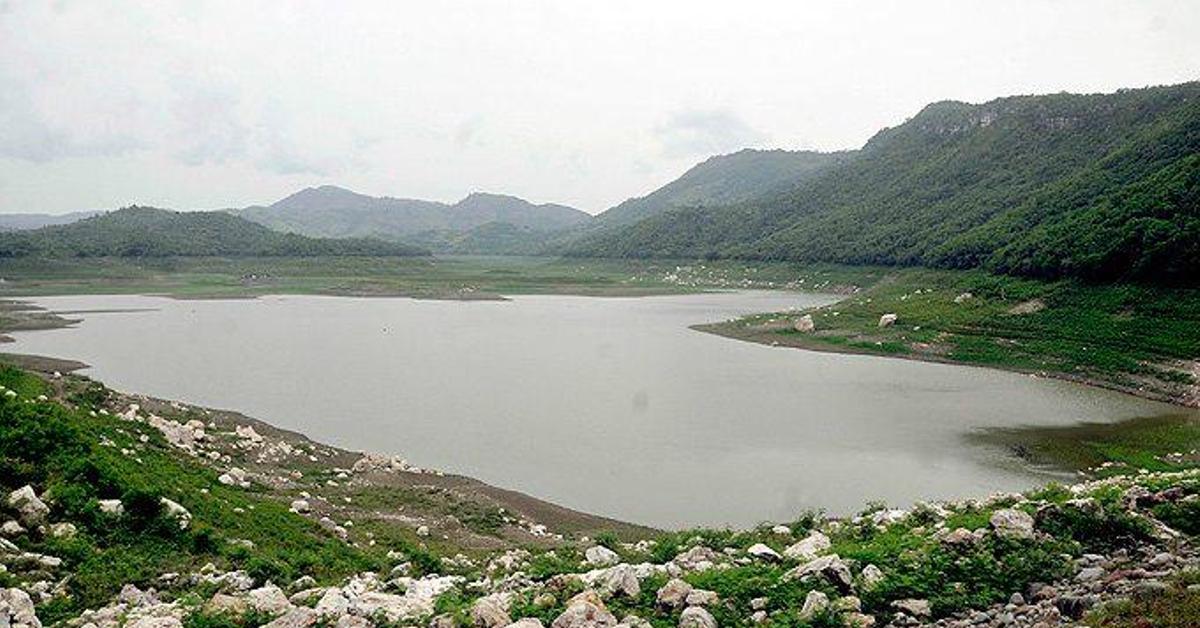
Havana/After a start of the year with few downpours and wet months that have not met expectations, Cuban reservoirs are minimized. In Granma and Santiago de Cuba, the situation is particularly tense, with the dams at the lowest water levels registered in recent years.
From May to July, the months that have already passed from the rainy period, in Granma 132 million cubic meters of water were lost, with a 14% decrease in filling capacity. The rainy regime has also been below expected: 501 millimeters accumulated until June, which is equivalent to 72% of the historical average of 692.7.
Currently, the 11 reservoirs of the province are, on average, full of 46%. The Cautillo dam, in the municipality of Jiguaní, presents the lowest level with just 2%, after being unparalleled to perform repairs. They follow chorus (guise) to 36%, coriander (pylon) at 41%and Pedregales (Bayamo) with 44%. Meanwhile, the reservoirs that supply the municipality of the head barely around 17.8% filling, which shows the intensity of the drought in the region.
The neighbor is not far behind Santiago de Cubawhere the authorities themselves have launched several alerts to the population to encourage water savings. The scarcity of rain has severely affected the reservoirs that supply the header city.
To the drought are added the constant breaks of driver and pumping equipment that lengthen the supply cycles to the population
Although the general system registers a 65% filling, the distribution of water is not a couple: 89% of the volume is concentrated in Carlos Manuel de Céspedes (contramastre) dams and Baraguá (Mella) protest, both located at a rare distance from the provincial capital.
Other reservoirs such as Gilbert, Charco Mono –hagotado since April – and Gota Blanca are below 20% capacity. Only the stop presents a relatively less critical situation. To this are added the constant ruptures of conductors and pumping equipment that lengthen the supply cycles to the population.
The state of Agua Santiago announced that it will carry out hydraulic works to guarantee the supply to the city. A new driver, he said, will allow the direct transfer from Mogote to the Quintero Aqueduct – from 80% of the city’s population and is “depressed” -, connecting the tunnel the Jagual with the driver Gilbert. The work, of 7.5 kilometers, is in charge of entities of the National Institute of Hydraulic Resources (INRH), the company of Military Constructions and other local organizations.
At the same time, the director of Aguas Santiago, Ludmila Rodríguez Barroso, reported that complementary actions are also carried out such as the suppression of salideos, the change of valves, the reduction of the theft of metrocontators – which exceeds 4,000 cases – and improvements in pumping and well stations.
Only 12 of the 30 tank trucks of the aqueduct and sewerage company are operational
However, transport problems aggravate the situation. Only 12 of the 30 tank trucks of the aqueduct and sewerage company are operational, which has forced the state to ask other entities for help to collaborate in the water supply to vulnerable communities, hospitals and prioritized sectors.
While the rains of the coming months are expected to contribute to a slight recovery, the authorities insist on the importance of saving water and the conscious use of this vital resource, especially in areas with a high degree of affectation such as the municipalities of Santiago de Cuba, Songo-La Maya and San Luis, where more than 65% of the provincial population is concentrated.
The rest of the eastern provinces are in a similar situation. A week ago, 14ymedio reported the serious drought holguin hitswhere some homes have not received water for a month. The situation now tells this newspaper a resident in the header city, has not improved anything since then.
“In my house we can barely drink cold water. We are taking alternatives and cooking, in the few hours that we do have water, lunch and food in a single batch,” he confessed. As if that were not enough, the lack of fuel has worsened the distribution of water with pipes. “In almost the entire municipality the water supply is zero, and I don’t see pipes giving trips to supply the people.”