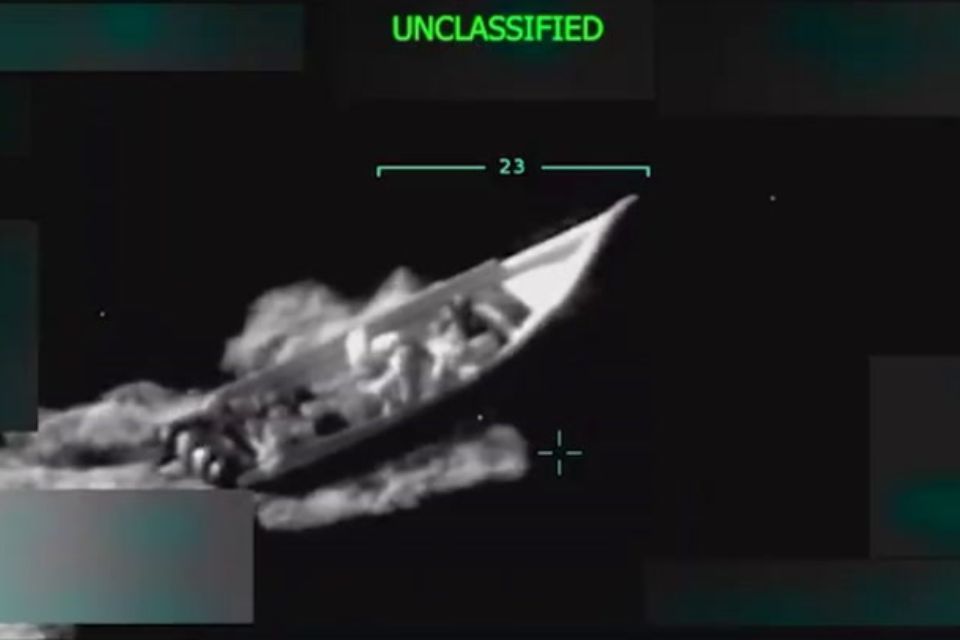
A document from the pacifist organization Project Plowshares determined, from the graphical interface included in the images, that the technology used for the attacks on drug boats comes from Canada and called for ensuring that the export of military material does not contribute to violations of international law.
The United States attacks against alleged “drug boats” in the Caribbean, in which several people died, used Canadian technology, according to a report released this Monday, October 6, by the pacifist organization Project Plowshares.
The document noted that the attacks on September 2, 2025 and September 15, in which around 14 people died, were carried out by the US with sensors manufactured by the Canadian company L3Harris.
Project Plowshares identified the Canadian technology from the graphical interface included in the images of the attacks distributed by the US Pentagon despite the attempt by military authorities to hide its origin.
The organization added that L3Harris is one of the world’s largest producers of electro-optical and infrared sensors, which are used by the armed forces of a large number of countries.
*Read also: Trump claims that a new “drug boat” was attacked in the Caribbean
In 2020, the organization already reported that Turkey had diverted WESCAM EO/IR systems “to several conflict zones where human rights violations had been documented,” which caused the Canadian government to suspend those exports.
Project Plowshares warned that both human rights observers and UN representatives “have determined that the attacks, which were carried out in international waters and targeted alleged drug traffickers in the absence of any declared conflict, constitute extrajudicial executions.”
«Canada is legally obliged to ensure that the export of military materiel does not contribute to violations of international law. But due to a decades-old agreement between Canada and the United States, most of the military material that Canada sends to its southern neighbor, including the WESCAM sensors used in these operations, evade controls,” the organization denounced.
The group noted that in 2019 Canada joined the UN Arms Trade Treaty, which imposes strict controls on the transfer of conventional weapons, but that an agreement signed by Washington and Ottawa almost 75 years ago “exempts most Canadian military exports to the United States from the obligation to obtain export licenses.”
“Canada should not only close this loophole to comply with the Arms Trade Treaty (ATT), but also establish the necessary checks and balances to prevent Canadian technology from being implicated in future illicit uses of force,” he concluded.
With information from EFE
*Journalism in Venezuela is carried out in a hostile environment for the press with dozens of legal instruments in place to punish the word, especially the laws “against hate”, “against fascism” and “against the blockade.” This content was written taking into consideration the threats and limits that, consequently, have been imposed on the dissemination of information from within the country.
Post Views: 280