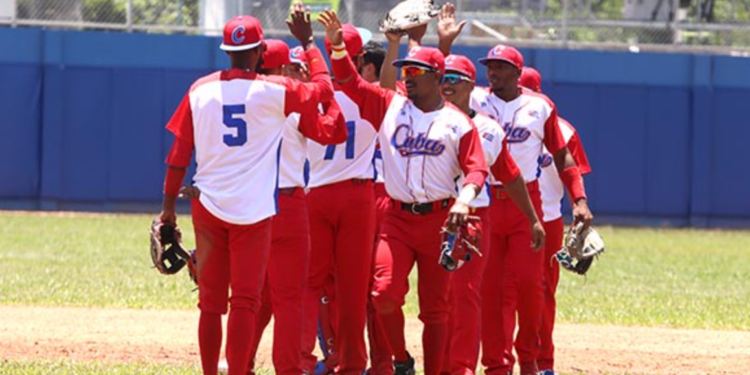
LIMA, Peru – US authorities denied visas for eight members of the Cuban delegation that intended to participate in the VI World Baseball Classic, soon to be held from March 5 to 17 with venues in the United States, Puerto Rico and Japan.
The state-run National Institute of Sports, Physical Education and Recreation (INDER) rejected Washington’s measure this Sunday, calling it “discriminatory treatment.”
“It constitutes the most recent act of aggression against our people and their national sport,” says the official body in a statement published in HIT.
The note never clarifies the specific reasons used by the US side to deny the members’ visas. Instead, it resorts to the political rhetoric of the Havana regime that seeks to show Cuban sport as a place besieged by imperialist interests.
According to INDER, the decision aims to intentionally hinder and damage the participation and performance of the Cuban team in such a renowned baseball competition.
“In its desire to hinder the development of sporting activity in Cuba, the denial of visas to Cuban athletes and federations for events in that country since January 2025 was not enough for the United States,” the statement underlines.
Likewise, the sports body accuses the United States Government of denying the visa to provoke a potential decision by the Cuban Baseball and Softball Federation not to attend the event under these conditions.
“The management of a competitive team demands, in addition to the contribution of athletes and coaches, the complementary work of executives and other specialists who, in this case, respond to areas defined by the organizers themselves,” the note warns, alluding to the fact that the sanctioned members would not have been baseball players.
“The national team would be deprived of figures in charge of tasks that contribute to sporting performance, including a pitching coach, thus limiting the possibilities that must be defined on the field, under equal conditions, and not subject to the political decisions of a Government,” adds INDER.
There are just weeks left until the start of the 2026 World Baseball Classic. This tournament will feature the participation of about 20 national teams.
Japan, who won the tournament in 2023, will return to defend their title, led by Shohei Ohtani. Each group will be made up of five teams that will play in a Round Robin format, with the top two teams in each group advancing to the quarterfinals.
Cuban team will not participate in the Caribbean Series
The 2026 Caribbean Series will finally be played in Guadalajara, Mexico, from February 1 to 8, following the decision of the Caribbean Professional Baseball Confederation (CBPC) to withdraw the venue originally awarded to Venezuela. As a consequence of this relocation and the reorganization of the format, Cuba will not participate in the tournament, an exclusion that adds to its absence in recent editions and that once again leaves Cuban baseball out of the main regional club event.
The CBPC confirmed that the tournament It will be held at the Pan-American Stadium in Zapopan, home of the Charros de Jalisco, and will have a reduced format. The participating teams will be the champions of the winter leagues of the Dominican Republic and Puerto Rico, two representatives from Mexico – the finalists of the Mexican Pacific League 2025-2026 – and Panama as a guest country. Cuba does not appear in this scheme, nor does the champion of the Venezuelan league.
The transfer of the headquarters It occurred after Mexico, the Dominican Republic and Puerto Rico communicated their refusal to play in Venezuela, citing “external situations beyond their control.” Although no detailed explanations were offered, the decision forced the CBPC to look for a new venue and redefine the structure of the tournament. Guadalajara was selected as a viable alternative, but the change involved adjustments that left out participants who were initially contemplated when the venue was Caracas.
When the 2026 Caribbean Series was scheduled to take place in Venezuela, Cuban participation had been considered as part of the guests, a possibility that was diluted after the reconfiguration of the tournament in Mexican territory.
The island was one of the founding countries of the Caribbean Series in 1949 and dominated several of its early editions before leaving the professional circuit in the 1960s.