“The dictatorship only seeks to distract from its incompetence, poor economic management, failed communist policies, corruption and repression,” Washington said.
MIAMI, United States. – The United States Department of State, through its Bureau of Western Hemisphere Affairs, rejected the attacks by the Cuban regime against the independent press and linked them to an attempt to divert attention from the serious economic crisis on the Island, in a context marked by the recent official offensive against the digital medium. theTouch.
“We reject the continuous attacks of the Cuban regime against independent journalists,” stated the entity in X.
In the same statement, Washington assured that “the dictatorship only seeks to distract from its incompetence, poor economic management, failed communist policies, corruption and repression.”
The Bureau also stressed that, “unlike the regime, the United States supports the Cuban people and their right to receive information without censorship.”
We reject the Cuban regime’s continued attacks on independent journalists. The dictatorship only seeks to distract from its incompetence, economic mismanagement, failed communist policies, corruption, and repression. Unlike the regime, the United States supports the Cuban people…
— Bureau of Western Hemisphere Affairs (@WHAAsstSecty) November 14, 2025
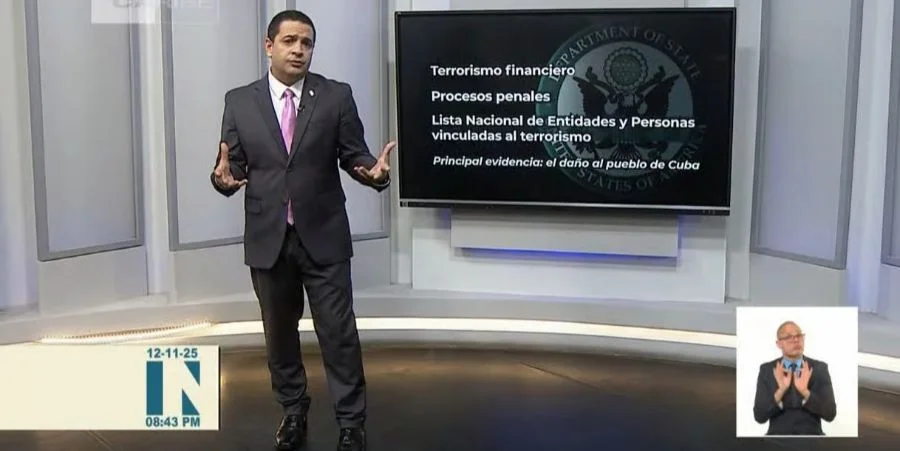
Although the statement in theTouch by name, comes immediately after the Government of Havana launch a new criminalization campaign against that mediumwhom he accuses of “currency trafficking”, “tax evasion” and of being part of an alleged “comprehensive economic war program” financed by the United States, according to the official television space Reasons for Cuba.
The regime also accused theTouchfinanced in part with US funds, of manipulating the informal exchange rate to “foment unrest” and called it “economic terrorism.”
The director of the medium, José Jasán Nieves, has admitted that theTouch receives subsidies from private donors and the State Department “to promote access to information in Cuba and support the United States Embassy in Havana in the implementation of public diplomacy programs,” and has stressed that “none of these relationships influence our editorial line.”
In statements to EFENieves insisted that “there is no such thing as ‘economic terrorism’ nor are we mercenaries at the service of anyone” and denied having participated “in any currency trafficking or tax evasion actions.”
The director of theTouch He described these accusations as a “distraction tactic” at a time when the Government itself has recognized that it cannot implement the promised floating exchange rate and while it is secretly holding trials against officials whom it tries to hold responsible for the economic collapse. “They are desperate to find a new scapegoat,” he said, and accused the regime of seeking to divert attention “from their resounding failure and the crisis in which they have plunged the country,” according to EFE.
The current campaign against theTouch was reflected on several fronts. The Central Bank of Cuba (BCC) issued a statement in which it assured that the medium “is part of the economic aggression against our country and is unacceptable” and that its rate does not have “economic legitimacy” as it operates through “non-transparent” mechanisms and vulnerable to speculation.
At the same time, the official newspapers Granma and Cubadebate They replicated the speech on state television with headlines like “theTouch acts against the well-being of the people of Cuba” and “theTouch“from economic terrorism to currency trafficking.”
In a response posted on FacebookJasán Nieves denounced that the “statements” shown on television were obtained a year ago under “psychological torture” in “sessions of more than eight hours in Villa Marista”, the State Security headquarters, and then “edited and taken out of context” to build a criminal case against members of the project since 2024.
The offensive against theTouch It is part of a context of systematic harassment of the independent press, aggravated after the entry into force, in October 2024, of the Social Communication Law of the Cuban regime. A report from LatAm Journalism Review points out that the new norm has brought “a wave of repression” against journalists who work outside the official media, who denounce interrogations, threats and accusations of “mercenarism.”
The director of the Cuban Institute for Freedom of Expression and Press (ICLEP), Normando Hernández, assured that publication that “the Cuban regime, without delay, has unleashed a new wave of repression, which can be described as state terrorism,” whose objective is to “instill terror” and force journalists to abandon their informative work.
The journalists of CubaNet They have also been systematically harassed, threatened and even condemned by the island’s regime. Since Monday, when the trial against former Cuban Deputy Prime Minister Alejandro Gil Fernández began, reporter Camila Acosta of this medium has been intermittently prevented from leaving her home in Havana.
“State Security told my partner years ago that what worried them was that I ‘took the streets’, that is, that I reported directly on the street,” Acosta confirmed to CubaNet.