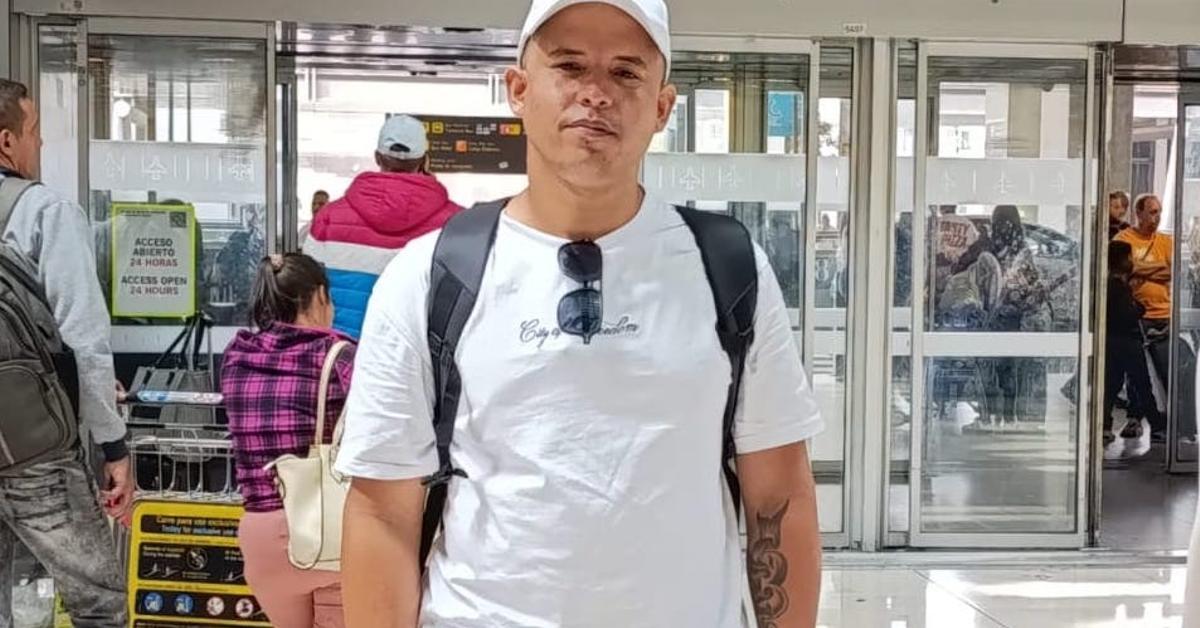
Madrid/Before becoming a political prisoner, Luis Robles He was “just another young Cuban who was struggling to get ahead.” In December 2020, his life changed when he decided to stand on San Rafael Boulevard, in Central Havana, with a sign calling for the end of repression and the freedom of rapper Denis Solís, a gesture that led him to prison. Five years later, exiled in Spain, for the first time he recounts details of his imprisonment, the physical and psychological torture he suffered and witnessed, and the total absence of guarantees within the Cuban prison system, in a long interview. published through the Cuba X Cuba platform.
Robles begins by telling the motivations that led him to his peaceful protest. “When you become a parent, you start to think a little differently, to look for better options to provide for your child.” That’s why he decided to come out with a sign. “I wanted to do something that would show that I did not agree with the situation, with the repression, the persecution, I thought I would do it in the best way so that they would not have to charge me, in a peaceful way, without disturbing the order.” He never imagined everything that would come next.
Robles says that he was first confined in the Combinado del Este, in preventive detention with common prisoners, in “cells with 20 people, in a space of three by four meters, locked up the entire day there in that small space.” They could only go out to the patio “once or twice a week, for an hour.”
I wanted to do something that would show that I did not agree with the situation, with the repression, the persecution, in a peaceful way, without disturbing the order.
Then he was transferred to the large cells of the same penitentiary center, “spaces for 45 people, that was bunk, bunk, bunk.” Common prisoners awaiting trial also lived there, mixed with political prisoners, he says. Many who knew about his case approached him and “were proud to know that I was the boy who had come out” with the poster, he says.
With the guards it was a different story. “The treatment they give you in prison is dictated by State Security, they treat you as State Security dictates.” In his case, treatment included continuous surveillance. “They took me pretty hard, they searched me at any time of the day or night.” Although everything he owned was authorized, “they did it to fool around,” he adds. “I documented the abuses that I began to see in prison, the torture they did to the prisoners, the way of teaching them and instilling fear in the other prisoners, and they began to harass me for that.”
Among these tortures, he remembers “several prisoners who suffered enormous beatings” and “others who, in order to punish them, were handcuffed in front of the fence from one day to the next.” Robles was one of those who received the most punishments: “Sometimes they looked for me to punish me without having done anything. They chained my hands and feet with special handcuffs that Shakiras say are used more with dangerous prisoners, they kept me for 3, 4 hours.” Sometimes they left him “staring at the wall handcuffed,” and once “from six in the morning until two in the afternoon.” He explains that “it was to hurt me, to torture me, and I discovered that those orders came directly from State Security.”
Part of the pressure was due to attempts to turn him into an informant. “The interest was to subdue, to make you submit, to use you as a snitch inside the prison.”
Without having done anything, they chained my hands and feet with special handcuffs, they kept me like this for 3 or 4 hours, sometimes more, to torture me.
The prison authorities themselves encouraged violence by common prisoners against political prisoners. On several occasions he saw himself threatened or in danger, especially when they changed floors, but the prisoners themselves warned him “they told me, ‘hey, take care of yourself, they sent you here to do this to you.'” But denouncing it publicly protected him in part. “Everything that happened to me I told my mother and we reported it on the networks.” They offered the other prisoners “more food, more telephone… those are the benefits in prison,” he says.
Material conditions were also part of the punishment. The food, he says, was “horrible, it came rotten, with a bad smell that made you want to vomit.” The hamburgers “came green, due to lack of refrigeration.”
The medical care was “lousy, lousy, lousy…many times I was not given medical care.” They only attended to him “when my mother went and protested… that day they wanted to attend to me.” The rest was abandonment: “they told me that there was no medicine, that I should wait there.”
From prison, Robles also witnessed firsthand the wave of repression following the protests of the July 11, 2021: “I saw people enter with a broken arm, people with shots fired, an older man whose arms were broken, a friend’s jaw was knocked loose from a beating.” Minors arrived: “boys of 17, 18 years old… children, minors who did not have to be in an adult prison.” Many had been detained for “standing in the doorway of their house” or “filming.”
The food was horrible, it came rotten, with a bad smell that made you want to vomit
Robles was one of the released last Januaryat the same time as hundreds of prisoners, as part of an agreement with the Government of Joe Biden, when he had not yet finished serving his sentence, so he remained under house arrest until last June. But later he discovered that freedom was fictitious: “I was prohibited from expressing any political opinion or talking about what I experienced in prison.” They warned him that everything would be fine “as long as you don’t talk… you can’t talk about what you experienced in prison… if not, you’ll go to prison again,” he denounces. The entire time he was in Cuba he suffered visits and calls from State Security.
“They came to check on me, to know how I was thinking.” They even “came into my room even though I was sleeping, two or three times a month. They came in as if they were the owners of the house. Unbearable,” he says.
When the sanction endedthey made it clear to him that any movement he made, even within the country, he had to report it. “I did not remain calm: I remained intimidated and silenced until the last day.”
The repression also affected his family. His brother was imprisoned: “a police officer attacked him and my brother is the one they put in prison, there for a year without trial.” For State Security, “my brother was a hostage, he is a hostage,” who remains imprisoned in Cuba, now for attempting to illegally leave the country. They repeated: “Remember that you have a brother imprisoned there.” His mother, Yindra Elizastigui, who also participated in the interview, suffered pressure and veiled threats.
The feeling of social isolation ended up pushing him into exile. “I felt alone, on my block the one who watched me was my neighbor. Even if I had complied, I was always going to be a prisoner.”
On October 13, 2025, he arrived in Madrid, but he recognizes that the after-effects persist, “that pressure of feeling that an enemy can come out wherever you want, the mind is active all the time.”
Even so, Robles believes that “resentment does more harm to the one who carries it than to the one who receives it.” “What I want is for justice to exist in my country. That this criminal, dictatorial and repressive government does not exist. But I don’t hold any resentment,” he says.
He sees national reconciliation as difficult but not impossible. The system “the first thing it did was divide us” and to rebuild the country “Cubans have to learn to value themselves as human beings. When we regain awareness of what it means to be master of oneself, then there will be reconciliation,” he says.
He sends a direct message to young people: “I wouldn’t want any young person to go through what I went through, to waste that time locked up there watching their life and health deteriorate. But I do urge people to fight for what they deserve. Let a change of mentality begin.”
And he concludes with a phrase that he assures he will continue to repeat until it is fulfilled: “Freedom for Cuba, freedom for all political prisoners, and freedom for all the innocent.”