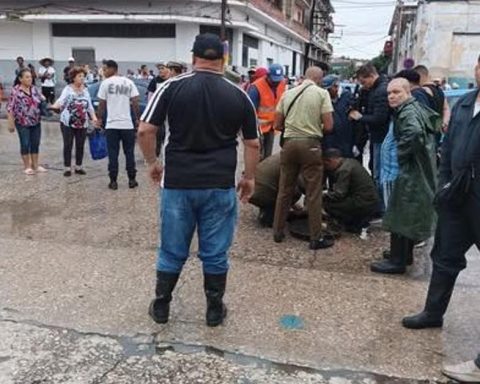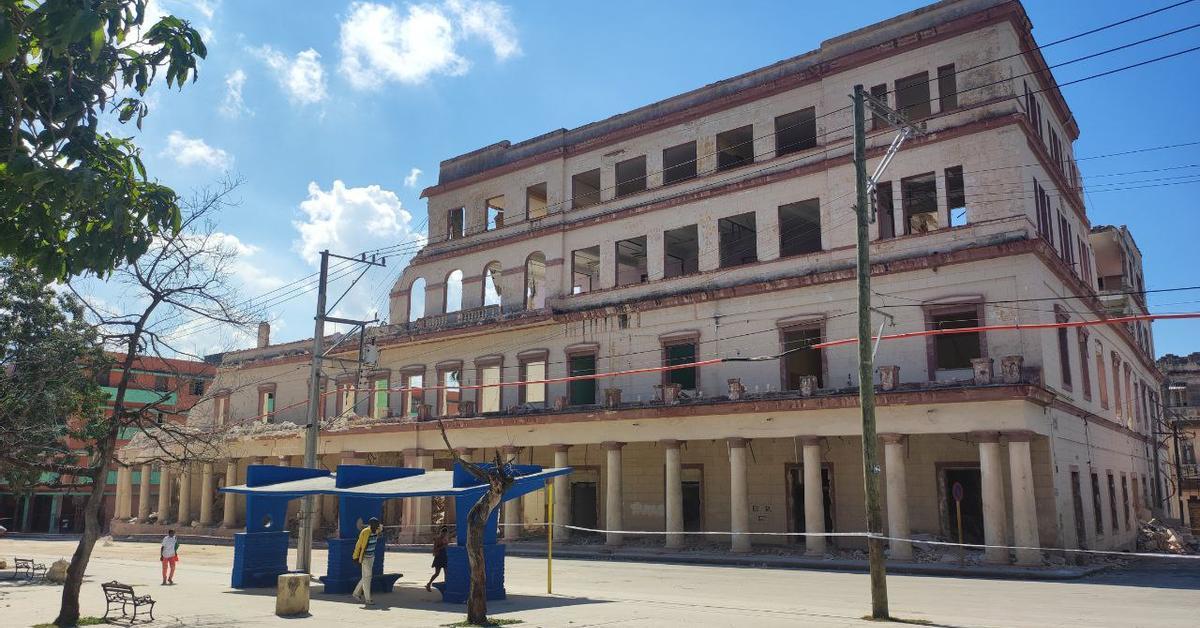
Havana/Dust covers Belascoaín Street in Centro Habana. Several yellow ribbons close the passage in the section in front of the building that used to be the Higher Institute of Industrial Design (ISDi). The umpteenth collapse of part of its structure has left a trail of debris that prevents the passage of vehicles and endangers pedestrians who venture to cross the signage. This Saturday, the image of that piece of avenue without vehicles was the living image of a city gripped between the fuel crisis and the deterioration of its infrastructure.
In the nearby queue to enter a restaurant on the corner of Reina Street, the talk was the noise that a piece of the building located between Maloja and Enrique Barnet made last week when it fell. Still at this point, some fragments of its walls and columns are scattered around the area. The nearby bus stop has also been surrounded by warning tape and passers-by walking along the sidewalk, in front of the mass without windows or doors, quicken their pace for fear of another collapse.
The building, which was originally a military hotel and club for officers of the Spanish Army, was also used as the headquarters of the Cadet School (1874-1878), Widows and Orphans Asylum, headquarters of the General Staff during the First American Occupation and even the Ministry of Health, before Fidel Castro came to power in January 1959. ISDi graduates remember it as a bright, welcoming space full of creativity. But for the closest neighbors, the property, which occupies an entire block, It’s been a headache for years and a permanent source of worry.
/ 14ymedio
Carmita, a resident nearby, fears that the destruction will continue for months or years without the authorities deciding to remove what remains of the structure. “That has been turning into a landfill and a public bathroom,” laments the woman. Added to the danger of a piece of its walls ending up on someone’s head is the epidemiological risks of ruins where mosquitoes, flies and garbage share space. In a city with serious health problems, the old ISDi has become another “focus of infections,” in the words of this Havana resident.
A Valentine’s Day flower seller offers his wares to couples. Carefully, the man periodically wipes the glass containers where he stores plastic roses and teddy bears. “There is tremendous dirt on this street,” laments the merchant while shaking off the dust from the ISDi, those fine particles that have remained in the air after the most recent collapse of the once colossus of Belascoaín.