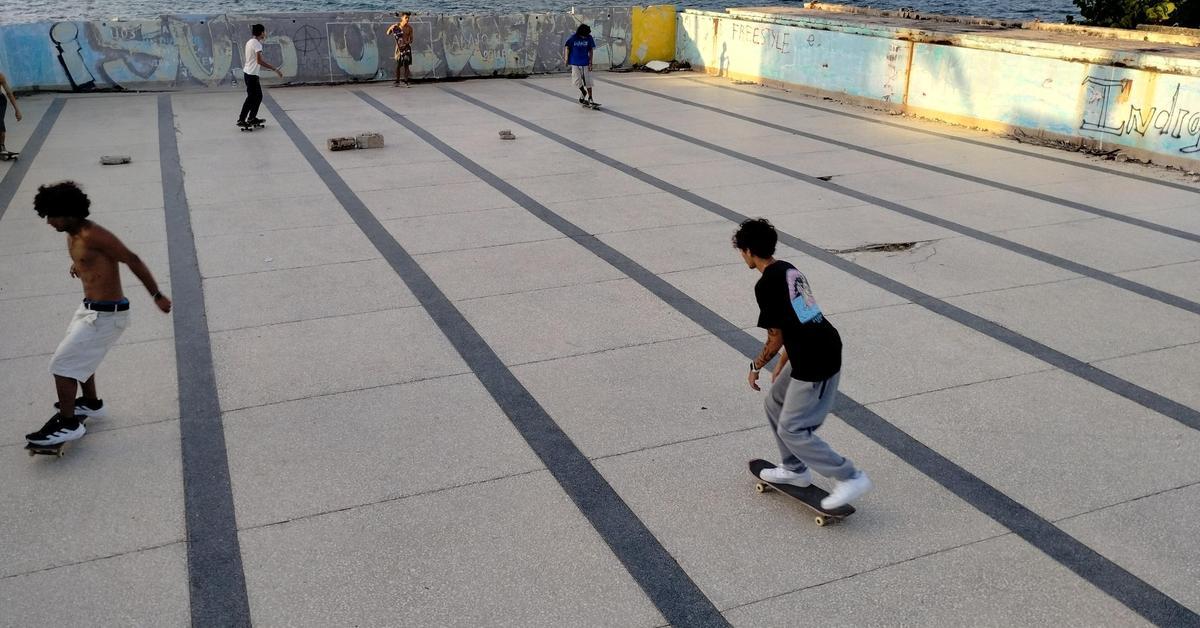
Matanzas/The Bahía swimming pool, in the city of Matanzas, was part of an ambitious recreational complex that promised to become local pride. Today, that space is just another ruin, devoured by abandonment and saltpeter, a cement shell where the splash of water or the laughter of bathers has not been heard for a long time. But the story didn’t end there. Among graffiti, cracks and discolored walls, a group of young people found a new purpose: to turn it into their skating rink.
The boys call themselves simply “the skaters “They have no uniforms or sponsors, but they do have a fierce loyalty to their little concrete kingdom. “Most of us are from the neighborhood,” Yuniel, one of the most enthusiastic, tells 14ymedio. “We started skating in the Peñas Altas park because there was nothing else to do. Little by little people joined in and without realizing it we can no longer spend two days without coming here.”
For them, the old pool is more than a place to practice jumps and pirouettes. It is your refuge, your space of freedom in a city where the youth recreational offer is reduced to a minimum. “We decided to come here because we don’t have many options,” says Yuniel. “In Havana they have a skate park with ramps, but we don’t. If we skate in the park, there are people who get upset. And if we do it on the street, we risk being hit by a car. Here we don’t bother anyone and no one bothers us.”
The group is between 14 and 22 years old. The majority study or work part-time, and they all share the same frustration: the lack of institutional support. “Before, my uncle and his friends would take the Hershey train at dawn with their skateboards on their shoulders,” remembers Pedro Armando, another of the young people. “They arrived in Havana mid-morning and spent the afternoon at the skating rink. Now that is impossible, because the train has not been running for years, and tickets to the capital are increasingly expensive.”
/ 14ymedio
Pedro Armando and his friends have been dreaming for months about a trip to Havana to participate in an event organized by brands like Vans or Red Bull, but logistical and economic difficulties keep them stuck in Matanzas. “We would like to participate in those events, meet others skaterslearn more,” he explains to this newspaper. “But everything stays in the capital, and we are still here, mending the skateboards as best we can.”
In theory, the National Institute of Sports, Physical Education and Recreation (Inder) has a department dedicated to extreme sports. In practice, support is concentrated in speed skating, where Cuba has achieved some international results. “He skate “It doesn’t count,” laments one of the young people. “Inder doesn’t even know we exist.”
If in Varadero, a multi-medalist race skater has had to pay for the equipment and tickets to national competitions out of her pocket, the skaters Matanzas do not expect much more. “Once the AHS (Association Hermanos Saíz) invited us to do a demonstration, but everything stayed there. There is no follow-up, there are no materials, there is nothing,” Yuniel summarizes.
Lacking support, they improvise. Broken boards are repaired with nails and tape; the bearings are cleaned with gasoline and patience; Sneakers, when they wear out, get patches over and over again. “Skating in Cuba is an act of faith,” Pedro Armando jokes. “You have to believe that you can, even if everything says otherwise.”
The image of these young people throwing themselves off the peeling walls of an empty pool has something poetic, but also tragic. In a country where public spaces degrade at the rate of abandonment, they have decided not to surrender to the ruins.
“Of course we would like to live off the skate“, Yuniel confesses. “But we know that is not going to happen. That’s why we continue studying. The time will come when we have to work and we won’t have time to come every day. But we are sure that others will come after us, and I hope they have better luck.”
His testimony contains a mixture of resignation and hope. The skaters Matanzas people do not dream of competing in the X Games or of international sponsorships. Their goal is more modest and deeper: to keep the passion alive, to create their own space in the midst of abandonment.