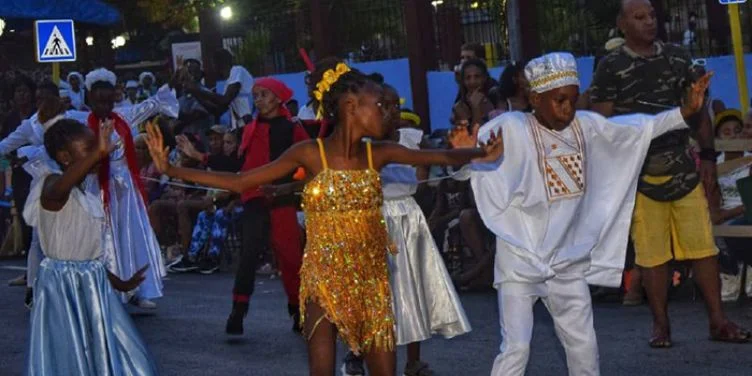
While the scarce energy resources of Santiago de Cuba were destined to sustain carnivals, large areas of the territory were dark.
Santiago de Cuba. – While some danced, others told the hours in gloom. For many in Santiago de Cuba, last week was an opportunity for disconnection, party and noise. For others, it was to go further in the challenge of daily survival. While the provincial authorities, headed by the first secretary of the Communist Party, Beatriz Johnson Urrutia, and Governor Manuel Falcón Hernández allocated the scarce energy resources to sustain the carnivals in the main arteries of the city, large areas of the territory were dark.
From the 20th and with an increase between 23 and 27, days in which the carnival was held, the blackouts extended in several distributions and municipalities for more than 12, 24 and up to 29 hours consecutive While the party was held in areas such as Dueño, Garzón, Martí or La Alameda avenues, families in peripheral neighborhoods and rural areas dealt with darkness, lack of water and stress to save food about to spo on.
“They made carnivals to disconnect the Cubans from reality, from misery, so that they would get drunk and forget for a while there is no light, no food or water; but many kept us in the dark every day,” said Carlos Álvarez, a neighbor of the Vista Hermosa cast.
This edition of the Santiago 2025 Carnival was held within the framework of the 510th anniversary of the Villa Foundation and the 10 years of its declaration as Cultural Heritage of the Nation. However, this year a Unpublished dynamics: The festive areas only worked between 2:00 and 10:00 pm, with recorded and live music. Meanwhile, the comparsas were limited between 6:00 and 10:00, when darkness returned.
What entails the dark
The sudden gloom encouraged crime: certain bands took advantage of the coverage of the blackouts to assault and create chaos., According to some affected by Cubanet: “They ran and wore clothes perch. Or they watched the time to go without paying food or other service. Even roasted pigs were stolen. Some sides had to get white weapons to defend themselves,” Rafael, owner of a business on Dream Avenue, said.
On Facebook, especially in publications by communicator Yosmany Mayeta, electrical failures were reported, even in the midst of musical presentations. The group Maykel Blanco and its major sauce, for example, reached its concert at the Alameda Santiaguera clock. Also, images of floats and parades circulated without lighting. Also of parents Pushing Manually the children’s attractions, without electric current to make them work.
In municipalities such as La Maya, there were reports of blackouts of up to 29 hours. “He left 22 at 5:00 in the morning and did not return until 11:00 p.m.
Social networks, as usual, became a mirror of discomfort. The images of people dancing and singing contrasted with those of homes in gloom, without food or water. “Half Santiago off from 2:00 pm and these are the holy hours [en] that remains the same ”, wrote Alejandro Arzuaga past midnight on the 23rd. “All for the carnival. Today is not cooked. Today only a part of Santiago lives. While some drink, there are elders who cannot eat or breathe,” he added.
On the other hand, a user identified as “I don’t know anything” He asked: “If there is energy deficit, how dream can be with day and night music, and the other neighborhoods without current more than 15 hours?”
Chicharrones, Caney and other areas also reported blackouts over 20 hours a day. To the dark another crisis was added: the lack of drinking water, which has become critical in much of the province.
A celebration at the expense of collective suffering
On this occasion, the carnival, Santiago identity symbol for decades, was held at the expense of the town. While some celebrated others, they cooked in a hurry before the meat was broken down. Those who could drank rum and beer, others queued to fill a cube of water.
Far from relieving tensions, the event exposed the official strategy: distract and collect, although that means exposing the population to more precariousness.
All this, in addition, in the midst of an ignored epidemiological crisis. The Ministry of Public Health has confirmed The circulation of at least 17 types of respiratory viruses in Cuba: influenza H1N1, respiratory syncitial virus, coronavirus, rinovirus, and a new variant of the SARS-COV-2 omicron, among others. In Santiago de Cuba, in particular, there is a high incidence of tuberculosis.
“Performing these carnivals was, at least, irresponsibility. Who can think of in today’s Cuba, when we are alive of a miracle? It is always the same: bread and circus for the sheep. Only now there is no bread. Only circus,” said Yoleidis Samé.