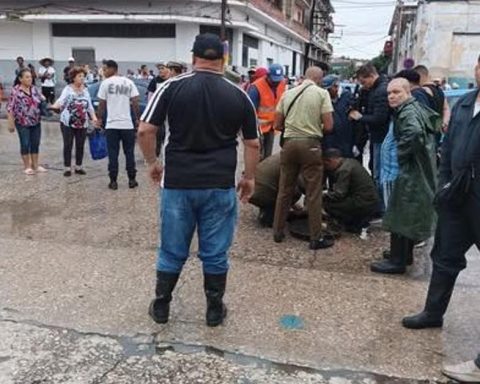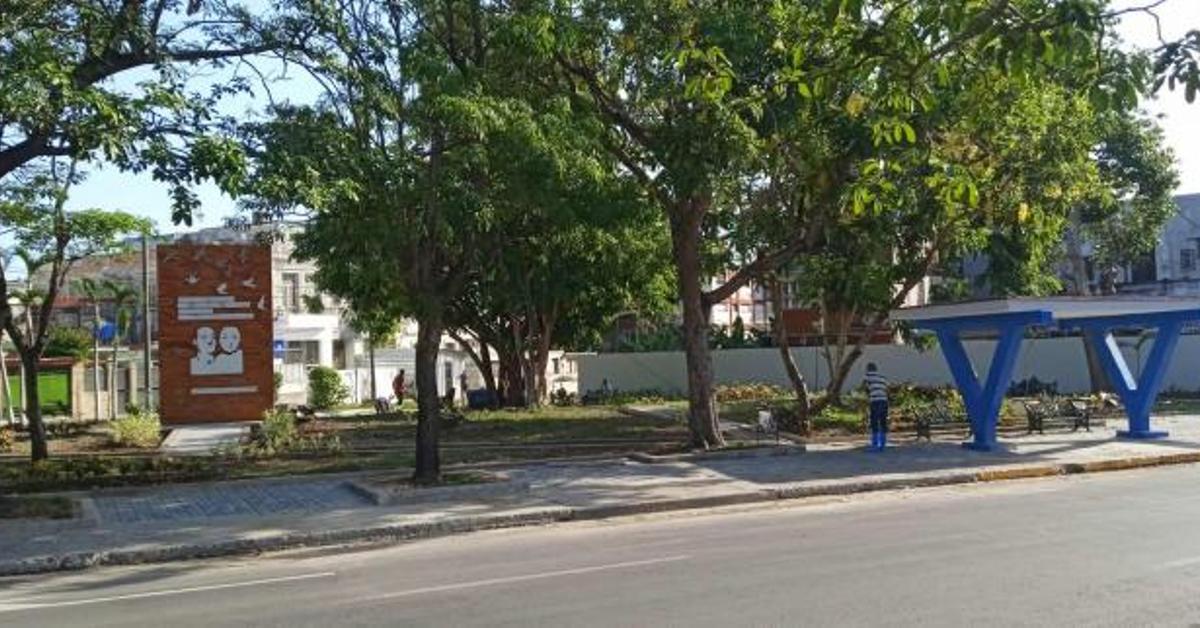
Havana/A busy habanera corner, some neighbors who pass fast while moving from one tail to another or work and a monument that almost nobody stops to look. The faces in the installation, covered with red bricks and with doves, are from Americans Julius and Ethel Rosenberg. The passage of time has made Cubans forget the details about this marriage that filled the official propaganda half a century ago.
The recent restoration of the park, which houses The rosenberg monument At the intersection of Zapata and Paseo avenues, in Havana, he summoned several officials who preferred to stick to the old script that the state media disseminated, without any allusion to the details that revealed the declassified files some time after the execution of both in the electric chair.
To placate the criticisms of the residents nearby, who claim that the deteriorated streets be paid, the operation of the traffic light affected by the blackouts is improved or the deteriorated cafes in the area are restored, the repair of the monument to the Rosenberg included some paint to a close buse stop.
Opened in 1983 before ambassadors and lawyers of the case, José Dearra’s sculptural team became the only monument in Latin America dedicated to these figures convicted of espionage in the United States. For decades, many Cubans assumed that they were completely innocent and victims of macartism. However, with the passage of time documents that clarify that version have come to light.
The recent restoration of the Park summoned several officials who preferred to stick to the old script disseminated by state media
Julius Rosenberg, an electrical engineer and active member of the American Communist Party, was convicted with his wife Ethel in 1951 for conspiracy to spy in favor of the Soviet Union and transmit information on the development of nuclear weapons from Los Alamos. His brother -in -law, David Grenglass, was the key piece in the trial: he assured that Julius asked him to deliver military secrets and that Ethel typed the notes, although he later admitted that he lied to protect his wife.
The revelations of VENONA PROJECT – a secret operation of American intelligence that managed to decipher Soviet communications – confirmed that Julius acted as an agent and recruiter within an active espionage network. Ethel, on the other hand, did not use aka or appeared as an operation in the intelligence archives. Documents recently declassified by the NSA They indicate that Ethel “knew” her husband’s activities, but did not participate directly in them.
Both were executed on June 19, 1953, becoming the first American civilians to receive the death penalty for espionage in peacetime. Various analysts, such as those mentioned by TimeThey have indicated that the information transmitted to the USSR was in many cases technical and limited, without justifying such a severe conviction.
For years, the children of the Rosenberg, Robert and Michael MeeropolThey have claimed a presidential proclamation that exempts their mother, claiming that their processing was unfair and politicized. Beyond the legend, the facts reveal that Julius did collaborate with the USSR, while Ethel was, at least in judicial terms, dragged by loyalty and the context of an era marked by fear, ideology and excess of heat.