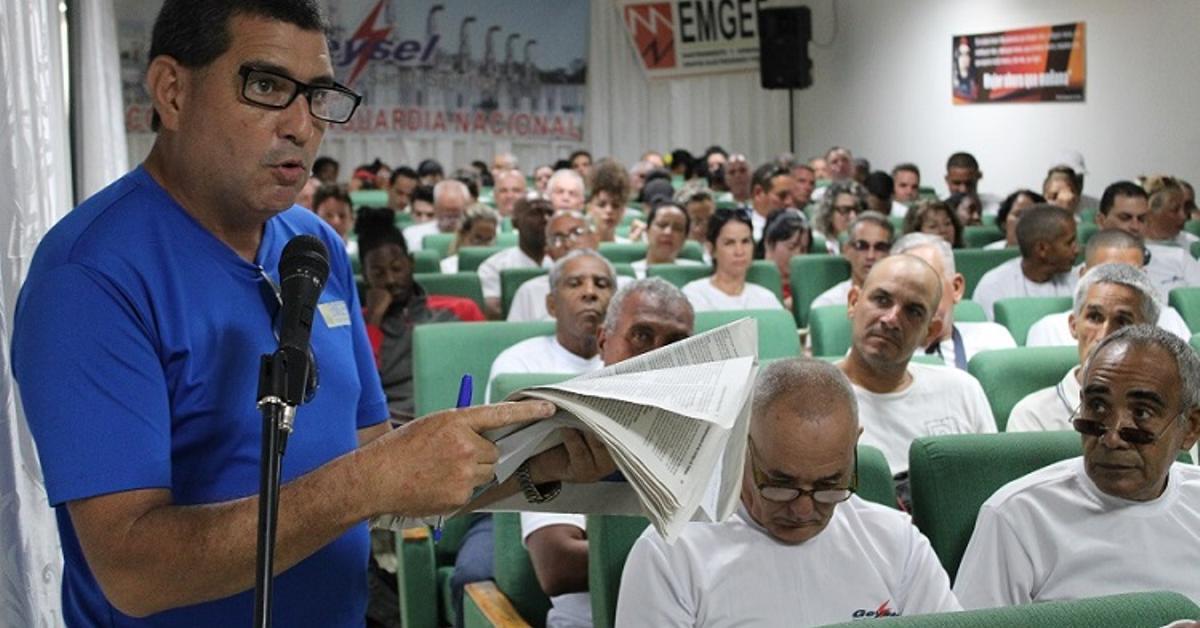
Madrid/The draft Law of Labor Code of Cuba began on Monday its journey, which will last Until November 30to be debated in the work centers. Although the authorities have talked about a deep reform, one of the main rights of workers, the right to strike will remain absent from the norm. Not surprisingly, the weekly publisher of the Single Union said in his editorial: “We are aware that it is a high significance process for our society. And that is another way, in 2025, to continue making revolution within the revolution.”
There are news in the heat of the new times. Among them, Teleworking, which will be agreed with the employer and promoted for family and personal conciliation, including from abroad. Contracts must include the conditions under which the control mechanisms, among them. In addition, the right to digital disconnection that is guaranteed in other countries is enshrined and which is that the employee cannot be contacted by his bosses outside the workday, as well as on rest days and holidays.
Another of the most striking novelties is the obligation that will be deprived to subscribe unemployment insurance for their workers. The policy must be hired and paid by the employer and is disconnected from the public social security system, although we will have to wait for a regulation that develops details on this issue. The standard does not detail what level of coverage or if the entity responsible for offering them will be only the national insurance company, since, today, the activity is prohibited for the private sector.
The autonomous work is recognized for the first time, understood as the one that is done “without subordination to an employer and without having subordinate working people”
This insurance must cover any work interruption, the cessation of the employment relationship for economic, technological and structural reasons; Unemployment for dissolution and/or cancellation of the MIPYME license and the temporary suspension of the exercise of the employer’s activity in the case of a natural person.
The autonomous work is recognized for the first time, understood as the one that is carried out “without subordination to an employer and without having subordinate working people”, although the difference with the worker on his own is not clear that, as detailed on television, on television the general director of Employment of the Ministry of Labor and Social Security, Ariel Fonseca Quesada, is a type of autonomous. “They can also be an artist or a creator,” he added.
The start age also changes to sign a contract, which passes from 17 to 18, although protection for adolescents who work due to extraordinary circumstances is planned. In addition, the social service has a broad section of its own in which it highlights the reduction of the time it must last. For the newly graduated at the upper level, it is reduced from three to two years and also allows its suspension or compliance in the non -state sector.
For this type of work, the use of the contract for a certain time for permanent activities is authorized, as well as to cover vacancies for maternity or disease licenses. For any other case, it is absolutely prohibited.
In addition, the employment contract for an indeterminate time for cyclic or seasonal work appears, provided for activities where employment demand increases in certain periods. In this sense, when the worker is not necessary, the employment relationship and payment are suspended, being able to assume another job at that time, before returning when necessary again in this.
As for the multi -employment, it is allowed whenever the maximum of 13 hours a day is fulfilled, while contemplating the concept of multi -activity, for those who simultaneously maintain an autonomous and other subordinate work.
On paper, there are rights that are expanded, including the possibility of claiming and receiving answers, as well as the protection of pregnant women, whose state cannot be a reason to prevent their promotion, hiring or permanence in the position. Workers will also have more mechanisms for collective bargaining, although the Central of Workers of Cuba remains the only legal union and its role is key to claim procedures, although its void interest in confronting state business directions is known.
The code also speaks of “decent employment”, including labor security, protections and the right to have sufficient “remuneration to meet basic needs.” However, the salary is not linked to variables such as inflation and the cost of living, nor is it obliged to periodic reviews as in most Western countries, including those in which Cuba says he has been set to prepare this regulation.